How to Clean Wool Dryer Balls Safely: Washing, Lint & Care
Here is how to clean wool dryer balls: first identify whether you are dealing with loose lint, actual soiling or damaged felt. Gently remove loose surface debris, then use a wet-cleaning method only if your specific manufacturer permits it. Follow that product’s washing, detergent and drying directions, and let the balls dry completely before storage.
There is no single washing recipe for every set. Some brands permit machine washing, others favor hand washing, and some expressly prohibit putting their balls in a washer. A fuzzy surface alone is not a reason to soak, shave or replace an otherwise intact ball.
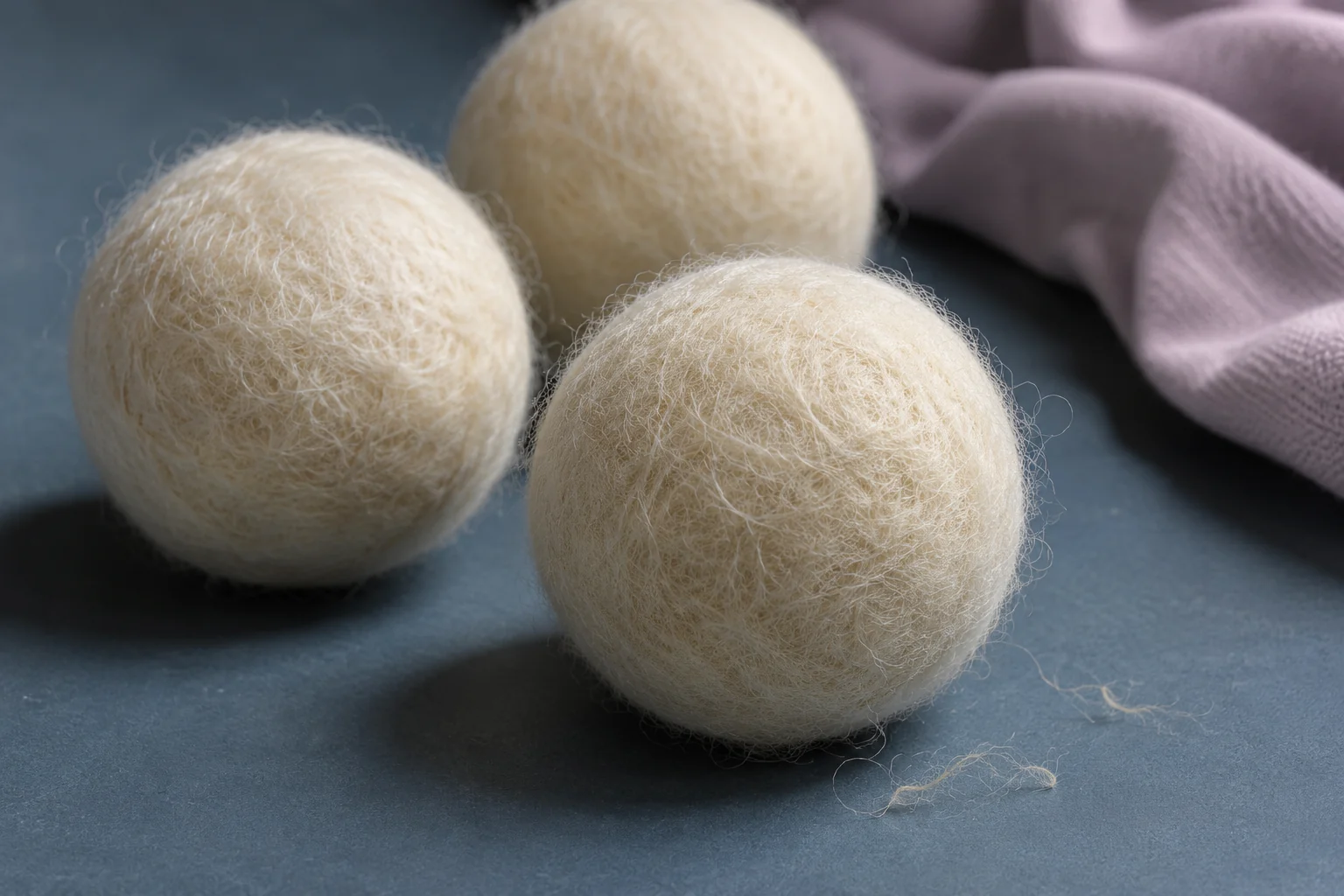
This research-based guide compares official product instructions and relevant appliance guidance, checked November 16, 2026. We have not performed cleaning or durability tests. The photographs are AI-generated editorial illustrations, not tested product photographs.
Do Wool Dryer Balls Need Cleaning?
Start with what you can actually see. A ball with a few loose towel fibers needs a different response from one dropped onto a dirty floor. Fine wool fuzz, collected pet hair, a sticky mark and a lifting felt layer should not all be treated as the same problem.
Our practical approach is condition-based: inspect when unloading, remove easily released debris, and investigate unusual soiling or odor. If the ball looks sound and clean, do not invent an extra wash solely because you used it again. Follow any maintenance schedule supplied for that particular product.
New does not automatically mean “wash first.” Friendsheep’s FAQ says its balls arrive ready for use without prewashing. That statement belongs to its products; check another brand’s packaging separately.
For ball counts and the ordinary laundry routine, see our guide to using wool dryer balls. This article addresses cleaning the accessory itself.
How to Clean Wool Dryer Balls: Start With the Care Instructions
Before wetting a ball, locate the product name on your receipt, storage bag or original listing. Read the manufacturer’s current directions alongside any instructions supplied with your set. A marketplace answer about a different brand is not a substitute.
- Identify the problem. Is it removable surface lint, a dirty patch, persistent odor or actual unraveling? Keep a suspect ball away from clean laundry while you decide.
- Find the permitted method. Look for explicit hand-wash, machine-wash or spot-clean instructions. Silence about washing is not permission to improvise.
- Check the details. Confirm water temperature, cleaner, bag or sock requirements, rinsing and drying. Permission to machine wash does not establish permission for high dryer heat.
- Check the appliance. Follow your washer and dryer manuals, including accessory restrictions. If instructions conflict, obtain clarification before proceeding.
- Inspect afterward. Cleaning should address the original problem. If the ball still has residue, an unexplained smell or separating felt, set it aside rather than repeating increasingly aggressive treatments.
If you cannot identify the maker, limit handling to readily removable dry debris. Ask the seller for the care directions before soaking or machine washing. Keep a photograph of the instructions once you find them.
How to Remove Lint and Surface Fuzz
Inspect the ball in good light when it is cool enough to handle. Look for foreign fibers resting on the surface rather than trying to make the wool itself perfectly smooth. Do not pull a firmly attached tuft just to see whether it comes away.
Maytag’s dryer-ball guidance suggests a lint roller for surface debris. Use that approach only when compatible with your ball’s care directions, with light contact; stop if it lifts the felt instead of removing loose material.
Friendsheep’s linked user manual describes surface pilling as normal and allows gentle removal of pills. That does not justify peeling layers off the body of a ball.
Our conservative recommendation is to leave attached wool alone unless the maker gives a suitable removal method. Razors, scissors and aggressive brushing are not necessary default steps. A small cosmetic bobble is different from a ball shedding clumps, and trimming the surface does not establish that its structure is sound.
Can You Wash Wool Dryer Balls?
Some can be washed under their maker’s instructions. The differences below show why a generic hot-wash recipe is unsuitable. These are summaries of published directions, not independent tests or permission to apply one brand’s method to another.
| Manufacturer | Official cleaning guidance | Important limitation |
|---|---|---|
| Smart Sheep | Its dirty-ball advice specifies mild soap, warm water and air drying. | A separate recharging article includes hand washing and hot machine washing with detergent. Confirm which procedure fits the problem. |
| Friendsheep | Its FAQ favors hand washing with mild soap in lukewarm water. | It discourages machine washing except when necessary, but separately describes a hot-water recharge. Ask the brand to resolve the distinction for your set. |
| Woolzies | Its FAQ permits a regular machine cycle with detergent while the balls are inside a thin sock or stocking. | It then specifies removing the covering and using the highest dryer heat. This is brand-specific; the FAQ does not give an exact wash temperature or detergent dose. |
| Molly’s Suds | The product page specifies a mesh bag or pillowcase, a warm delicate wash, then drying completely in a sunny window. | The FAQ instead describes washing with sheets on the usual cycle. Confirm the appropriate cycle when directions differ. |
| Steamery | Its US support page limits its balls to the tumble dryer and says not to use them in a washing machine. | The page does not supply an alternative wet-cleaning procedure. Ask Steamery rather than borrowing another brand’s recipe. |
If hand washing is permitted
Follow the specified water temperature and cleaner. Do not convert “mild soap” into a guessed tablespoon of concentrated laundry detergent, or add a soaking time the instructions never give. Check whether rinsing and a particular drying method are specified before you start.
When the maker permits a wool-compatible detergent, our guide to choosing wool detergent explains label distinctions. It is not blanket approval for every listed formula on every dryer ball.
If spot cleaning is permitted
Treat only the affected area using the approved cloth, liquid and technique. “Spot clean” does not mean soak the whole ball. We did not verify a universal spot-cleaning recipe from the manufacturer pages compared here, so this guide does not prescribe one.
If machine washing is permitted
Use the exact cycle and protective covering specified. A sock, mesh bag and pillowcase are not interchangeable unless the instructions say so. Check cleaner suitability for the washer too; a product intended for hand washing should not automatically go into a machine.
How to Dry Wool Dryer Balls After Cleaning
Choose the drying route before starting the wash. A method that leaves you with wet balls and no approved drying plan is incomplete.
The manufacturer examples differ substantially: Smart Sheep’s dirty-ball advice calls for air drying, Molly’s Suds specifies complete drying in a sunny window, and Woolzies specifies dryer heat. Do not average these instructions into an invented “medium heat for everyone” setting.
For approved air drying, use a clean location with airflow and follow any placement requirements. Avoid crowding damp balls into a closed container. If the permitted method involves the dryer, use only the stated conditions that are also compatible with the appliance.
Do not assume that a fixed number of hours guarantees dryness. Molly’s Suds’ product page emphasizes complete drying, while its FAQ gives a rough time in sunlight. Treat actual dryness as the endpoint, not the clock alone.
If a ball remains damp, keep it out of storage and continue the approved drying process. Do not escalate to an unapproved hotter cycle. If you cannot get it dry, or an odor develops, ask the manufacturer before returning it to laundry.
Once fully dry, keep the set in a suitable dry place. Friendsheep specifically recommends ventilation and advises against plastic storage. An open basket can make inspection and keeping the set together easier.
How to Refresh Wool Dryer Balls Without Expecting a Reset
“Refreshing” and “recharging” are not standardized care terms. Sellers use them for procedures involving washing, soaking or drying, and sometimes attach claims about restored softness, absorbency or service life.
Friendsheep’s FAQ illustrates the difficulty: its ordinary washing answer cautions against prolonged hot washing, while its recharge answer suggests hot water and either air or tumble drying. Those directions should be clarified with the company, not combined into a more intensive routine.
The sources reviewed do not establish that washing restores every old ball to new performance or adds a fixed number of future loads. CHOICE’s independent investigation compared dryer-ball products with no-ball runs; it did not test whether cleaning worn balls restored performance. It cannot validate a recharge promise.
A longer drying cycle or more static is not, by itself, a diagnosis of dirty balls. Review the load and appliance instructions before adding maintenance. Our comparison of dryer balls and dryer sheets explains why their effects on static and softness differ.
Handling Odors, Pet Hair and Stubborn Debris
For pet hair, start with loose surface removal rather than soaking automatically. Stop if the hair is tangled into the felt and removing it requires force. A brand-approved cleaning method may be appropriate; pulling away a patch of wool is not the goal.
For an unusual or musty smell, set the ball aside and check whether it was stored damp or picked up contamination. Tell the manufacturer what happened and what treatments have already been used. Odor alone cannot establish the cause, and a pleasant fragrance does not confirm cleanliness.
If the maker permits washing, follow that procedure and dry fully. Persistent odor, visible contamination or an unresolved sticky residue warrants further advice or replacement, not repeated improvised treatments. Do not claim a home wash disinfects the ball or prevents allergies.
Avoid adding essential oils as a cleaning or deodorizing fix. Maytag advises against oil application because it can increase flammability. A seller’s fragrance suggestion does not override your appliance manual.
Common Cleaning Mistakes to Avoid
- Copying another product’s method. A machine-washable set does not make all felted wool balls washable.
- Combining fragments of different instructions. Taking one brand’s detergent, another’s soak and a third’s high-heat setting creates an unverified procedure.
- Adding bleach, fabric conditioner or improvised cleaning mixtures. These are not default treatments in this guide. Use only the cleaner permitted for the exact product and appliance.
- Trying to remove every visible fiber. Surface neatness is not a cleaning or performance measurement.
- Putting damp balls away. Finish the approved drying process before storage.
- Boiling or repeatedly heating a deteriorating ball. A cleaning instruction is not evidence that structural damage can be repaired.
How Often Should You Clean Wool Dryer Balls?
There is no independently established cleaning interval for every brand and household. Follow your product’s schedule if it provides one, while addressing actual dirt or contamination when it appears.
For example, Smart Sheep’s recharge article recommends roughly every 100 loads. That is a manufacturer recommendation, not a demonstrated universal threshold. It does not override a different product’s prohibition on machine washing.
Make inspection the simple recurring habit: retrieve the balls, check their surfaces and condition, and store them appropriately. Cleaning a visibly dirty ball and washing an already-clean set because of a generic calendar reminder are different decisions.
When to Replace Instead of Clean
Set aside a ball with separating layers, loose clumps or substantial unraveling. Washing it again is not a proven repair. Our wool dryer ball lifespan and replacement guide covers the detailed assessment.
If replacement is needed, our wool dryer ball buying guide compares documented product details. Clear care instructions are a useful purchasing consideration.
Frequently Asked Questions
Can wool dryer balls go in the washing machine?
Some brands expressly allow it; others do not. Check the exact product’s directions, including cycle and protective covering. Do not put balls through every ordinary clothes wash simply because an occasional cleaning wash is permitted.
Can you clean wool dryer balls with detergent?
Only when the relevant cleaning instructions allow it. Some specify mild soap or detergent, while other procedures omit it. Do not invent a dose or assume fabric conditioner is an equivalent cleaner.
Can you put washed wool dryer balls in the dryer?
Only when their post-washing directions and your appliance permit that route. Being designed for use with damp laundry does not establish a particular heat setting or drying time after the ball has been saturated.
Will cleaning restore old wool dryer balls?
Cleaning can address removable dirt; it does not establish repaired felt, like-new performance or a renewed lifespan. Inspect the ball afterward and judge whether the original problem has actually been resolved.
Final Verdict
Remove loose debris gently, leave sound attached wool alone, and wash only by a method approved for the balls you own. Plan the drying step, finish it before storage, and investigate persistent odor or damage. Useful maintenance solves an identifiable problem without turning every load into another cleaning chore.