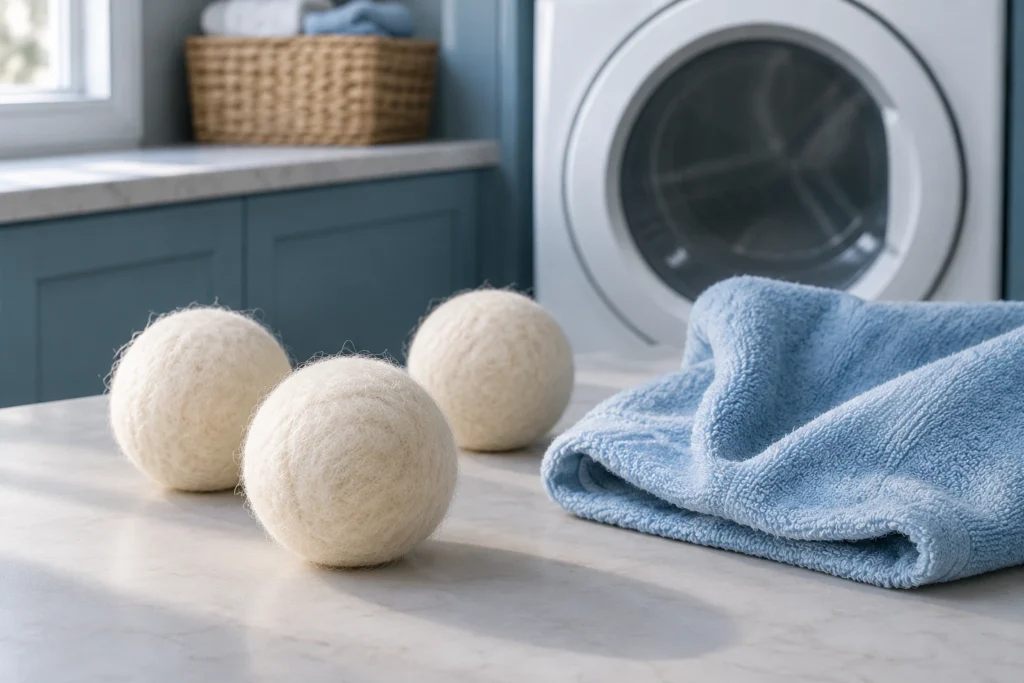
Here is how to use wool dryer balls: place them loose in the dryer with clean, wet laundry, choose the cycle allowed by the fabric care labels, and remove them when the load is finished. A common starting range is three to six balls, but your set’s instructions take priority: some brands specify four, while others vary the count by load size.
Wool dryer balls are reusable accessories, usually made from densely felted wool. Their movement can help separate fabric, but they do not guarantee faster drying, softer laundry or freedom from static. This guide draws on manufacturer instructions and published evidence; we have not tested the products ourselves.
Already have a set? Start with the routine below. If you are still choosing one, our wool dryer ball buying guide covers purchasing differences. Here, the focus is using the balls you own, including how many wool dryer balls to use, what to do about static, and how to care for them.
How to use wool dryer balls, step by step
1. Check the laundry labels and the dryer instructions
Start with laundry that is actually suitable for tumble drying. Match the cycle and heat to the garments, towels or bedding in the load; adding dryer balls is not a reason to raise the temperature. Check the ball manufacturer’s instructions too, particularly for special fabrics or an unfamiliar dryer type.
The word “wool” describes the balls, not a blanket permission to tumble-dry wool clothing. Woolmark’s drying guidance distinguishes garments labeled for tumble drying from those that should dry flat. If a sweater’s label says to dry flat, leave it out of the dryer even when you use wool balls. See also what makes wool shrink.
2. Prepare a load with room to tumble
Transfer laundry after the washer has completed its appropriate spin cycle, and loosen tightly bundled items as you load. Avoid packing the drum. A pair of balls cannot create useful space in a load that has no room to move.
ENERGY STAR’s dryer guidance emphasizes free tumbling, airflow and a clean lint filter. Clean the filter after each load, following the appliance manual. For a ventless model, follow its additional filter, condenser and water-container instructions rather than assuming the maintenance is identical to a vented dryer.
3. Add the balls loose among the laundry
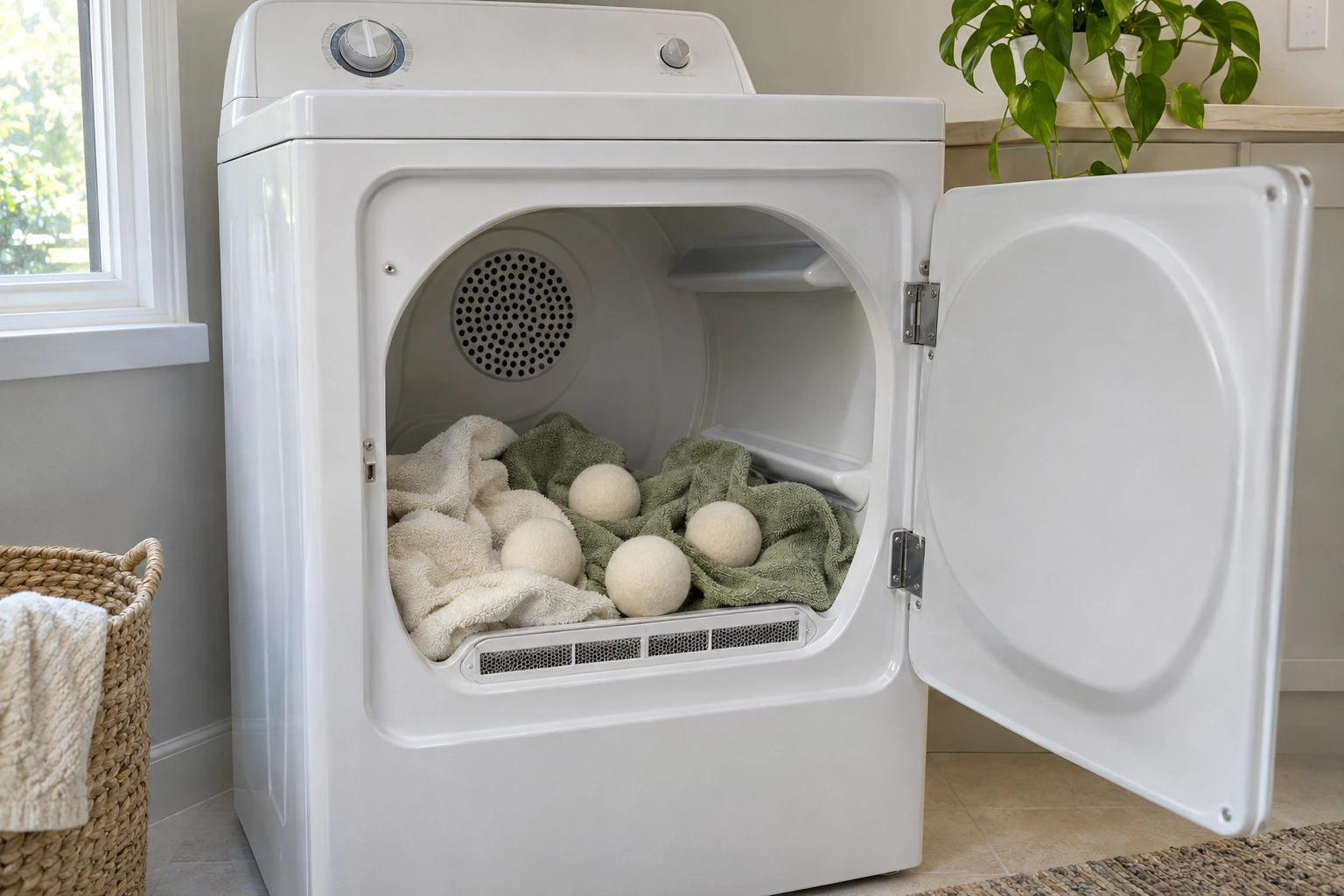
Remove any storage bag and distribute the recommended number of balls through the load. They need to move with the fabric. Do not leave them tied together or enclosed in their storage pouch during ordinary drying; a bag used for a manufacturer-approved cleaning procedure is a different situation.
Whirlpool’s usage guide describes spreading the balls through the laundry before starting. You do not need to position one beside every garment, and a ball settling to the bottom before the cycle starts is normal.
4. Choose the cycle, then check the actual result
Use the drying program and temperature appropriate for the laundry. Where the manual recommends it for that load, an automatic moisture-sensing cycle can help avoid unnecessary extra drying. On a timed cycle, check progress rather than automatically cutting a fixed number of minutes because you added balls.
At the end, check thicker sections such as towel edges and seams. If some pieces remain damp, follow the dryer’s guidance for further drying; do not put damp items away. If the laundry is already dry, adding time is not a useful way to make the balls “work harder.”
5. Retrieve the balls and let them dry before storage
Separate the balls from the finished laundry. Check inside pillowcases, sleeves and bundled sheets if one appears to be missing. Allow any damp balls to dry fully, then keep them in a dry, ventilated place. An open basket or the breathable bag supplied with the set can be convenient.
How many wool dryer balls should you use?
There is no universal count for every ball size, drum or load. Start with the directions supplied with your set. The examples below show why “always use six” is too broad; they are instructions to interpret, not a ranking of which brand dries best.
| Source | Published count | How to apply it |
|---|---|---|
| Maytag’s general usage guide | 3–4 for small or medium loads; 5–6 for large or extra-large loads | A general starting range when compatible with your ball and appliance instructions. |
| Friendsheep FAQ | 4 for small loads; 6 for full loads | Product-specific guidance. The brand also promotes higher counts; more balls do not establish greater savings. |
| Steamery US support | All 4 balls in its set | Follow the instructions for that set rather than imposing another brand’s load chart. |
“Small” and “large” are not standardized load weights in these examples. A compact dryer and a full-size dryer can hold different amounts. Check your machine’s capacity, including any lower load capacity for bulky items, rather than treating a nearly packed drum as a target.
For your first load, note the ball count and use a familiar group of laundry. If the load cannot move freely, reduce the load before adding more balls. If the package and the current website disagree, ask the manufacturer which instruction applies to your exact product. A twelve-ball package does not mean all twelve belong in every cycle.
What to expect from drying time, softness and static
Dryer balls are intended to tumble between fabrics and reduce clumping. That mechanism is plausible, but a manufacturer’s percentage claim is not a reliable prediction for your machine. Load composition, spin extraction, the drying program and the condition of the appliance all affect the result.
In its published dryer-ball investigation, Australian consumer organization CHOICE compared four products, including one wool set, in two dryers with a standardized cotton load. It found little effect on drying performance. The study does not cover every modern dryer or every wool ball, and it did not test softness. It does support avoiding a guaranteed time-saving or energy-saving promise.
If you want to judge usefulness at home, keep the laundry type, load size, wash spin and dryer setting similar across several ordinary loads. Note whether the laundry is equally dry at the end. Treat those observations as information about your routine, not proof that every household will get the same result.
If clothes still cling together
Check over-drying and fabric sorting before buying extra balls. Whirlpool’s static guidance identifies overdrying, low humidity and synthetic fabrics as contributing factors. Separate static-prone synthetics where practical and choose an appropriate cycle; dryer balls do not make a static-free result certain.
Some appliance guides suggest lightly misting wool balls with water for static. That is not a universal preparation step. Follow your ball and dryer instructions before trying it, and do not assume soaking the balls will improve drying. An appliance’s own static-reduction option, if fitted, also has load-specific directions.
Use them without essential oils
Plain, unscented use is the recommendation here. Maytag advises against essential oils on dryer balls because they can increase flammability. Some ball sellers recommend scenting, but that advice does not override your appliance manual or fabric instructions.
There is no need to add fragrance to make the balls tumble. We do not recommend a universal oil recipe, a drop count or a “let it soak in” workaround. Fragrance is a separate choice from the physical laundry accessory.
How to clean and store wool dryer balls
Inspect the balls when unloading. Remove loose surface lint gently, and follow the maker’s cleaning method when they are dirty. There is no single verified hot-wash “recharge” routine or cleaning schedule that applies to all sets.
For example, Smart Sheep’s care article describes cleaning a dirty ball with mild soap and warm water, followed by air drying. Friendsheep discusses surface cleaning and lukewarm hand washing, but its FAQ also gives a separate hot-water “recharge” method. When the instructions seem inconsistent, obtain clarification before choosing a heat treatment.
Dry the balls fully before storing them. Friendsheep recommends ventilated storage and advises against plastic. Do not seal moisture inside a container or assume washing has restored measured performance.
Stop using balls that are coming apart or shedding loose pieces. Friendsheep identifies loosening felt and unraveling as replacement signs. An advertised load count is not a deadline or proof that a damaged ball remains usable.
Troubleshooting common problems
| What you notice | What to check first | Practical next step |
|---|---|---|
| Laundry is still damp | Load size, selected cycle, filter condition and whether items are bundled | Reduce an overloaded batch and follow the appliance’s drying and maintenance guidance. More balls are not a repair for poor airflow. |
| Static remains | Over-drying and mixed synthetic fabrics | Adjust the routine described above before assuming you need a larger set. |
| A ball seems to have disappeared | Pillowcases, sleeves and folded or bundled bedding | Check the finished laundry before replacing the missing ball. |
| Lint or loose fibers appear | Whether lint is stuck to the surface or the ball itself is breaking down | Clean as directed; stop using a ball that is deteriorating. |
| No noticeable improvement | Whether the load is already drying satisfactorily | There is no need to keep adding balls to chase a promised percentage. Decide whether they are useful in your routine. |
Frequently asked questions
Do you need to wash new wool dryer balls before using them?
Only if the maker directs it. Smart Sheep says its balls arrive ready to use. That does not establish a rule for every set. Follow the package directions, particularly for a product with a coating, added fragrance or unfamiliar construction.
Do wool dryer balls go in the washer or the dryer?
For the routine described here, add them for drying. Steamery explicitly limits its balls to the tumble dryer. A brand-approved wash to clean the balls is different from putting them through every laundry wash. They do not replace detergent.
Can you use them in a washer-dryer combo?
Check both sets of instructions. Friendsheep specifies adding its balls only after washing has finished and the water has drained. Only do that if your machine’s operating instructions allow access between stages. Remove the balls before the next wash rather than automatically running them through a continuous wash-and-dry program.
Can wool dryer balls be used with wool sweaters or blankets?
Only when the textile’s care instructions allow the drying method and any accessories you intend to use. A machine-washable wool item is not automatically tumble-dryable. Our Merino wool washing guide explains the separate garment-care decisions.
Do you still need dryer sheets?
A dryer sheet is not required to use wool dryer balls. If you choose another laundry additive as well, follow its directions and check fabric and appliance compatibility. Balls and sheets are different products; switching to balls does not guarantee identical softness, scent or static control.
A simple routine to keep
Use the count specified for your set, leave enough room for the laundry to tumble freely, and select the cycle for the fabric. Check dryness, retrieve the balls and store them dry. If the result disappoints, review the load and dryer settings before adding more accessories. That is a practical way to use wool dryer balls without depending on claims your own laundry may not reproduce.
These are decorative AI-generated illustrations, not photographs of our own testing. The balls shown are illustrative; they do not establish a recommended count for every set.
Sources
- Maytag — How to Use Wool Dryer Balls: Complete Guide & FAQs
- Maytag — What Do Dryer Balls Do?
- Whirlpool — How to Use Wool Dryer Balls
- Friendsheep — Frequently Asked Questions About Eco Dryer Balls
- Steamery US Support — How Do I Use the Tumble Dryer Balls?
- ENERGY STAR — Clothes Dryers: Buying and Usage Guidance
- Whirlpool Product Help — Reducing Static in the Dryer
- Smart Sheep — Are Wool Dryer Balls Safe to Use?
- Smart Sheep — How to Use Wool Dryer Balls
- CHOICE — Do Dryer Balls Actually Work?
- Woolmark — Tumble Drying Wool