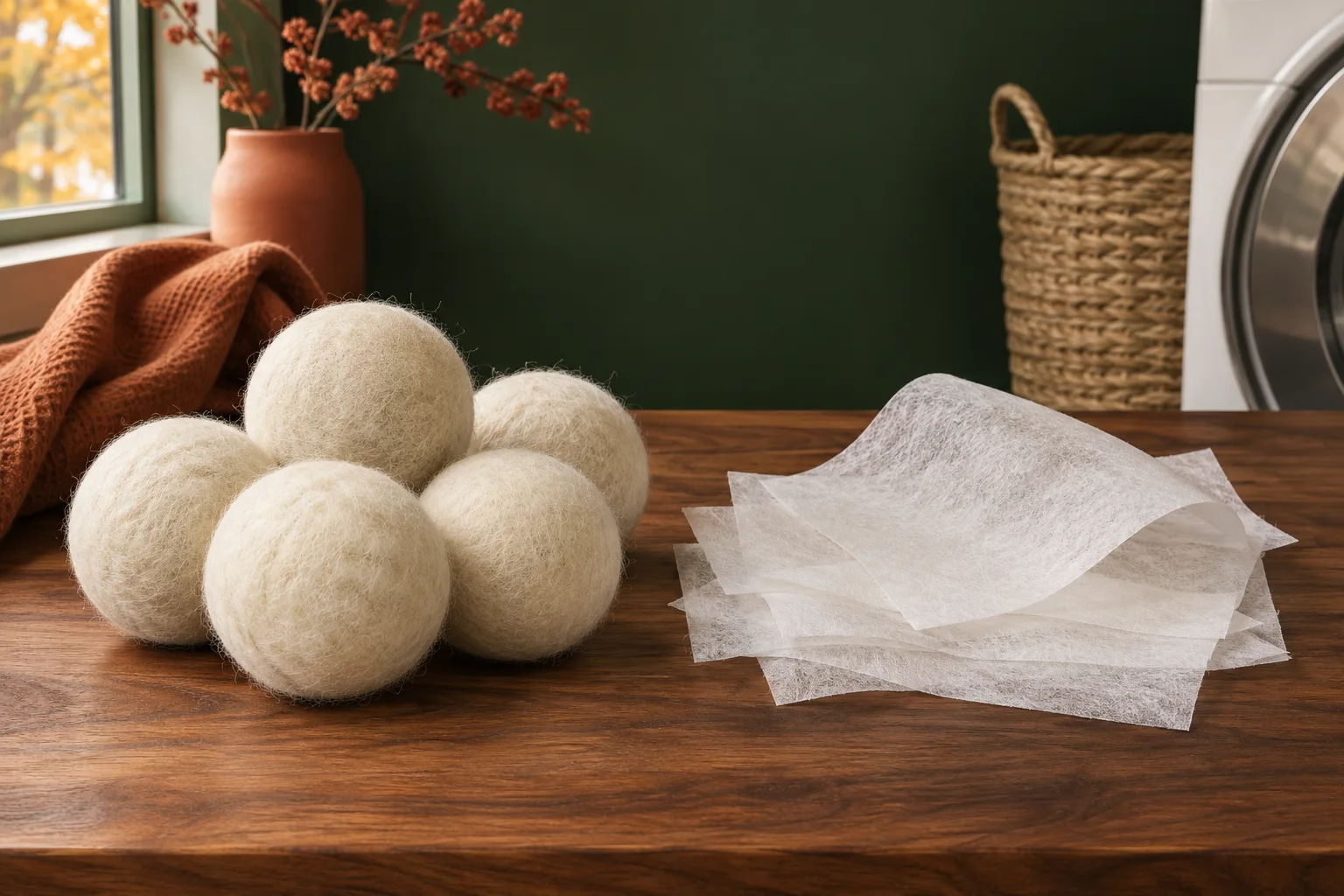
Wool Dryer Balls vs Dryer Sheets: Which Should You Use?
By Editorial Team
Wool dryer balls and dryer sheets solve different laundry problems. Wool dryer balls are reusable objects that tumble between fabrics and may help separate a load. Conventional dryer sheets release conditioning and antistatic ingredients onto fabric, so they usually offer more direct static control, a coated-soft feel and—when scented—a noticeable fragrance.
Choose wool dryer balls if you want an unscented, reusable accessory and can accept variable results. Choose dryer sheets if static control, fragrance or a conditioned feel matters more, provided the product is compatible with the fabrics and dryer.
This research-based comparison does not claim our own testing. Independent results are mixed, and products, machines and loads differ.
Quick verdict: wool dryer balls or dryer sheets?
- For static-prone synthetic laundry: Dryer sheets generally have the clearer advantage because their transferred ingredients are designed to reduce static. Wool dryer balls do not guarantee a static-free load.
- For fragrance-free, repeated use: Plain wool dryer balls are the simpler choice. Unscented dryer sheets also exist, but each sheet is normally used once.
- For a coated, conditioned softness: Dryer sheets are designed for this effect. Dryer balls rely mainly on tumbling and separation, so the feel is different and less predictable.
- For shorter drying cycles: Do not choose on a promised percentage. Independent findings are inconsistent, and your dryer, load size, starting moisture and program can change the result.
- For athleticwear, microfiber, towels or flame-resistant items: Check the care label and product directions. Some manufacturers advise against dryer sheets for particular fabrics.
If you already prefer dryer balls, our wool dryer ball buying guide compares documented product details. For quantities, placement and care, use the separate guide to using wool dryer balls.
Wool dryer balls vs dryer sheets at a glance
| Factor | Wool dryer balls | Conventional dryer sheets |
|---|---|---|
| Static reduction | Variable; may be insufficient for synthetics or over-dried loads | A primary function of the deposited antistatic ingredients |
| Fabric softness | Mechanical tumbling and separation may change feel | Conditioning ingredients transfer to fibers for a coated-soft feel |
| Drying time | Mixed independent evidence; no universal reduction | Not primarily intended to shorten the cycle |
| Fragrance | Plain balls are normally unscented | Scented and unscented formulas are available |
| Reusability | Reused until worn, damaged or lost; lifespan varies | Normally one sheet per use, sometimes more as directed |
| Residue | Does not intentionally deposit fabric conditioner | Designed to transfer ingredients; residue can affect some fabrics or dryer components |
| Upfront price | Higher for a set | Lower for a box |
| Cost per load | Falls with repeated successful use | Depends on box price and sheets used per load |
| Fabric compatibility | Still requires care-label and appliance checks | Not suitable for every performance, absorbent or flame-resistant textile |
| Environmental considerations | Reuse reduces the number of accessories discarded, but wool production and replacement still have impacts | Single-use waste and packaging recur; sheet carrier materials and formulas vary |
How wool dryer balls work
Wool dryer balls are densely felted spheres placed in a tumble dryer with compatible wet laundry. As the drum rotates, they move between items and can help keep some fabrics from staying tightly bundled. That may improve air movement, but it does not guarantee a shorter cycle.
Their softening effect is primarily mechanical: tumbling can fluff fabrics without intentionally coating them with conditioner. The result may feel different from sheet-treated laundry.
Use only the number and method specified for the set and appliance. The balls need room to move; adding more to an overloaded drum is not a repair for poor airflow. Our how-to-use guide covers those operating details without repeating them here.
How dryer sheets work
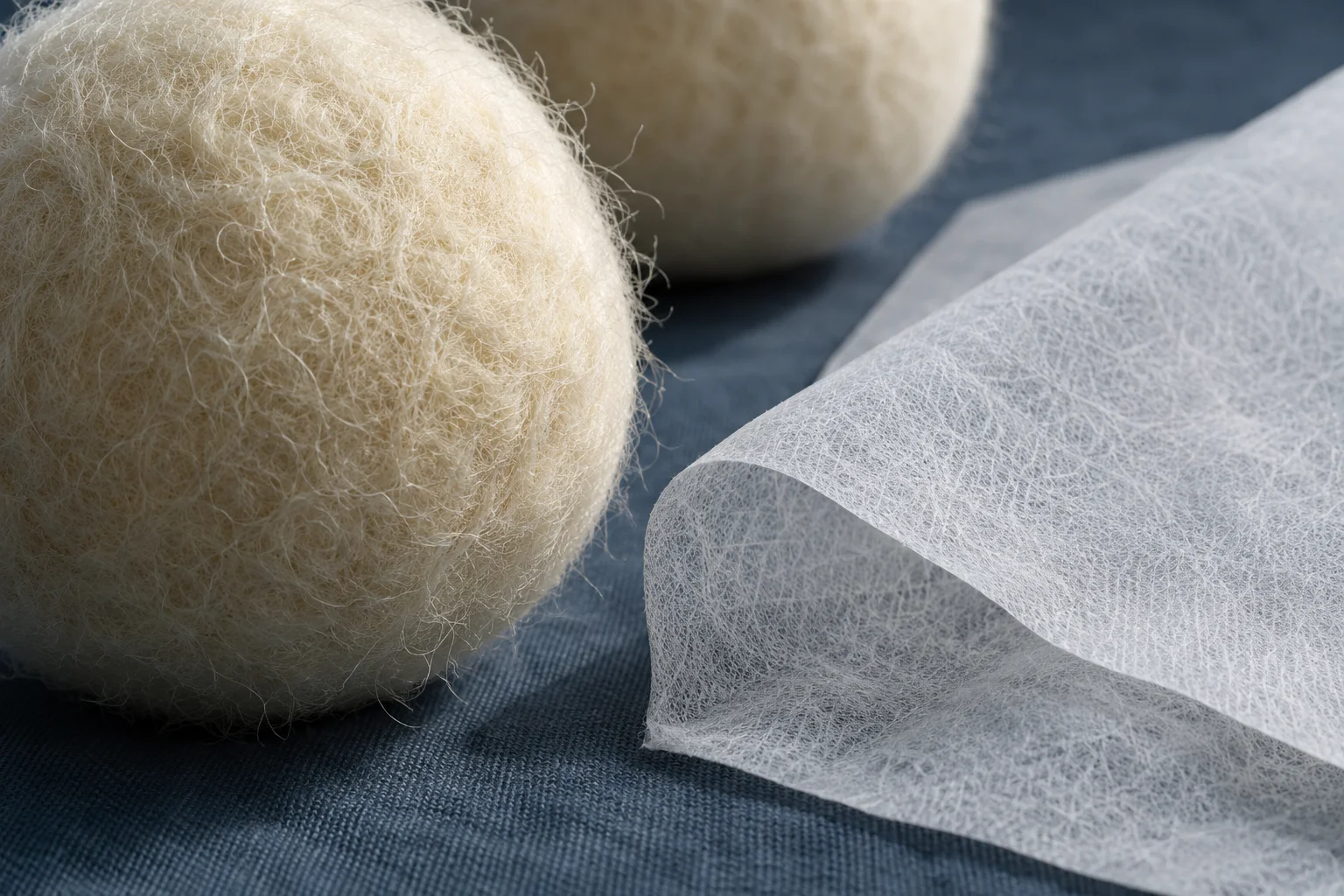
Dryer sheets are flexible carriers treated with fabric-conditioning ingredients. Dryer heat and tumbling help release those ingredients and transfer them to laundry. Whirlpool’s appliance guidance describes softening, static reduction and fragrance as the main functions.
Formulas are not identical. Some sheets include fragrance; others are sold without added perfume or dyes, and carrier material varies. “Contains chemicals” is not a useful verdict by itself. The practical questions are what the exact product contains, how it is used and whether it suits the textile and user.
Because dryer sheets work by deposition, they can leave residue. Whirlpool warns that buildup can affect a lint screen and advises regular cleaning when sheets are used. Follow the appliance manual rather than assuming the same maintenance schedule applies to every dryer.
Which works better for static?
Dryer sheets are generally the more purpose-built option for static. Their conditioning ingredients coat fibers and help neutralize the electrical imbalance that makes pieces cling. Wool dryer balls may separate fabric and sometimes help in a particular load, but they do not supply the same antistatic coating.
Static also depends on the load. Polyester and other synthetics tend to be more troublesome, and over-drying removes the remaining moisture that helps dissipate charge. Before adding more products, separate highly static-prone synthetics where practical and use a suitable moisture-sensing or lower-dryness program.
Consumer NZ reported no observed static improvement in its 2016 trial of one wool and one plastic product. Consumer Reports’ 2026 comparison found meaningful differences among six wool, plastic and rubber products. Neither test supports a universal “eliminates static” claim.
If static is the deciding problem and sheets are allowed for the load, a conventional sheet is the more predictable starting point. If you avoid sheets, manage drying time and load composition first rather than assuming additional balls will solve the problem.
Which makes laundry feel softer?
The two options create different kinds of softness. Dryer sheets transfer lubricating conditioners that reduce fiber-to-fiber friction, producing the familiar conditioned feel. Wool dryer balls do not add that coating; they may make some items feel fluffier by movement and separation.
Perceived softness also changes with fiber, weave, detergent residue, water, cycle, temperature and final moisture. A towel, cotton shirt and polyester fleece can respond differently.
There is also conflicting compatibility advice. Whirlpool advises avoiding dryer sheets on athleticwear, microfiber, towels, flame-resistant textiles and water-repellent fabrics because a coating may affect important properties. Industry sources sometimes describe modern softeners as compatible with a wider range when correctly dosed. The safest decision is to follow the garment and product labels, especially when absorbency, moisture management or flame resistance matters.
Do wool dryer balls reduce drying time?
They can in some conditions, but the evidence does not support one guaranteed percentage. Three independent sources illustrate why.
In 2026, Consumer Reports compared six wool, plastic and rubber products using a mixed load containing a towel, sheet, pillowcases, blouse and socks. Its public conclusion favored the wool products over the plastic and rubber options for the tested tasks. That is useful product-comparison evidence, but it does not turn one load into a prediction for every dryer.
CHOICE used identical 3.5-kilogram cotton loads in a vented dryer and a condenser dryer, comparing runs with and without four dryer-ball products. One set was wool. It found little effect on performance and advised against buying the products for promised time or energy savings.
Consumer NZ tested a 3.5-kilogram load in an automatic-sensing condenser dryer. In that trial, both its wool and plastic products increased drying time by three to four minutes and used almost 5 percent more energy. It also observed no improvement in softness or static.
These findings used different products, machines, loads and questions. Some compare brands; others compare balls with no balls. Starting moisture, drum capacity and automatic termination also matter.
The responsible conclusion is simple: dryer balls may improve separation in your load, but do not budget for a specific energy or utility-bill saving. Use the correct washer spin, avoid overloading, clean the lint filter and choose an appropriate sensor cycle. ENERGY STAR identifies automatic termination and lint-filter maintenance as established efficiency measures.
Fragrance and sensitive-user considerations
Plain wool dryer balls add no fragrance. That can suit households that prefer laundry without a transferred scent. Dryer sheets are available in both scented and unscented versions, so choosing sheets does not automatically mean choosing perfume.
People with a known fragrance or contact allergy should check the exact ingredient disclosure and seek appropriate medical advice. A peer-reviewed survey of 65 popular textile-care products found fragrance and essential oils among common allergens disclosed in several product categories, including dryer sheets. It did not show that every sheet causes symptoms or that every “free and clear” product suits every person.
Wool dryer balls are not “hypoallergenic” by default, and they do not prevent allergies. Someone avoiding animal fibers may prefer a different compatible laundry method.
Do not automatically add essential oils to dryer balls to imitate a scented sheet. Maytag advises against that practice because of flammability concerns. Product sellers sometimes give different advice, but a seller’s scent recipe does not override the dryer manual.
Reusability, waste and environmental trade-offs
The clearest difference is frequency of disposal. A wool dryer-ball set is reused, while a conventional sheet is generally discarded after one cycle. Reuse can reduce discarded accessories and replacement packaging.
Dryer balls are not impact-free: wool production, felting, transport and disposal still matter. A lost or prematurely replaced set spreads those impacts over fewer loads. Manufacturer lifespan estimates are not independent guarantees.
Dryer sheets also differ. Some use polyester carriers, others paper or another substrate, and formulas and packaging vary. “Biodegradable” or “plant-based” should be checked against the exact product documentation rather than assumed from the category.
Buy only an accessory you will use, follow appliance and textile instructions, and do not assume energy savings.
Cost per load and long-term value
Dryer balls require more money at checkout but can become cheaper per use if they remain usable. Dryer sheets spread their cost across a box but must be replaced.
Here is a transparent US example using Target prices checked November 13, 2026, before tax or promotions:
- Everspring’s three wool dryer balls were $12.79. That equals about 12.8 cents per load after 100 uses, 4.3 cents after 300 uses, or 2.6 cents after 500 uses.
- Bounce Free & Gentle cost $9.99 for 240 sheets, about 4.2 cents per sheet. Its directions specify one sheet for a small load, two for an average load and three for an extra-large load—about 4.2, 8.3 or 12.5 cents per load.
At those prices, the ball set reaches the cost of one sheet per load after roughly 307 uses, or two sheets per load after roughly 154 uses. This is arithmetic, not a durability promise. Lost or damaged balls, changed prices, different sheet counts and shipping alter the result. Any energy saving is excluded because it has not been established for a particular household.
Dryer and fabric compatibility comes first
Check three instructions before using either product: the dryer manual, the laundry accessory label and the textile care label.
A dryer ball does not make a garment tumble-dryable. Woolmark says wool garments should be tumble dried only when the care claim permits it; otherwise, many wool knits should be dried flat. This is especially important for sweaters, coats and blankets. Our guides to washing wool socks and why wool shrinks explain the garment-level risks.
Dryer sheets also have restrictions. Depending on the product and appliance, residue can affect moisture-wicking, absorbent, water-repellent or flame-resistant textiles. A steam cycle may have separate limits. Remove the used sheet after the cycle and maintain the lint screen as the manual directs.
Neither accessory replaces detergent. If the wash itself is the concern, choose a compatible product separately; our wool detergent guide addresses that different decision.
When wool dryer balls make more sense
Consider wool dryer balls when:
- you want an unscented, reusable laundry accessory;
- your compatible loads do not require strong antistatic treatment;
- you are comfortable evaluating results without expecting a fixed drying-time reduction;
- you have room to store the set dry and will replace balls that unravel or deteriorate; and
- wool is acceptable in your household.
They are a poor fit if you expect fragrance, guaranteed static control or promised utility savings.
When dryer sheets may be more suitable
Consider dryer sheets when:
- static cling is the main problem, especially in compatible synthetic loads;
- you prefer the conditioned feel they create;
- you want fragrance and choose a scented version; or
- you want a low initial purchase price and do not mind recurring replacement.
They are a poor fit where labels prohibit them or when you want to avoid deposited conditioner or single-use accessories.
Can you use wool dryer balls and dryer sheets together?
You can use both only when the dryer, sheet and fabrics allow it, but combining them is not automatically more effective. The sheet still deposits its conditioning ingredients, so using a ball does not remove the compatibility, residue or fragrance considerations.
Start with the outcome you need. For static and scent, a compatible sheet may already address the goal. For separation without added conditioner, use plain balls. Adding both increases cost and makes it harder to tell which product changed the result.
Frequently asked questions
Are wool dryer balls better than dryer sheets?
They are better for repeated, unscented use without intentional fabric-conditioner deposition. Dryer sheets are usually better for predictable static reduction, fragrance and a conditioned feel. The better choice depends on the load and your priorities.
Do wool dryer balls replace dryer sheets?
They can replace sheets if you are satisfied with their results, but they do not provide identical static control, softness or scent. A switch is a change in method, not a like-for-like guarantee.
Do dryer balls eliminate static?
No. They may help in some loads, but over-dried synthetics can still cling. Adjust the load and drying program first if static persists.
Are dryer sheets bad for your dryer?
Not automatically. Use only products permitted by the appliance manufacturer. Because sheet residue can build up on a lint screen or drum, follow the specified cleaning schedule and stop using a product that causes stains or operating problems.
Are dryer balls safe for wool clothing?
Only if the garment’s care label permits tumble drying and the appliance instructions allow the accessory. A machine-washable wool label does not necessarily mean tumble-dry safe.
How should sensitive users choose?
Read the exact ingredient list rather than relying only on “natural” or “free” marketing. Unscented sheets and plain balls are options, but neither guarantees that an individual will avoid a reaction.
Final verdict
For a reusable, fragrance-free routine, wool dryer balls are the more practical choice—provided you accept variable static and drying-time results. For stronger static control, fragrance or a coated-soft feel, conventional dryer sheets have the clearer functional advantage when the load and dryer permit them.
Do not choose balls for a guaranteed energy percentage or reject every sheet as “toxic.” Compare the documented function, compatibility, total cost and waste pattern that matter in your household. Whatever accessory you use, the dryer manual and fabric care label remain the final authority.
Sources
- Consumer Reports — The Only Dryer Balls Worth Buying
- CHOICE — Do Dryer Balls Actually Work?
- Consumer NZ — First Look: Dryer Balls
- Whirlpool — What Do Dryer Sheets Do?
- Maytag — How to Use Wool Dryer Balls
- Dermatitis — Contact Allergens in Top-Selling Textile-Care Products
- ENERGY STAR — Clothes Dryers
- Woolmark — Tumble Drying Wool
- Target — Everspring 100% New Zealand Wool Dryer Balls, 3 Count
- Target — Bounce Free & Gentle Dryer Sheets, 240 Count