How to Clean a Wool Rug Safely: Care by Rug Type
By Editorial Team
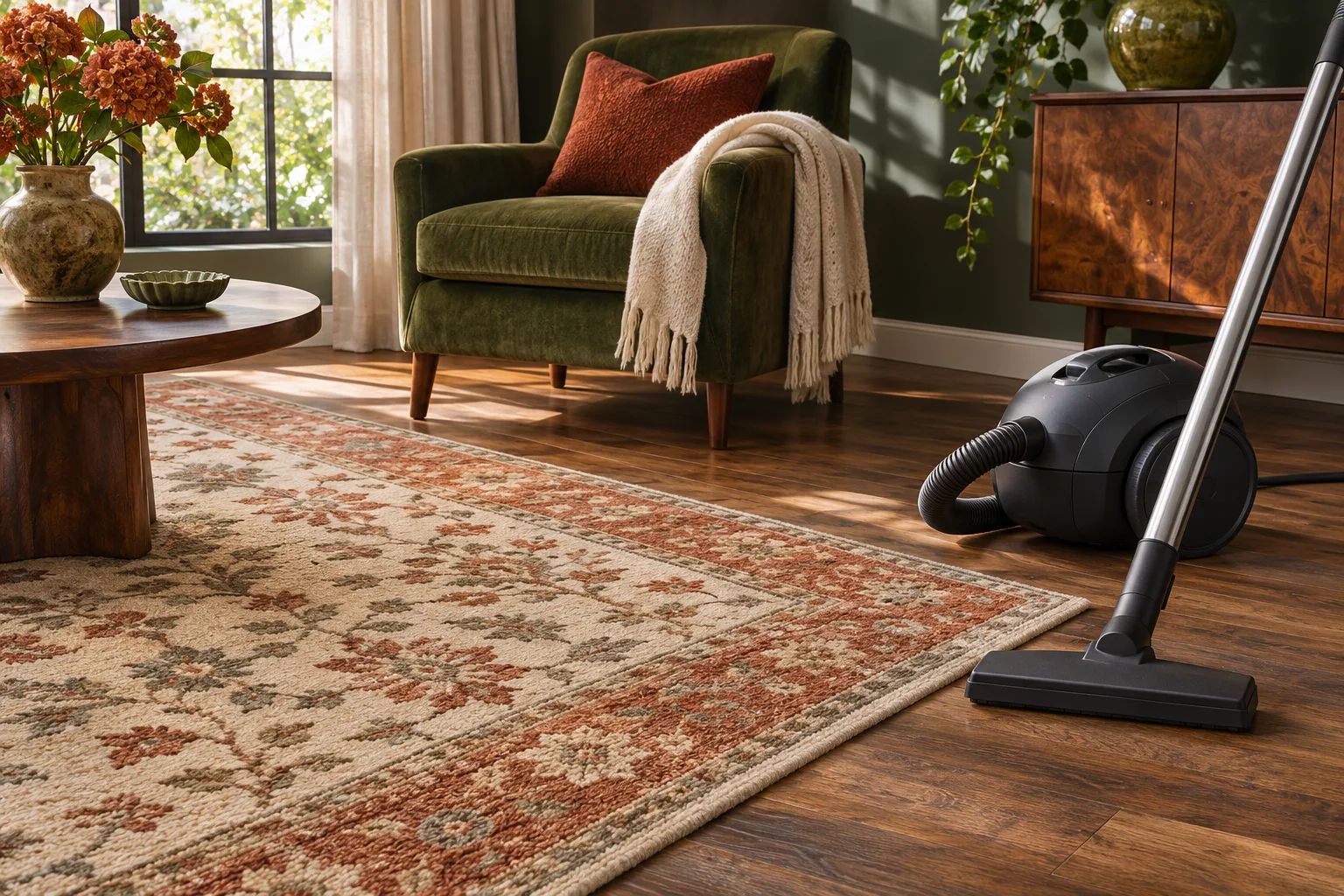
Cleaning a wool rug safely starts with identifying the rug—not reaching for a universal recipe. Construction, foundation, backing, dyes, pile and fringe all affect how much suction, moisture and agitation it can tolerate.
For routine care, use the vacuum setup permitted by the maker and respond to spills by lifting solids and blotting liquid with a clean white cloth. Spot-clean only when the instructions allow it. A hand-knotted heirloom, a latex-backed hand-tufted rug and a machine-made wool blend may need different treatment.
This guide covers everyday care, fresh spills, limited spot cleaning and when to call a cleaner experienced with the rug’s construction.
Quick Answer: The Safest Way to Clean a Wool Rug
Use this order of operations:
- Identify the rug. Note fibers, construction, backing, pile, fringe and restrictions.
- Remove dry soil gently. Use the approved vacuum head and suction level. Keep rotating brushes away from fringe, loose loops and any construction that prohibits agitation.
- Respond to spills promptly. Lift solids with a dull edge and blot liquid with a clean white cloth; do not scrub.
- Limit moisture. If spot cleaning is permitted, use a product specifically approved for the rug, in small quantities, after the maker’s required colorfastness test.
- Dry completely. Protect the floor and keep air moving. Replace the pad and furniture only when the whole rug is dry.
- Stop when risk increases. Dye transfer, distortion, odor, a large spill, pet contamination or unknown backing call for a qualified cleaner.
The goal is to remove soil or liquid with the least risky method the specific rug allows—not to make every rug “washable.”
Start With Construction and the Care Instructions
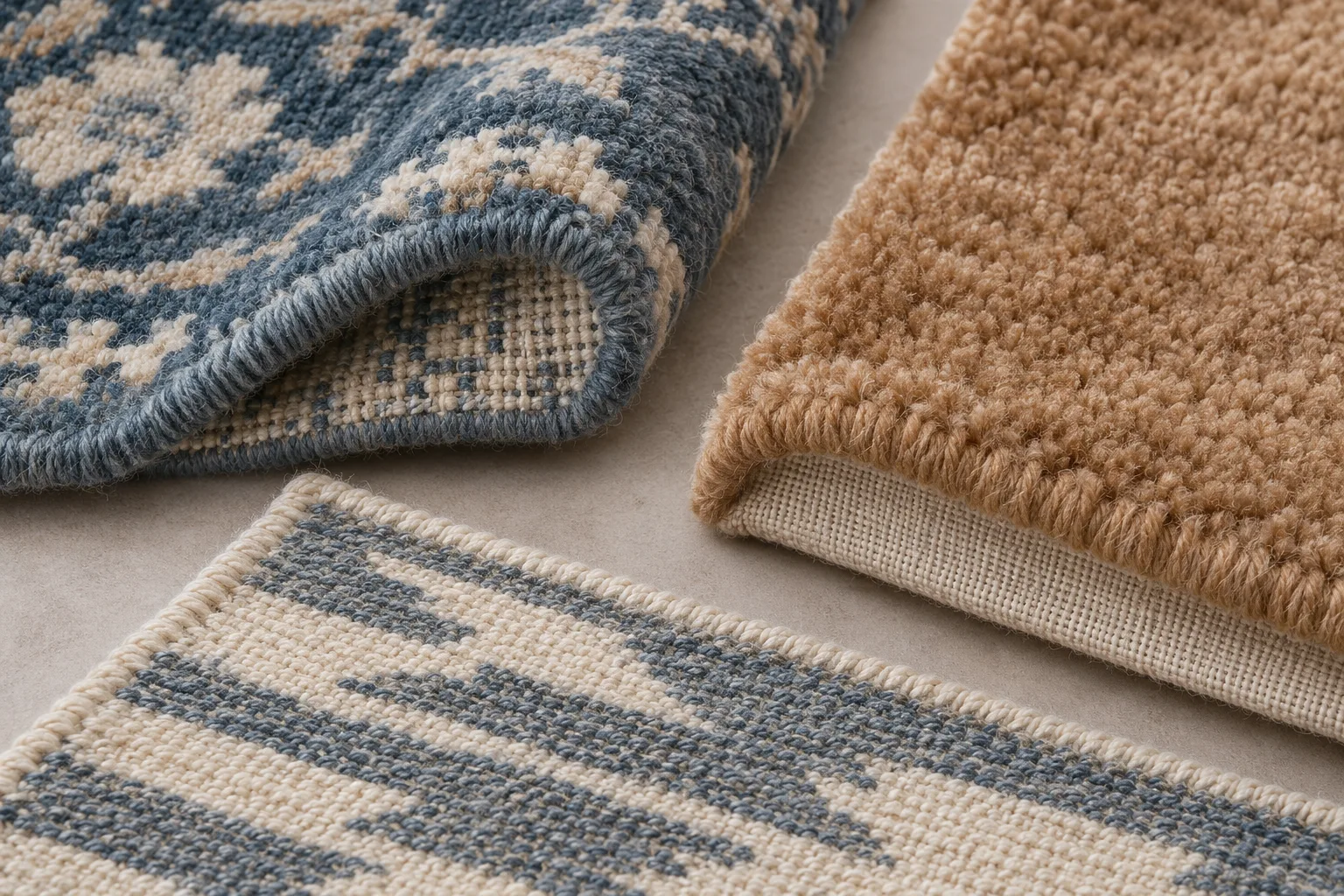
The word wool describes fiber content, not the whole object. Our guide to choosing a wool rug explains the main constructions. For cleaning, examine the face and back, then confirm the construction against the label or manufacturer’s documentation.
The Canadian Conservation Institute notes that rugs may be knotted, woven or hooked and may use cotton, linen, hemp or jute foundations. Those materials can react differently to moisture than the wool surface. Safavieh’s construction guide also distinguishes hand-knotted rugs from hand-tufted rugs with a backing layer.
Rug Construction and Cleaning Considerations
| Rug type | What matters before cleaning | Safer routine-care direction | Reasons to stop and seek advice |
|---|---|---|---|
| Hand-knotted pile | Foundation, dyes, age, repairs, fringe | Follow the maker’s vacuum instructions; protect fringe | Antique or valuable rug, dye transfer, loose knots or large spill |
| Hand-tufted | Secondary backing and possible adhesive | Use the approved vacuum setup; control moisture | Powdery/separated backing, odor, rippling or a soaked backing |
| Flatweave or kilim-style | Reversible structure, edge finish, dyes, tendency to shift | Use the maker-approved low-agitation setup; stabilize the rug if the head pulls it | Curling, pulled yarn, color transfer or uncertainty about whether wet cleaning is allowed |
| Machine-made wool or wool blend | Fiber blend, backing, pile and warranty | Follow the product label, not general wool advice | Unknown blend, adhesive backing or distortion |
| Long-pile or shag | Loose yarns, pile length, ability to reach embedded soil | Use only the maker-approved method; some designs require cleaning the reverse rather than the face | Tangling, matting, yarn entering the nozzle or embedded contamination |
| Looped, fringed or delicate edges | Continuous loops, tassels, binding and repairs | Keep rotating action away; clean fringe separately only as directed | A loop lifts, fringe is weak, edges unravel or the head catches yarn |
This table screens risk; it does not replace the rug’s instructions. Rugs in one category can use different fibers, adhesives, finishes and dyes.
What You Need for Routine Wool-Rug Care
A conservative kit includes:
- Care instructions and warranty information.
- A vacuum setup those instructions permit.
- Clean, absorbent white cotton cloths or plain white paper towels.
- A spoon or dull-edged tool for lifting solids.
- A rug-specific spot product only when authorized.
- Dry towels and airflow.
Avoid dish soap, laundry detergent, bleach, ammonia, oxygen bleach and viral mixtures. WoolSafe’s care guidance says general household cleaners can leave residue, cause rapid re-soiling or damage pile and backing. Its approved consumer-product list is useful, but it does not override the rug maker.
How to Vacuum a Wool Rug Without Overworking It
Vacuuming removes gritty soil before traffic works it deeper into the pile. Frequency should match traffic, pets and tracked-in dirt—not a rigid universal calendar.
- Pick up objects and check for lifted loops, pulled yarn, weak fringe or a separating edge.
- Identify whether the head has stationary bristles, a turbo brush or a powered brush. Low suction does not switch a brush off.
- Use the permitted setup and make unhurried passes without pressing into the pile.
- Work in the pile direction where the maker specifies it. Keep the machine off fringe and tassels.
- Stop if the rug lifts, yarn catches, the surface fuzzes rapidly or the head becomes hard to move.
- When the instructions allow it, periodically clean beneath the rug and inspect the pad and floor.
WoolSafe advises suction-only vacuuming as a general rule for loop pile. The Canadian Conservation Institute’s rug-care page recommends low suction, no power head and extra care around loose threads and fringe for important rugs. Product instructions still decide what is suitable for an ordinary household rug.
If you are choosing equipment rather than cleaning today, our vacuum guide for wool rugs explains straight-suction, combination, turbo and electric floorheads without treating any machine as universally safe.
What to Do Immediately After a Spill
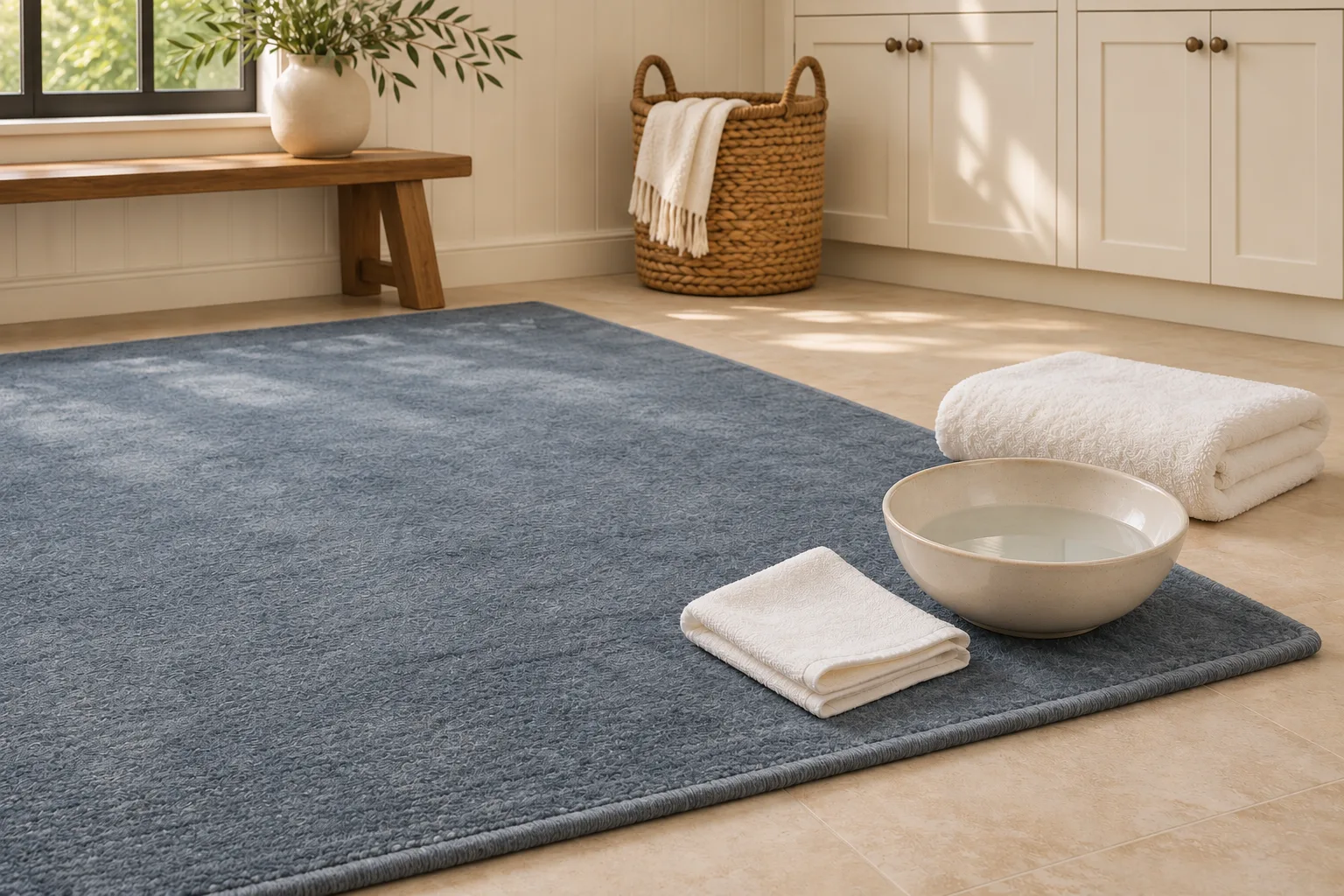
First, check whether electricity, hot liquid, broken glass, chemicals or biological contamination makes the area unsafe. For a routine food or drink spill:
- Lift solids with a spoon or dull edge, working carefully so they do not spread.
- Place a clean white absorbent cloth over the liquid. Press and lift; do not rub back and forth.
- Change to a dry section of cloth and repeat until little or no transfer remains.
- Check the care instructions before adding water or cleaner.
- If authorized, apply a small amount of compatible product to the cloth—not indiscriminately across the rug—and follow the product’s directions.
- Blot away remaining moisture and keep the area ventilated until the pile, foundation and backing are fully dry.
A white cloth makes dye transfer visible. Stop if rug color appears on it. Call a specialist for a hot drink, large spill, old stain or liquid that reached the backing. WoolSafe advises light applications and blotting rather than rubbing.
Limited Spot Cleaning: A Decision, Not a Recipe
Spot cleaning is appropriate only when the rug documentation allows it and the problem is small enough to control. “Natural,” “mild” and “pH neutral” are not proof that a product suits a particular dye, finish, blend or backing.
Before treatment, record the spill and read the rug and product instructions. If testing is permitted, use the inconspicuous location specified by the maker and let it dry; some changes appear only then.
Use very little solution. Do not pour cleaner onto the rug or saturate the foundation. Blot out residue as directed because detergent left in the pile can attract soil. Dry on a protected surface with airflow and no direct heat.
Jaipur Living’s wool-rug guidance tells owners to blot spills, turn off the beater bar and use periodic professional cleaning. Safavieh’s care FAQ also emphasizes prompt blotting, product-specific care and professional cleaning. These examples show why the manufacturer’s method matters more than a generic internet formula.
Cleaning Differences by Rug Type
Hand-Knotted Wool Rugs
Assess knots, foundation, dyes, fringe and repairs together. Do not assume wool pile makes a hand-knotted rug surface-washable. Unless written instructions permit more, limit home care to approved vacuuming and fresh-spill response. Send antique, unstable or high-value pieces to a hand-knotted-rug specialist.
Hand-Tufted and Adhesive-Backed Rugs
Hand-tufted pile is inserted into a backing and may be secured with adhesive before a secondary backing is added. Liquid can travel past the pile; prolonged dampness can affect the backing. If the back is powdery, sticky or detached, avoid moisture and seek advice.
Flatweaves
Flatweaves have no upright pile, but not all are washable. Weaves can distort, edges curl and dyes migrate; strong suction can also lift a thin rug. Follow the exact product instructions rather than copying another flatweave’s routine.
Wool Blends and Machine-Made Rugs
The second fiber, backing and finish change care requirements. Read the full label and warranty. Our wool vs. synthetic rug comparison explains why fiber category alone cannot predict cleaning performance.
Long-Pile, Shag and Fringed Rugs
Long yarns can tangle around rotating brushes; suction can pull fringe or loose ends. Do not cut raised yarn unless the maker identifies it as a trimmable sprout. See our guide to wool-rug shedding for warning signs.
Methods to Avoid Unless the Maker Specifically Allows Them
- Rubbing or stiff brushing: can spread a spill, fuzz the pile or disturb the structure.
- Excess water: can reach the foundation and backing, encourage dye migration, distort the rug and lengthen drying.
- Hot water or direct heat: may affect wool, dyes, finishes or backing and can set some stains.
- Household detergents and improvised mixtures: can leave residue or incompatible chemistry.
- Pressure washing or hosing: gives little control over saturation and drying.
- A rented carpet machine by default: a “carpet” setting does not establish compatibility.
- Vacuuming fringe with a rotating brush: risks pulling or tearing the edge.
- Unapproved deodorizing powders: residue can remain in pile or backing.
The 2024 IWTO guide says no technique is foolproof and links wet-cleaning damage to over-wetting, agitation and unsuitable products. Shaw’s wool checklist warns that methods for synthetic flooring may damage natural-fiber rugs or affect warranties.
Can You Steam-Clean or Deep-Clean a Wool Rug?
There is no universal yes or no. “Steam cleaning” is often used loosely for hot-water extraction, vapor steam and rental carpet machines, which do not expose a rug to the same amount of heat, water or suction.
The decision depends on construction, backing, dye stability, soil, equipment and the cleaner’s ability to remove moisture quickly. A surface that looks dry may still hold moisture in its foundation or adhesive layer. Read our focused guide, Can You Steam Clean a Wool Rug?, before renting a machine.
For a heavily soiled, large, valuable, hand-knotted, hand-tufted, shag or unknown rug, professional cleaning is usually the lower-risk choice. Ask whether the rug will be cleaned in place or at a rug-cleaning facility and how the cleaner will test dyes, protect fringe, handle the backing and verify complete drying.
Wool-Rug Cleaning Troubleshooting
| Problem | First safe response | Avoid | Escalate when |
|---|---|---|---|
| Loose dry soil | Use the approved vacuum; inspect rug and pad | Stronger agitation after one pass | The rug is fragile, the head catches or soil remains |
| Food or colored drink | Lift solids; blot liquid with white cloth | Scrubbing, hot water or unapproved recipes | Dye transfers, spill is large/hot, or mark remains |
| Grease or oil | Blot and consult the rug/product instructions for a compatible treatment | Water-only scrubbing or random solvents | The rug is valuable, the product is unapproved or residue persists |
| Pet urine | Blot fresh liquid; protect floor; use specific guidance | Fragrance masking or saturation | Foundation is affected, odor returns or dye changes |
| Persistent odor | Identify moisture, contamination or backing deterioration | Perfume powders and repeated wetting | Odor returns, backing is damp/powdery or mold is suspected |
| Shedding or pulled yarn | Photograph and compare the surface; use only approved vacuuming | Pulling yarn or repeatedly vacuuming one spot | Pile thins, backing appears or loops lift |
| Moths or carpet beetles | Inspect rug, pad and nearby textiles; document signs | Random pesticide on the rug | Larvae, webbing, cases or fresh fiber loss appear |
| Water damage or dye bleeding | Stop, blot accessible water and move only if structurally safe | Heat, rubbing, stacking wet layers or home shampooing | The rug is saturated, heavy, distorted, contaminated or transferring color |
For targeted help, see dog urine in wool rugs, wool-rug odors and moths in wool rugs. These problems often extend below the visible pile.
When to Hire a Professional Wool-Rug Cleaner
Get specialist help for antique or valuable rugs, uncertain backing, heavy soil, pet contamination, flooding, mold, dye movement or persistent odor. Also call when the label requires it or the rug is too large to dry evenly at home.
Ask prospective cleaners:
- What training do you have in wool and this construction?
- Will you inspect the foundation, backing, fringe and repairs?
- How do you test dyes and choose the chemistry?
- Is the rug cleaned in place or at a dedicated facility?
- How do you control moisture and confirm complete drying?
- What happens if damage or unstable dye is found?
WoolSafe recommends checking training and accreditation. Give the cleaner the label, maker, construction, dimensions, prior treatments, spill details and pre-cleaning photos.
A Practical Maintenance Checklist
- Keep the product page and care label.
- Inspect the rug pad periodically.
- Vacuum for the soil level with the approved setup.
- Keep fringe and delicate edges out of powered brushes.
- Rotate it when permitted to balance wear.
- Blot spills promptly and record what was used.
- Keep wet-cleaning products off the rug unless explicitly permitted.
- Confirm rug, backing, pad and floor are dry after moisture.
- Reassess if surface, odor, backing or edges change.
Frequently Asked Questions
Can I clean a wool rug myself?
Many rugs allow routine vacuuming and limited fresh-spill care. Full washing is different: construction, backing, dyes, size and drying conditions may make professional cleaning safer.
Can I use dish soap or laundry detergent on a wool rug?
Do not assume so. Household detergents may leave residue or damage pile and backing. Use only a rug-compatible product authorized by the maker.
Is baking soda safe on a wool rug?
Not universally. Powder can remain in dense pile or backing. Identify the odor source instead; persistent odor needs construction-specific assessment.
How often should I vacuum a wool rug?
Base frequency on traffic, pets, soil and the manufacturer’s instructions. Use the approved setup; more aggressive vacuuming is not better care.
How long does a wool rug take to dry after spot cleaning?
Drying depends on moisture, pile, backing, humidity and airflow. Check that the whole structure and floor are dry before replacing pad or furniture.
What if the care label is missing?
Find the product page or ask the seller using the model name and photos of the front, back and edge. Until construction and backing are known, use only conservative dry-soil removal and seek advice for stains or deep cleaning.
Final Recommendation
To clean a wool rug safely, match the method to the whole rug. Identify construction and backing, follow vacuum guidance, blot spills, control moisture and stop when color, shape, odor or structure changes.
A home routine can handle dry soil and some small fresh spills. It should not become an improvised full wash. When backing, dyes, fringe, contamination or drying add uncertainty, choose a cleaner trained in wool rugs.