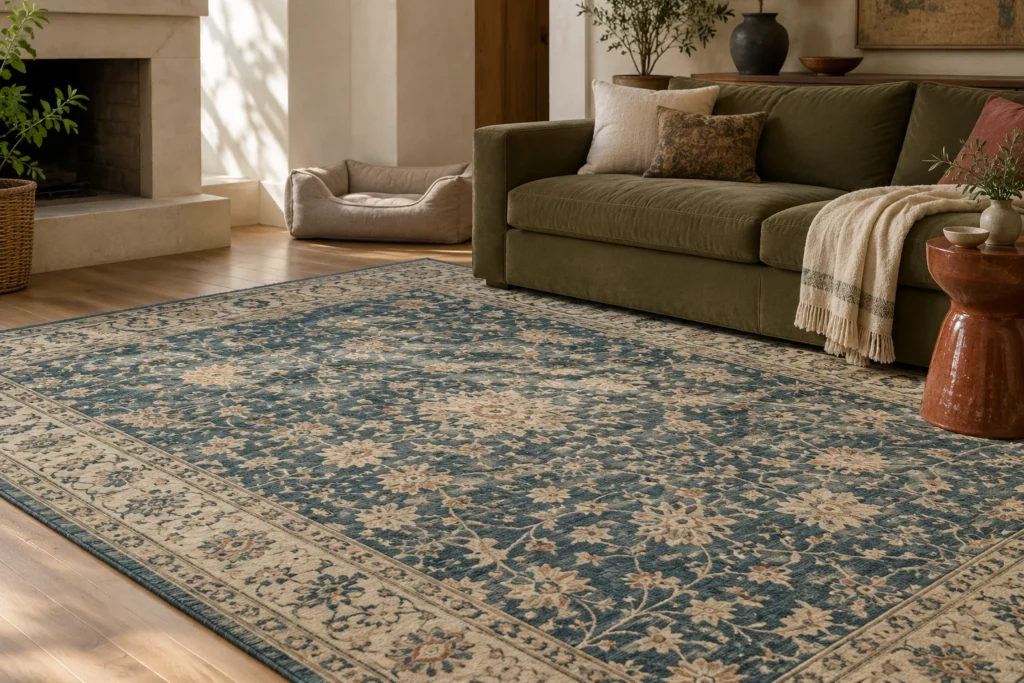
If your dog has just peed on a wool rug, blot immediately with clean white towels. Do not scrub, soak the rug, or reach for a steam cleaner. Check the rug’s care instructions before adding water or a cleaning product. Old stains, lingering odor, wet backing, and color transfer call for a wool-rug specialist.
The difficult part is deciding how far to go after blotting. A small surface accident on a modern, colorfast rug is different from urine that has reached an antique rug’s foundation. The same bottle and procedure cannot safely cover both.
This research-based guide explains how to clean dog urine from a wool rug cautiously, where home care stops, and what to ask a professional. It draws on textile-care organizations and manufacturer guidance; we have not physically tested cleaning treatments.
Start here: fresh accident, old stain, or deeper contamination?
Use the condition of the rug to choose your next step. The visible mark does not necessarily show the full contaminated area. Check the reverse and pad only if you can do so without dragging, stretching, or sharply folding a wet or fragile rug.
| What you find | Cautious first response | When to stop home treatment |
|---|---|---|
| Fresh, localized wet spot | Blot with dry white towels; check the care label before further treatment. | Color transfers, the spot spreads, or the underside is wet. |
| Dried or older stain | Photograph it and collect the rug’s care details and previous cleaning history. | Arrange professional assessment before trying stronger products. |
| Persistent or returning odor | Check the rug, pad, and floor as separate possible sources. | Odor remains after drying or returns after surface cleaning. |
| Wet backing, foundation, or pad | Protect the floor, keep the area accessible, and contact a rug specialist promptly. | Do not keep pouring cleaner through the rug to reach deeper layers. |
| Antique, valuable, fragile, or color-sensitive rug | Carefully absorb fresh liquid without rubbing. | Seek specialist or textile-conservation advice before wet treatment. |
How to clean dog urine from a wool rug after a fresh accident
Absorb the liquid before choosing a cleaner
Keep your dog away from the area. Lay plain white absorbent towels over the wet spot, press gently, and lift them straight up. Change to a clean, dry section as it takes up moisture. Work inward from the edges rather than spreading the liquid across clean pile.
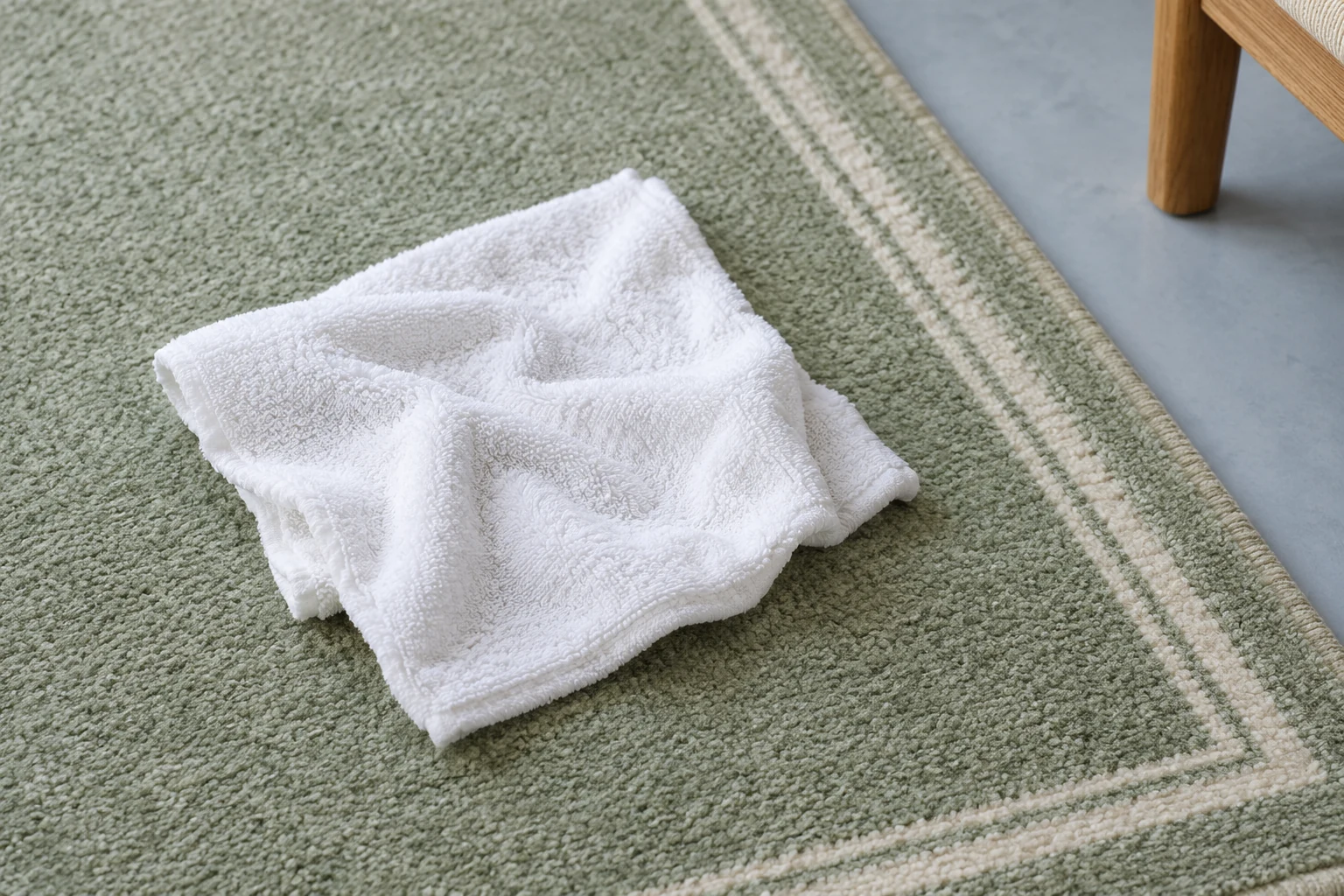
WoolSafe’s carpet and rug care guide recommends blotting rather than rubbing and applying small quantities of spot remover to a cloth rather than directly to the rug. The aim at this stage is to remove liquid, not work a treatment deep into the fibers.
Watch the towel. A color resembling the rug’s pattern, rather than simply the spill, is a reason to stop adding moisture and call for advice. Do not keep rubbing to see whether the color transfer clears.
Check whether limited damp blotting is permitted
Find the care label or the manufacturer’s instructions for the exact rug. “Wool” may describe only its pile; silk, viscose, cotton, jute, adhesives, or other materials may also be present. A professional-clean-only instruction takes precedence over a general internet method.
If the maker permits water-based spot care and the rug is in sound condition, use a white cloth lightly dampened with cool water, followed by a dry towel. Do not pour water onto the spot. Stop if the color, texture, or shape changes. If the instructions are missing or unclear, continue dry blotting and ask the seller or cleaner before proceeding.
This is limited first aid, not proof that the urine has been removed throughout the rug. Wool-carpet instructions such as Cormar’s care guide distinguish damp-cloth application, approved spot treatments, residue removal, and drying. Those steps still need to fit your particular area rug.
Use a compatible product only when its directions fit the rug
If a mark remains, do not automatically move to a stronger cleaner. Verify the product as described below, follow its actual dilution and contact instructions, and test as directed in an inconspicuous area. Let the test dry before judging color and texture. A successful small test reduces uncertainty; it does not guarantee that a contaminated section will behave identically.
If the product requires saturation but your rug’s instructions prohibit it, the instructions conflict. Ask for a suitable alternative rather than inventing a shorter contact time or weaker mixture.
Remove remaining moisture and allow drying
After any permitted treatment, remove residue according to the product and rug instructions, using controlled damp blotting rather than flooding. Blot with fresh dry towels, then allow ordinary room airflow. Avoid hot hair dryers, radiators, or steam as shortcuts.
Do not leave a saturated towel covering the spot indefinitely. Keep traffic off the area until the rug and anything beneath it are dry. If the reverse or pad remains damp, arrange help rather than repeatedly treating the surface. There is no dependable drying deadline for every rug, room, and amount of liquid.
Why urine stains and odors can persist
Urine creates two related problems: material left in the rug and possible changes to the rug itself. Removing contamination cannot necessarily restore altered dye or weakened fibers.
The Carpet and Rug Institute’s technical bulletin explains that urine can change carpet dyes immediately or over time, and that results depend on the urine, dyes, finish, and elapsed time. Moisture can also weaken bonds between backing layers. Its general carpet-cleaning recipes should not be treated as permission to use them on every wool rug.
Depth matters as much as appearance. Rug-care specialist Lisa Wagner describes how urine can reach the internal cotton foundation of a wool rug in her discussion of rug odors. A cleaner that improves the surface may leave that deeper source untouched.
A lighter patch after cleaning is not necessarily a removable stain that needs another application. It may represent lost color. Likewise, a pleasant fragrance is not evidence that contamination has been removed.
What to do about dried stains and lingering smell
For an old dog urine stain on a wool rug, start with assessment rather than rewetting. The IWTO Wool Carpet Care Guide, developed in consultation with WoolSafe, specifically directs old urine stains to a professional cleaner. Fresh urine receives a different treatment sequence.
Photograph the spot in ordinary daylight. Record when you noticed it, whether accidents have happened there before, and every cleaner already used. Keep the bottle or photograph its label. This history helps a cleaner distinguish remaining urine from dye change, product residue, or another problem.
For lingering odor, tell the cleaner whether it seems strongest at the pile, underside, or pad, and whether it returns after the rug has dried. Do not repeatedly soak an apparently clean surface simply because the smell remains.
The IICRC’s consumer care information notes that aged urine may cause irreversible fiber and dye changes. Professional treatment can improve a rug without restoring its original appearance. Agree separately on the likely outcome for odor and for visible discoloration.
A UV light can assist a professional’s inspection, but it is not a reliable home pass-or-fail test for successful cleaning. The IICRC notes that fluorescence can remain after urine treatment; a glowing area alone does not prove that cleaning was incomplete.
Are enzymatic pet cleaners safe for wool?
Some formulations can be suitable; others are explicitly unsuitable. Never assume that an enzymatic cleaner is safe for wool merely because it removes pet urine.
Wool is a protein fiber. In WoolSafe’s discussion of enzyme cleaners (page 15), Dr. Agnes Zsednai explains that research led the organization to move away from a blanket enzyme ban. She also warns that unsuitable concentrations and prolonged contact can damage wool. Approval depends on the formulation, and use must follow its instructions.
For a concrete counterexample to blanket safety claims, the US directions for Nature’s Miracle Urine Destroyer for Dogs exclude wool specialty fabrics. That is an exclusion to respect, not something a hidden-area test overrides. Check the label on your exact bottle because products and regional formulations differ.
Before buying or applying a cleaner, verify:
- Explicit suitability for wool carpets or rugs, with no conflicting exclusions.
- The exact product’s current listing in the WoolSafe consumer product directory, where applicable.
- Compatibility with the rug’s other fibers, dyes, backing, and care instructions.
- Whether the product is intended for consumer spot treatment or professional equipment.
- Required testing, dilution, contact time, rinsing, drying, and pet re-entry instructions.
“Natural,” “pet-safe,” “pH-balanced,” and “safe on carpets” do not answer all those questions. Nor does the approval of one product establish the safety of every bottle from the same brand.
Woolmark’s laundry guidance warns against enzyme-containing biological detergents and bleach when washing wool clothing. That is useful fiber-care context, but it is not a rug spot-cleaning recipe or a reason to substitute sweater detergent for an approved rug product.
Why common DIY remedies can be risky
Bleach, peroxide, ammonia, and strong alkalinity
Do not use chlorine bleach on the rug. Oxygen-based laundry treatments and household hydrogen peroxide are also poor experiments on colored wool: apparent stain removal can include unwanted color loss. The IICRC’s peroxide advice specifically excludes wool and other natural fibers without extensive testing for color loss.
Skip ammonia-based household cleaners and strong alkaline degreasers. University of Georgia Extension identifies wool’s vulnerability to strong alkalies, including ammonia. A general carpet remedy should not override that material-specific concern.
Vinegar and baking soda
Neither is a universal solution for dog pee on a wool rug. Some carpet-care protocols use controlled acidic treatments, but that does not validate an improvised vinegar concentration for an unknown rug. A cleaner needs to account for the dye, contamination, and previous treatments.
Our conservative recommendation is to skip homemade mixtures and baking-soda pastes unless the rug manufacturer explicitly supplies that method. Fizzing, a temporary change in smell, or a powder-covered stain does not demonstrate removal from the foundation. Do not layer remedies over a commercial product or mix cleaners.
Soaking, scrubbing, and steam
More water can spread the affected area and leave deeper layers difficult to dry. Scrubbing adds mechanical stress and can alter the pile. Stop if the surface becomes fuzzy or distorted; our wool rug shedding guide explains why new fiber loss deserves assessment rather than more brushing.
A household vapor steamer is not a suitable first response to urine. Professional hot-water extraction is a different process, but it is not automatically appropriate for every rug or sufficient for contamination in the foundation. Our wool rug steam-cleaning guide explains that distinction. A rental machine should not be the default next step.
Construction, backing, and the floor beneath
Fiber content is only part of the decision. Our wool rug guide covers the broader construction differences; for a urine accident, these are the practical implications:
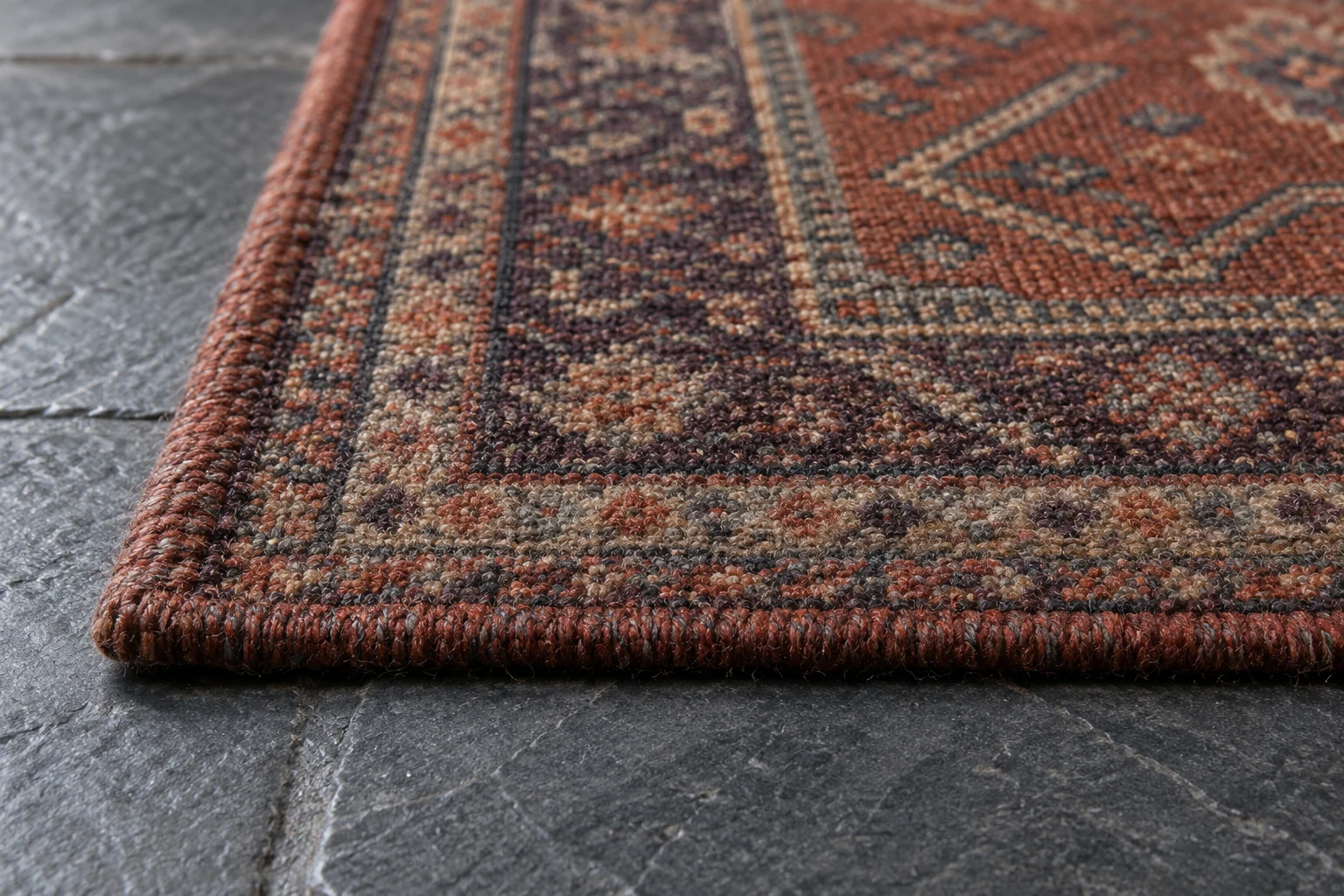
- Hand-knotted: the pile and structural foundation both need assessment. A wool pile may sit on cotton foundation yarns; check dyes, repairs, and condition before wet cleaning.
- Hand-tufted: adhesives and a secondary backing commonly hold the structure together. Contamination in those layers can complicate odor treatment and limit suitable washing.
- Flatwoven: a thinner rug can still transmit liquid to the pad or floor. Lack of deep pile does not make its dyes or fibers washable.
- Machine-made: construction and backing vary. Machine production alone does not establish compatibility with a household extractor.
Inspect beneath the rug if it can be moved safely. A contaminated pad may need replacement; a washable one needs its own approved cleaning method. Treat the floor according to its finish and manufacturer instructions, not automatically with the rug cleaner.
For a fragile or historic rug, avoid experimental wet testing. The Canadian Conservation Institute treats cleaning historic textiles as an irreversible intervention and advises against washing historic wool textiles within its home-style washing guidance. A textile conservator can help balance contamination removal against preservation.
When to call a professional—and what to ask
Call promptly for wet backing, recurring odor, old stains, dye transfer, weakened areas, or a valuable rug. Room & Board’s wool-rug instructions, for example, recommend professional cleaning for set-in stains. Do not wait for multiple failed home treatments.
Look for documented experience with your construction and urine contamination. The WoolSafe directory offers a starting point; confirm that the business handles area rugs like yours.
Ask how the cleaner will assess dye stability, identify affected layers, select treatment, and verify drying. Ask whether off-site work is needed, what happens to the pad, and whether color change may remain. A proposed immersion wash needs to be justified for that rug; it is not universally safe.
Request an estimate that distinguishes cleaning from backing repair, color restoration, or pad replacement. Keep children and pets away during treatment and follow the product’s re-entry directions.
Frequently asked questions
Can dog urine permanently damage a wool rug?
Yes, it can change dyes, weaken fibers, or affect backing, although not every accident causes permanent damage. Prompt absorption helps, but neither home treatment nor professional cleaning can guarantee restoration.
Can I use vinegar to remove dog urine smell?
Do not use a general vinegar recipe on an unidentified wool rug. Suitability depends on the rug and the treatment already applied. Persistent odor needs assessment of deeper contamination, not simply another deodorizing application.
Can I leave an enzyme cleaner on wool overnight?
Not as a general rule. Use only a verified compatible formulation and follow both product and rug instructions. Do not extend contact time, change dilution, or saturate the rug to make an unsuitable product work.
Will baking soda remove an old urine stain?
It should not be relied on to remove old contamination or restore changed dye. An old stain belongs on the professional-assessment route, especially when odor persists or the rug’s construction is unknown.
Why does my wool rug still smell after cleaning?
Urine may remain in the foundation, backing, pad, or floor. Other odor sources are also possible. Ask a specialist to identify the source before repeating treatment; a clean-looking surface is not enough to judge the whole rug.
How can I reduce repeat accidents and damage?
Restrict access while the area is treated and dries, respond promptly to new accidents, and keep white towels and the rug’s care instructions handy. Address recurring house-soiling with appropriate veterinary or training advice. Do not treat a rug spray as a substitute for solving the cause.