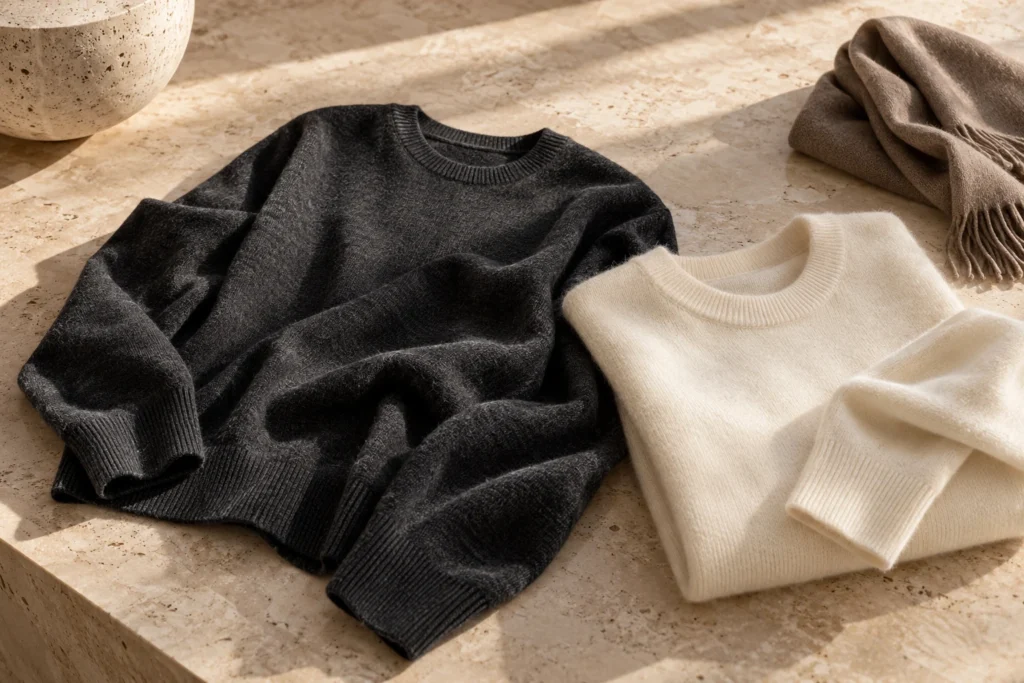
Choose Merino wool first when you want a base layer or a sweater with a documented care routine that fits frequent wear. Choose cashmere when the feel and drape of a particular sweater or scarf justify its price and maintenance for you. Neither fiber name guarantees the softer, warmer or longer-lasting garment.
The useful way to compare Merino wool vs cashmere is to start with what you are buying. A thin hiking top, a substantial winter sweater and a scarf have different jobs. Compare equivalent garments, then check composition, construction, fit and care before paying for the label.
This is a research-based comparison using textile guidance and manufacturer specifications. The product examples illustrate buying choices; they have not been physically tested for this article.
Merino wool vs cashmere at a glance
| Buying question | Merino wool | Cashmere |
|---|---|---|
| Fiber source | Fleece of Merino sheep | Fine undercoat of cashmere goats, separated from coarse guard hair |
| Fineness | Woolmark describes a typical span from below 17.5 to about 22–24 microns | US labeling requires an average diameter no greater than 19 microns, alongside other criteria |
| Garments to compare | Base layers, sweaters, cardigans and accessories | Sweaters, cardigans, scarves and other accessories |
| Softness | Fine Merino can suit direct skin contact | Often chosen for a soft handle; assess the actual garment |
| Warmth | Depends on the finished fabric and garment | Also depends on the finished fabric and garment |
| Care | Some items allow machine washing; others require gentler methods | Some allow hand washing; others specify professional cleaning |
| Price tendency | Often costs less than cashmere in comparable knitwear | Commonly carries a premium, without guaranteeing better construction |
| Main buying check | Does the garment suit your activity and washing routine? | Is its feel, construction and likely use worth the total cost? |
The fineness entries use Woolmark’s fiber guidance and the FTC’s cashmere definition. They are not matching quality grades: one describes a typical range, while the other is a labeling threshold.
Start with the garment you need
Merino comes from sheep; cashmere comes from a goat’s fine undercoat. For the breed, geography and production story, see where Merino wool comes from. Those origins identify the material, but they do not settle a purchase.
For a sweater worn over a shirt, look closely at fit, cuffs, seams and how the knit sits beneath your jacket. For a base layer, prioritize freedom of movement, seam placement, fabric weight and washing instructions. For a scarf, consider neck comfort, width and bulk under a coat.
A fair comparison also needs the full composition. A Merino blend containing nylon is a different proposition from a pure Merino sweater. Likewise, a garment with a small cashmere percentage should not be evaluated as if it were entirely cashmere. Read the percentages before comparing prices.
Softness depends on fineness and finishing
Cashmere can feel exceptionally soft, but it is not automatically softer than every Merino garment. The diameter ranges overlap: the FTC specifically notes that some sheep produce fibers comparable in diameter to cashmere.
Finer wool fibers generally bend more readily against the skin, which helps explain their use in close-fitting clothing. That makes a disclosed micron measurement useful when comparing similar products. It does not tell you everything about the finished surface, seams or your own sensitivity.
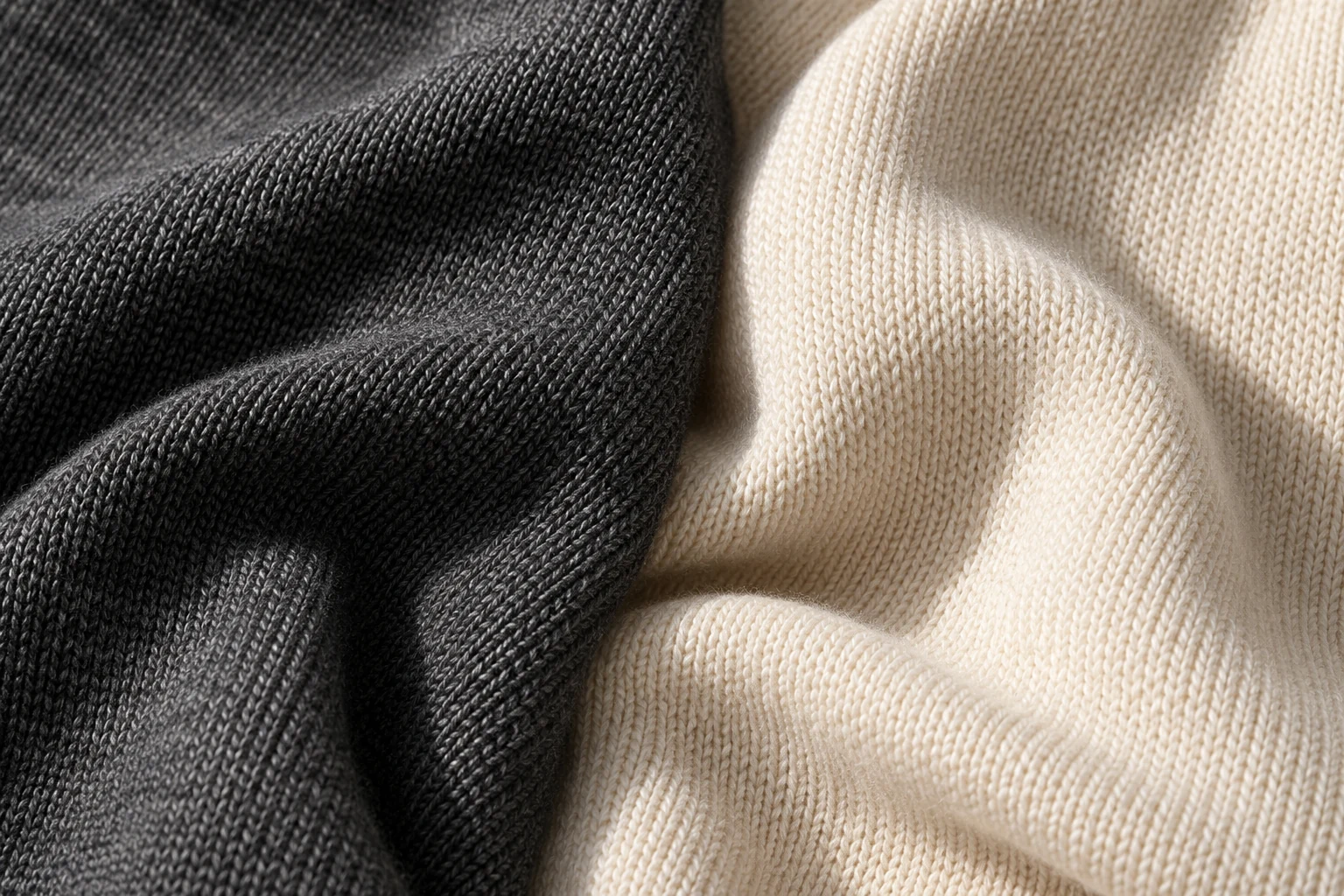
Yarn construction, knit structure and finishing also affect the feel. A smooth, compact knit and a brushed, fluffy knit can feel different even when their fiber labels match. A soft first touch alone does not establish resistance to pilling or years of wear.
If neck comfort is the deciding factor, try the actual neckline or scarf against your neck before committing, within the seller’s return conditions. Online, favor clear fabric information and a workable return policy over an unqualified promise that a material is itch-free.
Warmth and breathability depend on construction
Neither cashmere nor Merino has a universal warmth advantage across finished garments. Fabric thickness, loft, knit openness, coverage and fit all deserve attention. A lightweight top intended for layering should not be treated as an equivalent to a thick sweater simply because both contain wool.
There is direct evidence that construction matters within cashmere itself. A 2024 study of cashmere knitted fabrics found that changing knit type, tightness and yarn ply affected thermal comfort properties. Those laboratory results do not rank the sweaters in a shop, but they show why one fiber name cannot supply the answer.
Merino’s ability to absorb moisture vapor is documented in Woolmark’s breathability guidance. That is useful context for base layers, not proof that every Merino garment dries faster or feels cooler than cashmere. Airflow through a fabric, moisture absorption and drying speed are different questions.
For walking or travel, check whether you can adjust layers as activity changes. For cold, mostly seated use, compare substantial knits with adequate coverage. If a listing gives grams per square meter, use that as fabric-weight information—not a temperature rating. Total garment weight is a different measurement and changes with size and design.
Pilling and durability need a closer look
Both Merino and cashmere can pill. Pilling occurs when surface fibers become entangled into small balls, often where clothing rubs during wear. Woolmark’s pilling guidance identifies friction as a cause and highlights fiber length, yarn twist and fabric construction as relevant design choices.
This creates a trade-off worth investigating rather than guessing from softness. Ask whether the brand explains its yarn or construction, and examine areas likely to rub against bags, sleeves or a desk. A very fine fashion knit and a garment designed for repeated active use may need different treatment, regardless of their fiber names.
Wool’s natural crimp contributes to stretch and recovery. That fiber property does not promise that every Merino cuff will hold its shape better than cashmere. Rib structure, seams, fit and care still matter. Choose a size that does not put constant strain on the fabric and inspect joins for obvious gaps or distortion.
Some pilling is a maintenance issue rather than proof that a garment is unusable. Follow the maker’s instructions before using a comb or fabric shaver, work gently and avoid repeated aggressive removal. No evidence in this comparison supports a fixed lifespan or a universal durability winner.
Read the care label before buying
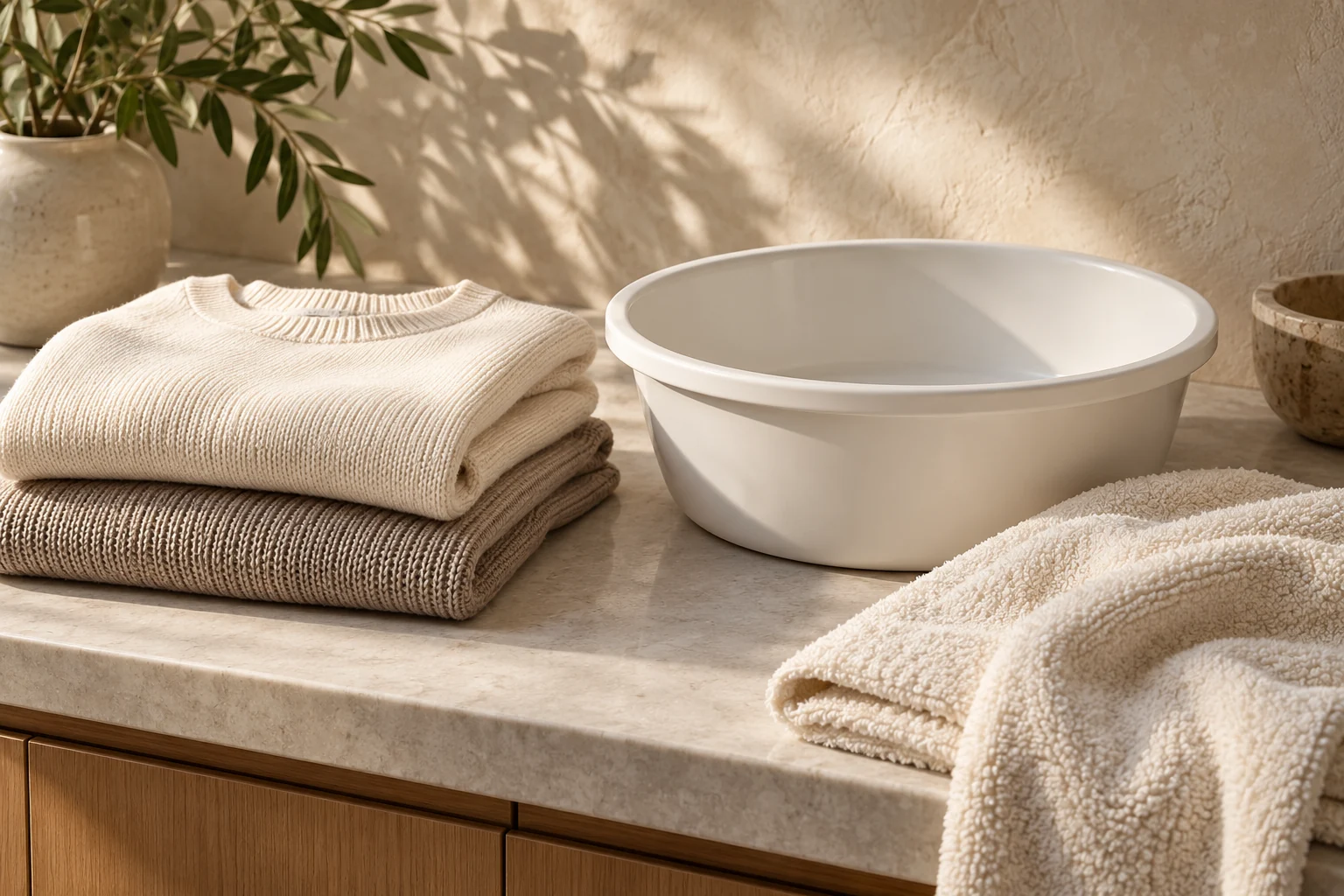
The easier garment to own is the one whose instructions you can follow. Hand washing, a machine wool or gentle cycle, drying flat, line drying and professional cleaning are not interchangeable permissions.
Check washing temperature, cycle, detergent, drying and ironing separately. A machine-washable label does not automatically permit a tumble dryer. A blend is not automatically machine washable, and 100% cashmere is not automatically dry-clean-only.
The FTC distinguishes “Dry Clean Only,” which warns against washing, from “Dry Clean,” which is not the same prohibition. If the label gives no washing method, ask the manufacturer before experimenting. For a garment that explicitly permits washing, select a detergent suitable for that textile and method.
Woolmark recommends a mild, neutral detergent for wool and advises against heavy-duty, enzyme-containing “bio” detergents and bleach. Our best wool detergent guide compares specific options for washable wool, Merino and cashmere. The detergent cannot override the garment’s care label.
Treat these instructions as part of the purchase price. If a sweater needs a routine you will consistently postpone, a different garment may offer better value even if the fiber itself appeals to you.
Three US product examples that show the differences
These examples were checked on October 12, 2026. Each had an active US product listing; size and color availability can change. They illustrate specifications and care choices, rather than a performance ranking.
UNIQLO cashmere sweater
The UNIQLO Women’s Cashmere Sweater is listed as 100% cashmere. Its instructions allow cold hand washing or dry cleaning. The checked page identifies product 485318 and also references 479160, so confirm the item received against its own label.
This is a useful example of cashmere knitwear that permits washing at home. The listing does not establish its superiority in softness, warmth or durability over another sweater, and it supplies no weight or gauge used in this comparison.
Icebreaker Merino 200 Oasis base layer
The Icebreaker Women’s Merino 200 Oasis Long Sleeve Crewe Thermal Top, style IB104375401, uses 100% Merino wool, excluding decoration. The page specifies 18.9-micron fiber, a slim fit and a small-size garment weight of 183 grams.
Its care instructions require a cold gentle machine wash and line drying in shade, with no fabric softener, bleach, tumble drying or dry cleaning. Consider it as a documented base-layer example; its total garment weight is not directly comparable with another fabric’s grams-per-square-meter figure.
Smartwool Classic All Season Merino base layer
The Smartwool Women’s Classic All-Season Merino Base Layer Crew, style SW016912, is 88% Merino wool and 12% recycled nylon, excluding decoration. The listing gives a fabric weight of 150 g/m² and describes a recycled-nylon core with Merino next to the skin.
Its label permits a warm gentle machine wash and low tumble drying, and prohibits bleach and dry cleaning. That differs materially from the Icebreaker instructions. The nylon construction is a reason to investigate this blend for repeated use, not independent proof that it will outlast the pure-Merino example.
Compare price with the use you will get
Cashmere often commands a premium. The Cashmere and Camel Hair Manufacturers Institute describes a limited annual underdown yield and processing that includes sorting and removal of coarse guard hair. These supply and production demands help explain cost, alongside fiber selection, yarn, knitting, finishing and retail positioning.
Finer fiber is one specification, not a complete value calculation. A higher price does not reveal how much material is in a sweater, how well it is assembled or whether it suits your wardrobe.
The US listings checked for the examples showed $120 for the Icebreaker top and $100 for the Smartwool top. UNIQLO’s current page did not reliably expose a price during this check. These are dated, product-specific snapshots, before tax or delivery, not a market range or a like-for-like price test.
Compare similar garments at the price you can actually buy them. Include cleaning costs, delivery and possible return charges. A sweater you can comfortably wear and care for every week may be better value than a more prestigious fiber that rarely leaves the drawer.
Look for specific sourcing evidence
Neither “Merino” nor “cashmere” is an animal-welfare certification. For wool, the Responsible Wool Standard covers animal welfare, land management and social requirements, with chain-of-custody controls. For cashmere, The Good Cashmere Standard addresses goat welfare, people, the environment and management.
Look for a claim that applies to the particular product, and read what the named standard covers. A general brand commitment does not establish certification for every item. These standards also do not rate a sweater’s softness, warmth or resistance to pilling. No certification claim is assigned to the three product examples here.
Which material should you choose
For a base layer or active travel: Start with purpose-designed Merino or Merino-blend garments that disclose fabric weight, fit and care. Compare seam placement and whether the washing and drying routine works during your trip.
For an everyday sweater: Compare both materials in the same cut and approximate weight. Merino is worth investigating when it offers the care routine and price you want; cashmere earns consideration when the particular knit’s feel and drape matter enough to you.
For a scarf or occasional piece: Cashmere can be a worthwhile purchase if you like the actual fabric and will maintain it. Fine Merino remains a valid alternative. Check dimensions and skin comfort rather than buying by fiber reputation alone.
For a blend: Read every percentage and the reason for the construction. A small cashmere addition does not promise the feel of pure cashmere, while synthetic content can serve a specific design purpose. Evaluate the finished item on its own terms.
Frequently asked questions
Is cashmere warmer than Merino wool?
Not necessarily in the garments you are comparing. Knit structure, thickness, loft, coverage and fit affect insulation. Cashmere can make warm knitwear, but its name alone does not establish a warmth advantage over a particular Merino garment.
Is Merino wool less itchy than cashmere?
There is no reliable universal ranking. Fiber fineness matters, and fine Merino overlaps with cashmere in diameter. Your response to the actual fabric, neckline and seams is more useful than a general itch-free claim.
Does cashmere pill more than Merino?
Either material can pill. Fiber characteristics, yarn twist, construction and friction affect the outcome. Without comparable testing of the garments, the labels alone do not justify a definite pilling ranking.
Can Merino and cashmere go in the washing machine?
Only when each garment’s instructions permit it. Some Merino pieces allow machine washing, while others do not. Some cashmere garments permit hand washing. Match the cycle, temperature and drying method to the individual label.
Is a Merino cashmere blend worth buying?
It can be, if its composition, feel, construction and care suit your needs at the offered price. Check the cashmere percentage rather than assuming the word “blend” guarantees luxury, durability or easy washing.
Is cashmere worth the extra money?
It can justify a premium when you prefer the specific garment and expect to use it enough. Compare construction, fit, return conditions and care costs. Price and fiber purity do not, by themselves, establish better value.
The most useful Merino wool vs cashmere decision ends with a garment you understand: what it contains, how it is made, when you will wear it and how you will care for it. Let those answers determine the purchase.