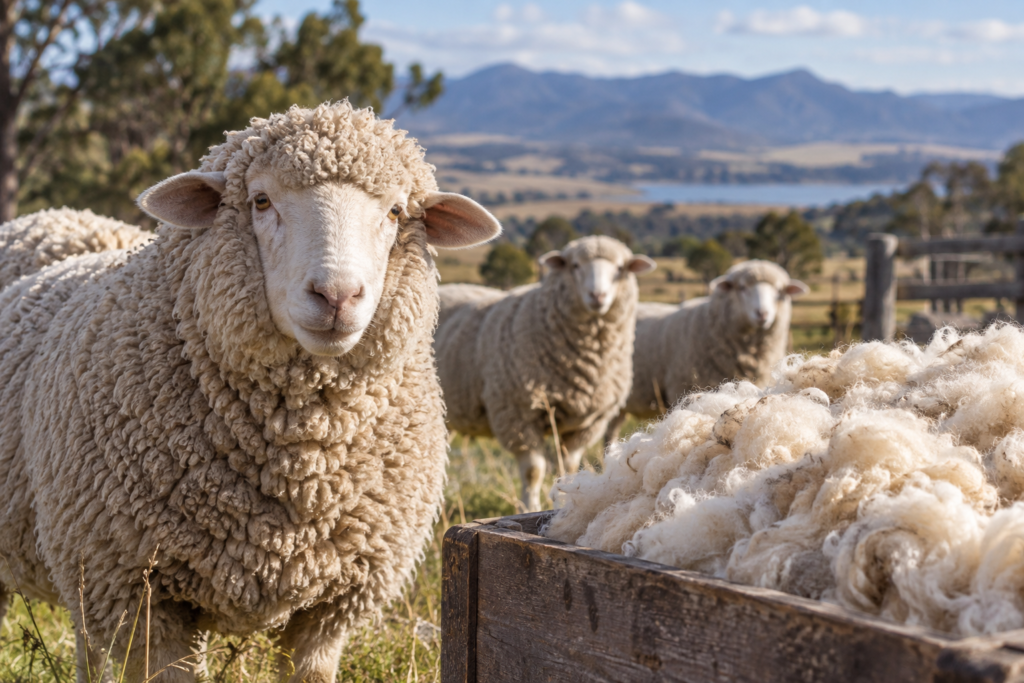
Merino wool is everywhere, from lightweight sweaters and base layers to blankets, socks, and other textiles. But its name can be a little misleading. Is Merino a type of wool, a place, or a particular breed of sheep? And does all Merino wool come from Australia?
The short answer is that Merino wool comes from Merino sheep. The breed has historical roots in Spain, while today Merino sheep are raised in several wool-producing regions around the world. Australia has become especially closely associated with Merino wool and is now a major source of the fine Merino used in clothing and other textiles.
Understanding where Merino wool comes from also helps explain what makes it different from many other types of wool. Its fine fibre diameter, the history of the breed, and the way Merino sheep have been selectively bred all play a role in the wool we know today.
Where Does Merino Wool Come From?
Merino wool comes from the fleece of Merino sheep, a breed known for producing particularly fine wool fibres. Like other sheep’s wool, Merino is a natural, protein-based fibre made largely from keratin. What distinguishes it is not that it is made from a different material, but that Merino sheep generally produce much finer fibres than many other wool-producing breeds.
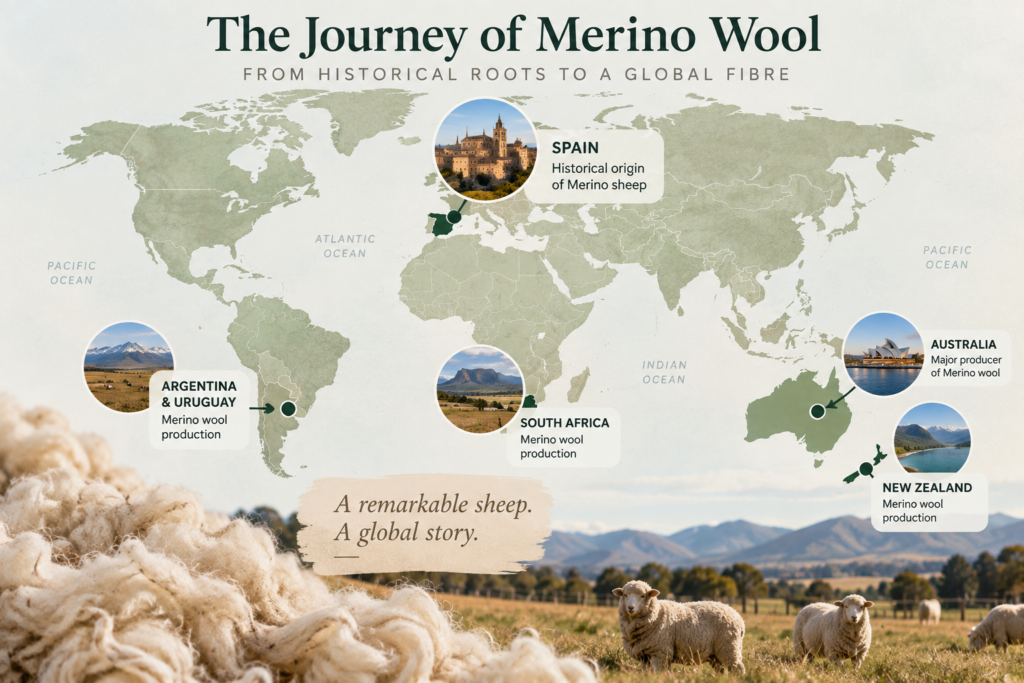
Historically, the Merino breed developed in Spain, where fine-wool sheep became highly valuable. Merino sheep later spread beyond Spain, including to South Africa and Australia. Selective breeding in Australia subsequently played a major role in the development of the modern Merino wool industry.
Today, Merino wool does not come from one country alone. Australia is strongly associated with modern Merino production, but fine wool is also produced in countries including New Zealand, South Africa, Argentina, Uruguay, and the United States. So when a product is labelled “Merino wool,” the term identifies the type of sheep and fibre, not automatically the country where that wool was produced.
What Is Merino Wool Made Of?
Merino wool is made from the fleece of Merino sheep. It is a natural animal fibre, not a synthetic material, and like other types of sheep’s wool, it is composed mainly of a protein called keratin.
What makes Merino distinctive is largely the fineness of its fibres. Fibre diameter is measured in microns, and finer wool generally feels softer against the skin than coarser wool. This is one reason Merino is widely used for garments and other products designed for close contact with the body.
The exact characteristics of Merino wool can still vary. Not every Merino fleece has the same fibre diameter, length, strength, or quality, and the finished textile also depends on how the wool is processed, spun, woven or knitted. In other words, seeing “Merino wool” on a label tells you where the fibre comes from, but it does not mean that every Merino product will feel or perform exactly the same way.
Merino wool can also be blended with other fibres. A product labelled 100% Merino wool indicates that its fibre content is Merino wool, while a Merino blend may also contain fibres such as cotton or synthetics. We’ll look more closely at what the “100% Merino” label means later in this guide.
Where Did Merino Sheep Originally Come From?
Merino sheep are most closely associated today with countries such as Australia, but the breed’s history goes back much further. Merino sheep have deep historical roots in Spain, where fine-wool sheep were carefully bred and became highly valued for the quality of their fleece.
For centuries, Spain played an important role in the development of Merino sheep and tightly controlled the export of valuable breeding animals. Over time, however, Merino sheep began to spread beyond Spain and were introduced into other parts of Europe and eventually to wool-producing regions farther abroad.
Merino sheep reached Australia in the late 18th century. From there, selective breeding and adaptation to local conditions helped shape the Australian Merino and contributed to the growth of the country’s fine-wool industry.
This history explains an important distinction: Merino sheep did not originate in Australia, even though Australia later became one of the countries most strongly associated with Merino wool production.
So when people ask where Merino wool originally comes from, the historical answer points to Spain and the development of the Merino breed there. Where Merino wool is produced today, however, is a much broader story.
Where Is Merino Wool Produced Today?
Merino sheep are now raised in several parts of the world, so modern Merino wool production is no longer tied to the breed’s historical origins in Spain. Climate, breeding programs, farming conditions, and the type of wool being produced all influence where Merino flocks are found today.
Australia
Australia is particularly well known for Merino wool and has developed a large fine-wool industry around Merino sheep. Generations of selective breeding have produced different Merino types suited to varying environments and intended uses.
This strong association is why consumers often connect the word “Merino” with Australia. However, an important distinction remains: Merino describes the sheep breed and its wool, not a country of origin.
New Zealand
New Zealand also raises Merino sheep, particularly in areas suited to fine-wool production. The country produces several types of wool, so not all New Zealand wool is Merino. Different sheep breeds and wool characteristics are used for different textile applications.
South Africa and Other Producing Regions
South Africa has a long history of Merino sheep farming and remains another source of fine wool. Merino and fine-wool production can also be found in countries including Argentina, Uruguay and the United States, among others.
This means the answer to “Where does Merino wool come from in the world?” depends partly on the individual product. A Merino sweater, blanket or other textile may contain wool grown in Australia or another Merino-producing region.
If the geographic origin matters to you, look beyond the word “Merino” on the label. Product information, certification or traceability details may provide more specific information about where the wool was grown and processed.
Why Is Australia So Closely Associated With Merino Wool?
To understand where Merino wool comes from today, it helps to look at why Australia became so closely associated with the fibre. Merino sheep arrived in the country in the late 18th century, and over generations, breeders selected sheep for traits suited to Australian conditions and for the production of fine wool. Over generations, breeders selected sheep for traits suited to Australian conditions and for the production of fine wool, helping Merino become an important part of the country’s wool industry.
Australia’s climate and large grazing areas also allowed sheep farming to expand on a significant scale. Over time, the country developed extensive expertise and infrastructure around wool growing, classing, selling and processing for international markets.
That history helps explain why Australian Merino wool is so familiar to consumers today. But the association can sometimes create a misconception: Merino is not an Australian-invented fibre, and the word “Merino” by itself does not mean that a product contains Australian-grown wool.
The term refers to wool from Merino sheep. To determine whether a particular product uses Australian Merino wool, you need additional origin or traceability information from the manufacturer rather than relying on the word “Merino” alone.
Does All Merino Wool Come From Australia?
No. Although Australia is strongly associated with Merino wool, Merino sheep are raised in several countries, and their wool can enter textile supply chains from different regions.
Merino wool may come from Australia, New Zealand, South Africa, Argentina, Uruguay, the United States and other locations where Merino or Merino-derived sheep are raised.
It is also useful to separate three different ideas: where the sheep were raised, where the wool was processed, and where the finished product was manufactured. These locations are not necessarily the same.
For example, wool can be grown in one country, processed or spun into yarn in another, and made into a finished garment or home textile somewhere else. That is why a “Made in” label on a finished product does not necessarily identify where the Merino fleece itself was grown.
For shoppers who specifically care about wool origin, detailed sourcing information and traceability provided by the brand or manufacturer are more informative than the word Merino alone.
What Makes Merino Wool Different From Other Wool?
Merino wool is still sheep’s wool, but one of its most notable characteristics is the fineness of its fibres. Merino sheep are known for producing fine wool, while other sheep breeds may produce medium or coarser fibres suited to different purposes.
Fibre diameter is commonly measured in microns. In general, finer fibres bend more easily when they come into contact with the skin, which can make fine Merino wool feel softer than many coarser types of wool. This is one reason Merino is commonly used for clothing, base layers, socks and other textiles worn close to the body.
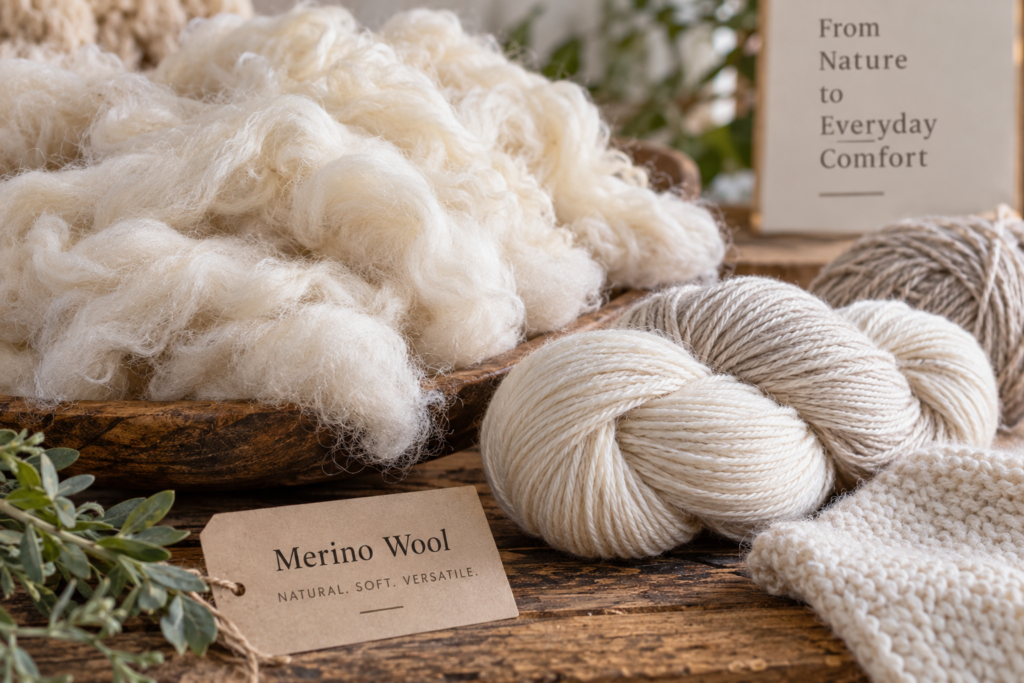
Merino fibres also have the natural crimp and elasticity associated with wool. These characteristics can help wool yarns and fabrics recover from compression and contribute to their texture and structure.
However, the word “Merino” should not be treated as an automatic guarantee of identical quality. Merino wool can vary in fibre diameter, length, strength and processing, while the construction of the finished textile also affects how it feels and performs.
A fine Merino knit designed for clothing, for example, is a very different product from a heavier woven wool blanket. Both may contain Merino wool, but fibre selection, yarn construction, fabric weight and manufacturing all influence the final result.
Is Merino Wool the Same as Regular Wool?
Merino wool is a type of wool, but not all wool is Merino wool.
The word wool generally refers to fibre obtained from sheep, and many different sheep breeds produce it. Merino wool refers more specifically to wool obtained from Merino sheep.
Other sheep breeds can produce wool with different fibre diameters, lengths, strengths and textures. Coarser and stronger wool, for example, can be useful for products where durability and structure matter, including certain carpets and rugs. If you’re comparing wool for the home, our Wool Rugs Guide explains how fibre, construction and pile can affect the finished rug. Finer wool is more commonly associated with products where softness against the skin is important.
So the difference is not that Merino and wool are two completely separate materials. A better way to think about it is:
Wool = the broader fibre category.
Merino wool = wool produced by Merino sheep.
That distinction is also useful when reading product labels. A product described simply as “100% wool” is not necessarily made from Merino wool unless the manufacturer specifically identifies the fibre as Merino.
How Does Merino Fleece Become Wool Fabric?
After Merino wool is shorn from the sheep, the fleece goes through several stages before it becomes yarn or fabric. The exact process can vary depending on the intended product, but it generally begins with sorting and cleaning the raw wool to remove wool grease, dirt and other unwanted material.
The cleaned fibres are then prepared for spinning. Processes such as carding help separate and organize the fibres, while some wool intended for worsted yarns goes through additional preparation to create a smoother, more aligned fibre arrangement.
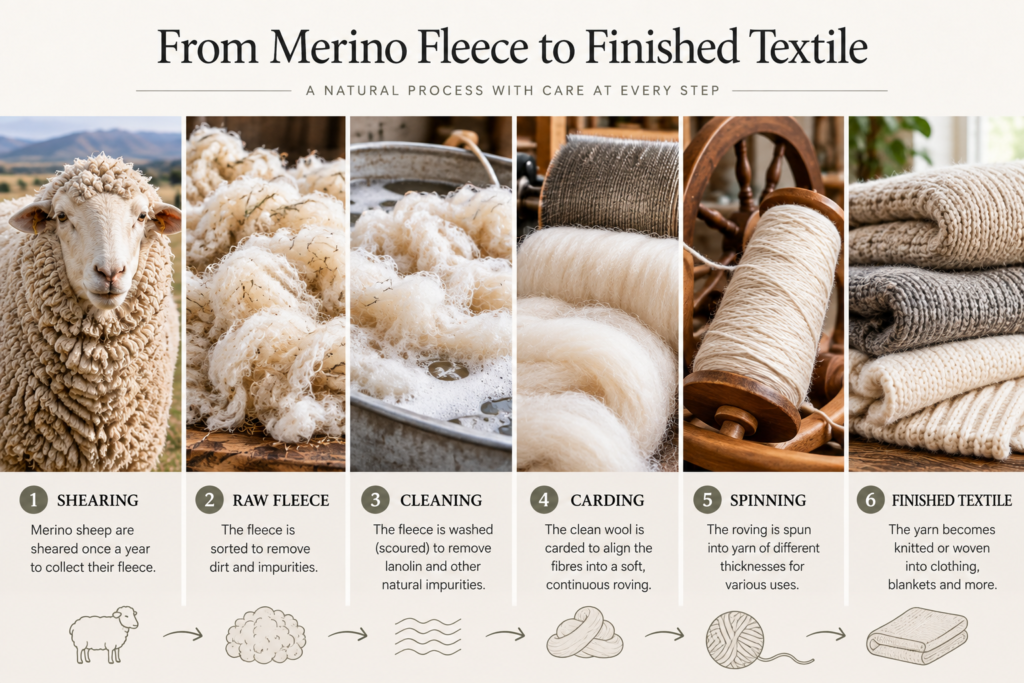
The prepared wool is spun into yarn, which can then be knitted or woven into finished textiles. Depending on the fibre, yarn and construction, Merino wool can be used in products ranging from lightweight clothing and socks to blankets and other home textiles.
If you want to see this process in more detail, our Where Does Wool Come From? guide follows the journey from sheep and raw fleece through cleaning, carding, spinning and finished wool products.
Internal link for “Where Does Wool Come From?”:https://homesteadwoolandgiftfarm.com/where-does-wool-come-from/
What Does “100% Merino Wool” Mean?
When a product is labelled 100% Merino wool, it means the stated fibre content is Merino wool rather than a blend of Merino with another fibre.
That is different from a Merino blend, which may combine Merino wool with materials such as cotton, nylon, polyester or other fibres. Blending can be used to change characteristics such as durability, stretch, weight, drying behaviour or cost, depending on the product.
However, 100% Merino wool does not tell you everything about quality. Two products carrying the same fibre-content description can still feel and perform differently because of differences in fibre diameter, yarn construction, fabric weight, knitting or weaving method, finishing and overall manufacturing quality.
The label also does not automatically tell you where the wool was grown. Unless additional sourcing information is provided, “100% Merino wool” identifies the fibre content rather than guaranteeing that the wool came from Australia, New Zealand or any other particular country.
For shoppers comparing Merino products, it therefore helps to look beyond the percentage alone. Fibre specifications, construction, product weight, care instructions and sourcing information can provide a more complete picture of what you are actually buying.
Common Questions About Merino Wool
Does Merino Wool Come From Sheep?
Yes. Merino wool comes from the fleece of Merino sheep. Merino is not a synthetic fibre or a separate material from wool; it is a particular type of sheep’s wool known especially for its fine fibres.
Is Merino Wool a Natural Fiber?
Yes. Merino wool is a natural animal fibre. Like other sheep’s wool, it is made primarily from the protein keratin and grows naturally as part of the sheep’s fleece.
Where Does the Best Merino Wool Come From?
There is no single country that automatically produces the “best” Merino wool. Australia is strongly associated with fine Merino production, but quality depends on factors such as fibre diameter, length, strength, consistency, processing and the requirements of the finished product.
Rather than judging Merino wool by country alone, it is more useful to look at the specifications and sourcing information provided for the particular product.
Is All Merino Wool Soft?
Merino is known for producing fine fibres that can feel softer against the skin than many coarser types of wool. However, not every Merino product feels identical. Fibre diameter, yarn, fabric construction and finishing can all affect the texture of the finished textile.
Does All Merino Wool Come From Australia?
No. Australia is a major producer and is closely associated with Merino wool, but Merino sheep are also raised in other countries. The word “Merino” identifies the type of sheep and wool rather than guaranteeing a particular geographic origin.
Is 100% Wool the Same as 100% Merino Wool?
No. A product labelled 100% wool can contain wool from sheep breeds other than Merino. A product specifically labelled 100% Merino wool identifies Merino as its stated fibre content.
Final Thoughts
So, where does Merino wool come from? The simplest answer is that it comes from the fleece of Merino sheep. The breed has deep historical roots in Spain, while modern Merino wool is produced in several parts of the world, with Australia playing a particularly important role in today’s fine-wool industry.
Merino is not a completely different material from wool. It is a specific type of sheep’s wool, known especially for its fine fibres. And although the word “Merino” can tell you something about the source of the fibre, it does not automatically tell you where the sheep were raised, where the wool was processed, or how well the finished product was made.
When comparing Merino products, it is therefore worth looking beyond the name alone. Fibre content, construction, sourcing information and the intended use of the finished textile can tell you much more about what you are actually buying.
For a closer look at what happens after wool leaves the sheep, read our Where Does Wool Come From? guide, which follows wool from fleece through processing and into finished textiles.