This article contains affiliate links. If you buy through an eligible link, we may earn a commission at no extra cost to you.
A good wool comforter should keep you comfortably insulated without leaving you hot and clammy overnight. Wool combines insulation with breathability and moisture management, making it an appealing natural alternative to down and synthetic fills. But wool comforters vary considerably in fill weight, construction, washability, and warmth.
After comparing current wool comforters by wool content, fill weight, shell material, care requirements, certifications, construction, and intended sleeping conditions, our top overall pick is the Naturepedic Organic Wool Duvet Insert. For warm sleepers, the Woolroom Organic Washable Wool Comforter – Light offers a much lighter 200 GSM fill, while shoppers who prioritize easier home care have several machine-washable options to consider.
Quick answer: The best wool comforter depends mainly on how warm you sleep, your climate, and how much maintenance you are comfortable with. Naturepedic is our strongest all-around organic option, Woolroom’s 200 GSM Light model stands out for warmer sleepers, and Sleep & Beyond’s myMerino® Comforter offers an organic Merino wool option for year-round use, with specialized care rather than machine washing.
Important: This is a research-based buying guide. We compared published product specifications and manufacturer information; we have not personally sleep-tested these comforters. Product specifications can change, so always confirm current details with the manufacturer before purchasing.
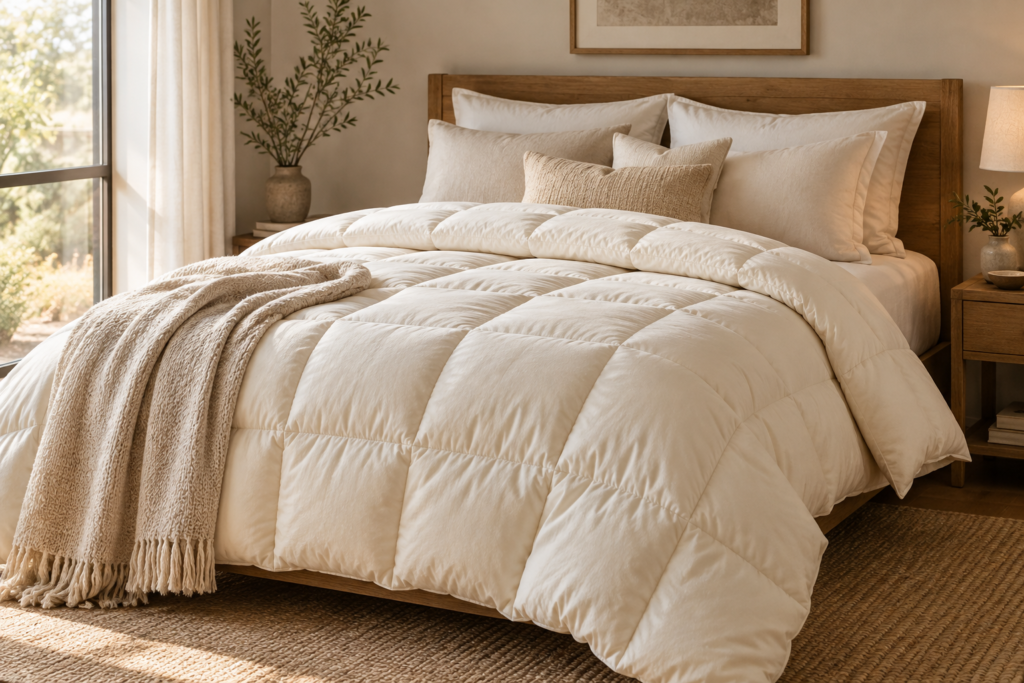
Best Wool Comforters at a Glance
| Wool Comforter | Best For | Fill | Warmth / Fill Weight | Care |
|---|---|---|---|---|
| Naturepedic Organic Wool Duvet Insert | Best Overall | GOTS-certified organic wool | Approx. 500 GSM | Spot clean |
| Woolroom Organic Washable Wool Comforter – Light | Best Lightweight | Organic traceable British wool | 200 GSM | Machine washable |
| Coyuchi Washable Wool Filled Comforter | Best Easy-Care Wool Blend | 85% NATIVA wool + 15% plant-based batting | Not our basis for selection | Machine washable |
| Holy Lamb Organics Certified Organic Wool Comforter | Best Warmth Options | GOTS-certified wool | Light, Perfect or Extra | Specialized wool care |
| Sleep & Beyond myMerino® Comforter | Organic Merino Wool for Year-Round Use | 100% organic Merino wool | 530 GSM | Spot clean cover; no machine washing or drying |
| Holy Lamb Organics All-Season Wool Comforter | Best Adjustable All-Season | Premium eco wool | Two separable layers | Specialized wool care |
| Holy Lamb Organics Dual-Weight Comforter | Best for Couples | Premium eco wool | Different warmth on each half | Specialized wool care |
How We Chose These Wool Comforters
We compared wool comforters using publicly available manufacturer specifications and documentation rather than relying on unsupported claims of hands-on testing.
Our selection criteria included:
- Wool content and sourcing
- Fill weight and intended warmth
- Shell material
- Construction
- Washability and care requirements
- Available sizes
- Relevant third-party certifications
- Practical differences between competing designs
- Suitability for warm sleepers, cold sleepers, couples, and year-round use
We favored products that provide enough technical information for shoppers to make meaningful comparisons.
Because warmth is personal, there is no single wool comforter that will be ideal for every sleeper. Bedroom temperature, climate, bedding layers, and whether you naturally sleep hot or cold can all affect the right choice.
1. Naturepedic Organic Wool Duvet Insert — Best Overall
The Naturepedic Organic Wool Duvet Insert earns our best-overall position because it combines a substantial organic wool fill with a strong certification profile and a relatively straightforward construction.
Naturepedic lists approximately 500 GSM of GOTS-certified organic wool inside a GOTS-certified organic cotton percale shell. A stitch-through box pattern helps keep the fill distributed across the comforter.
The wool is also listed as RWS certified, while the finished product carries MADE SAFE certification.
At around 500 GSM, this is not the lightweight choice in our lineup. It makes more sense for someone looking for a substantial wool layer rather than a very light summer comforter.
One important trade-off is care: Naturepedic recommends spot cleaning rather than machine washing the insert. Using a duvet cover therefore makes practical sense, especially if this will be your primary comforter.
Pros
- Approximately 500 GSM organic wool fill
- GOTS-certified organic wool and cotton
- RWS-certified wool
- MADE SAFE certified
- Box construction helps maintain fill distribution
- Strong option for shoppers prioritizing certified natural materials
Cons
- Spot clean only
- May be more insulation than some warm sleepers need
- Limited compared with products offering several warmth levels
Best for: Shoppers who prioritize certified organic materials and want a substantial wool comforter for regular use.
2. Woolroom Organic Washable Wool Comforter – Light — Best Lightweight Wool Comforter
If you tend to sleep warm, a thick wool comforter may provide more insulation than you actually need.
The Woolroom Organic Washable Wool Comforter – Light takes the opposite approach with a 200 GSM fill of organic, washable, traceable British wool.
The wool is enclosed in a 300-thread-count unbleached organic cotton cover, and the comforter includes corner ties for securing it inside a duvet cover.
Woolroom positions the Light version for warmer conditions and lists it for rooms at approximately 68°F and above.
Its biggest practical advantage is washability. According to the manufacturer’s care instructions, the comforter can be washed using a wool/delicate cycle with wool detergent and a low spin speed, then line dried.
That combination makes it particularly interesting for shoppers searching for a lightweight wool comforter without giving up the convenience of home washing.
Pros
- Lightweight 200 GSM wool fill
- 100% organic, traceable British wool
- 300-thread-count organic cotton outer fabric
- Machine washable with specific wool-care instructions
- Corner ties for a duvet cover
- Better suited to warm sleepers than heavier wool comforters
Cons
- May be too light for cold bedrooms or cold sleepers
- Requires wool-specific washing and line drying
- Not designed for tumble drying
Best for: Hot sleepers, warmer climates, summer bedding, and anyone specifically looking for a lightweight washable wool comforter.
3. Coyuchi Washable Wool Filled Comforter — Best Easy-Care Wool Blend
The Coyuchi Washable Wool Filled Comforter takes a different approach from the 100% wool-filled options in this guide.
Its fill consists of 85% NATIVA wool from Uruguay and 15% plant-based batting, while the shell is made from organic cotton sateen.
That distinction matters. If your priority is a comforter with 100% wool fill, choose another option. But if convenient care matters more, Coyuchi’s wool blend deserves attention.
The comforter can be machine washed on a cold gentle cycle and tumble dried on low according to Coyuchi’s care instructions. It also has corner loops, allowing it to function as a duvet insert.
This is a good example of why reading beyond the phrase “wool comforter” is important: two products can both be marketed around wool while having meaningfully different fiber compositions.
Pros
- Machine washable
- Can be tumble dried on low
- Organic cotton sateen shell
- Traceable NATIVA wool component
- Corner loops for use inside a duvet cover
- Easier care than many traditional wool-filled comforters
Cons
- Fill is not 100% wool
- Shoppers seeking an all-wool fill may prefer another option
Best for: Shoppers who prioritize convenient home washing and are comfortable with a wool-and-plant-based fill blend.
4. Holy Lamb Organics Certified Organic Wool Comforter — Best Choice of Warmth Levels
Not everyone needs the same amount of wool over them at night.
The Holy Lamb Organics Certified Organic Wool Comforter addresses that by offering multiple warmth levels rather than forcing every sleeper into one fill weight.
It uses GOTS-certified wool encased in a GOTS-certified organic cotton 300-thread-count sateen shell.
The comforter is available in Light, Perfect, and Extra options. For example, Holy Lamb lists Full/Queen wool weights of approximately 3.3 pounds for Light, 4.5 pounds for Perfect, and 7 pounds for Extra.
That range makes the comforter particularly useful for shoppers who already know whether they sleep warm, neutral, or cold.
Pros
- GOTS-certified wool
- GOTS-certified organic cotton shell
- Multiple warmth options
- Useful for matching bedding to climate and sleeping preference
- Corner ties for securing a duvet cover
Cons
- Care is more involved than a conventional machine-washable comforter
- Choosing between multiple weights requires understanding your own warmth preference
Best for: Shoppers who want certified organic wool but also want more control over how warm their comforter feels.
5. Sleep & Beyond myMerino® Comforter — Organic Merino Wool for Year-Round Use
The myMerino® Comforter suits shoppers seeking organic Merino wool who are comfortable with specialized care.
According to Sleep & Beyond, it contains 530 GSM of 100% organic Merino wool in a 400-thread-count organic cotton sateen cover. The brand positions it for year-round use.
It has box quilting and corner loops. Sizes range from Crib to Super King; compare the listed dimensions before ordering.
Do not machine wash or machine dry this model. Use a duvet cover, air it periodically and spot clean the cover. For major stains, the brand recommends eco-friendly dry cleaning with limited moisture.
Pros
- 100% organic Merino wool fill
- 530 GSM fill
- 400-thread-count organic cotton sateen cover
- Corner loops and box quilting
Cons
- Not machine washable
- Substantial fill may be too warm for some hot sleepers
Best for: Shoppers prioritizing organic Merino wool and a substantial fill over easy home washing.
6. Holy Lamb Organics All-Season Wool Comforter — Best Adjustable All-Season Design
An all-season comforter often involves a compromise: enough insulation for winter can feel excessive in summer, while lightweight summer bedding may not be enough when temperatures fall.
The Holy Lamb Organics All-Season Wool Comforter approaches the problem with two separate wool comforters that can be tied together.
During colder weather, both layers can be combined. As temperatures rise, they can be separated and a single lighter layer used instead.
The comforter uses domestically sourced premium eco wool inside an organic cotton 300-thread-count sateen shell.
For the Full/Queen size, Holy Lamb lists approximately 2.9 pounds of wool in a single layer and 5.8 pounds when both layers are combined.
This modular construction gives it an advantage over a fixed-weight comforter if your bedroom conditions change substantially between seasons.
Pros
- Two separable wool layers
- Adjustable across seasons
- Organic cotton shell
- Domestic eco wool
- Can reduce the need for separate summer and winter comforters
Cons
- More expensive and complex than a single-layer design
- Specialized care required
- The manufacturer classifies it as a custom item, so check current return terms carefully before ordering
Best for: Homes with large seasonal temperature changes and sleepers who want one adaptable wool bedding system.
7. Holy Lamb Organics Dual-Weight Comforter — Best Wool Comforter for Couples
Sharing a bed can make choosing a comforter surprisingly difficult when one person sleeps hot and the other sleeps cold.
The Holy Lamb Organics Dual-Weight Comforter is designed specifically around that problem.
Instead of giving the entire comforter one warmth level, each half can have a different amount of wool.
Holy Lamb currently offers combinations including Extra/Light, Perfect/Light, and Perfect/Extra.
The comforter uses domestically sourced eco wool and a GOTS-certified organic cotton 300-thread-count sateen shell. It is available in Queen and King sizes.
This is a specialized product rather than the obvious choice for everyone, but its design addresses a real limitation of conventional comforters.
Pros
- Different warmth levels on each side
- Designed specifically for couples with different temperature preferences
- Eco wool fill
- GOTS-certified organic cotton shell
- Queen and King sizes
- Corner ties for use with a duvet cover
Cons
- Not necessary if both sleepers prefer similar warmth
- Specialized care
- Custom product with restrictive return conditions, so current terms should be checked before purchase
Best for: Couples where one person regularly sleeps warmer or colder than the other.
What Is a Wool Comforter?
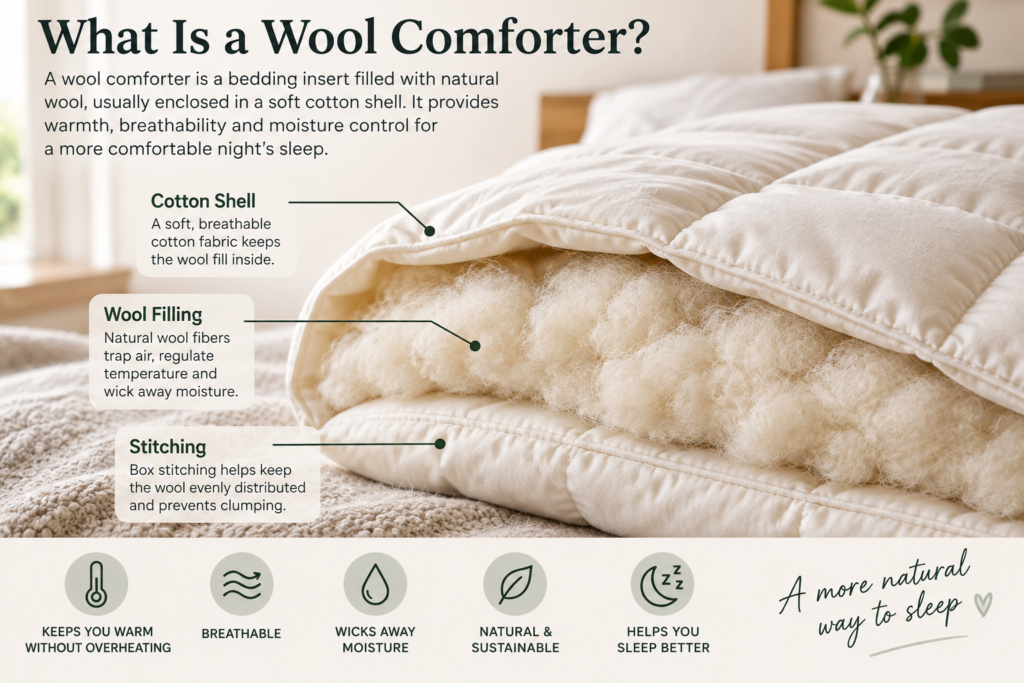
A wool comforter is a bedding insert filled primarily with wool batting, usually enclosed in a cotton shell and designed to provide insulation while allowing moisture vapor to move through the bedding.
Unlike a wool blanket, where the wool itself usually forms the visible fabric, a wool comforter typically hides the wool fill inside a woven outer shell.
You may also see similar products described as wool duvets, wool duvet inserts, or wool-filled comforters.
The terminology varies by brand and market, so the actual materials and specifications are more important than the product name alone.
Wool Comforter Benefits: Why Choose Wool?
Wool Combines Insulation With Breathability
Wool fibers trap air, which provides insulation, but wool bedding does not have to be extremely thick to feel warm.
The result can be a more balanced sleeping environment than simply adding increasingly heavy layers.
That does not mean wool can never feel too warm. A high-fill wool comforter can still provide too much insulation for a hot sleeper, which is why fill weight matters.
Wool Can Manage Moisture
Wool can absorb and release water vapor, which is one reason it is widely used in clothing and bedding designed around temperature and moisture management.
For sleepers who dislike the clammy feeling that can occur under less breathable bedding, this is one of wool’s most appealing characteristics.
Wool Offers an Alternative to Down and Synthetic Fill
Some shoppers simply prefer not to use down. Others want to reduce the amount of polyester or other synthetic fill in their bedding.
A wool-filled comforter provides another option, particularly when paired with a cotton shell.
However, check the actual composition rather than assuming every product labeled “wool” contains 100% wool fill. As the Coyuchi example shows, some use wool blends.
Wool Comforters Come in Different Warmth Levels
One of the biggest mistakes when buying wool bedding is assuming that “wool” automatically means heavy winter bedding.
It does not.
The products in this guide range from lightweight 200 GSM options to substantially heavier constructions, plus modular comforters that use multiple layers.
If you’re also comparing other types of wool bedding, see our guide to washable wool blankets for more options.
Lightweight vs. All-Season vs. Heavy Wool Comforters
The right wool comforter depends more on your sleeping environment than on a universal definition of “best.”
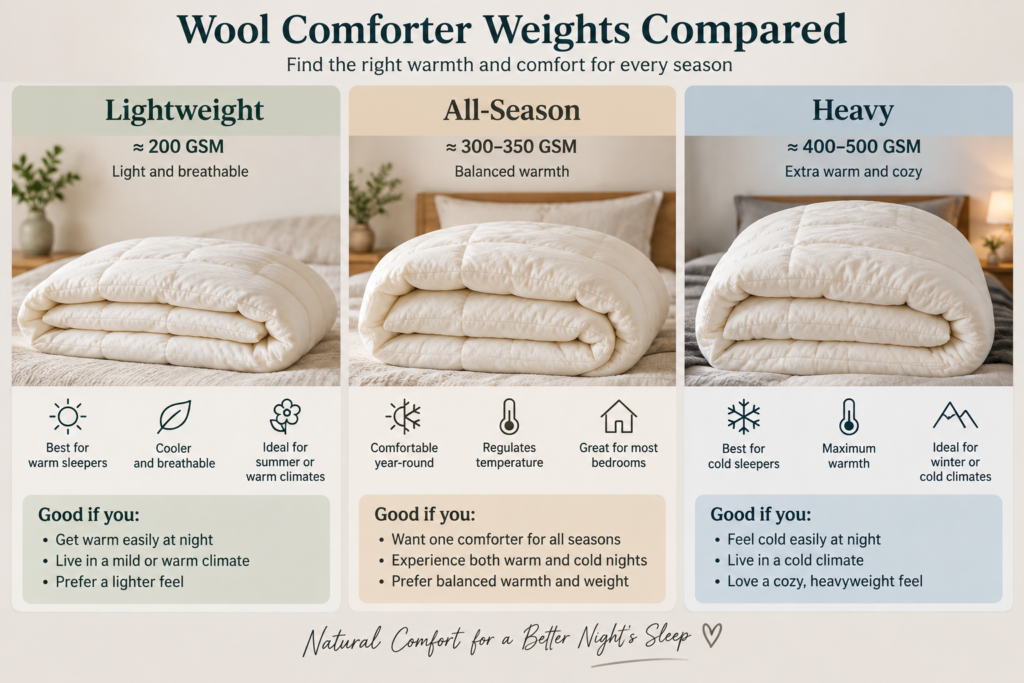
Choose a lightweight wool comforter if:
- You naturally sleep hot
- Your bedroom stays relatively warm
- You live in a warm climate
- You want wool bedding mainly for spring, summer, or early fall
- You already use other bedding layers
A 200–250 GSM wool comforter is a useful starting range to investigate for these conditions.
Choose a medium or all-season wool comforter if:
- Your bedroom temperature is relatively stable
- You want one comforter for much of the year
- You are neither an especially hot nor cold sleeper
- You prefer adding a blanket during unusually cold weather
Consider a heavier wool comforter if:
- You sleep cold
- Your bedroom stays cool
- You live in a cold climate
- You prefer substantial bedding
- Winter warmth is more important than summer versatility
Remember that GSM is only one variable. Construction, wool loft, additional bedding layers, room temperature, and individual physiology all affect perceived warmth.
What Does GSM Mean in a Wool Comforter?
GSM means grams per square meter. In a wool comforter, it describes how much fill material is distributed across a given area.
For broadly comparable wool constructions, a higher GSM usually means more insulation.
For example:
- Around 200 GSM generally represents a lightweight wool fill
- Around 250 GSM remains relatively light
- Around 400–500 GSM provides substantially more wool per square meter
But GSM should not be treated as an exact warmth rating across unrelated products. Different construction methods and materials can affect how a comforter performs.
Use GSM as a comparison tool, not as the only buying criterion.
How to Choose the Best Wool Comforter
1. Start With How Warm You Sleep
This should come before brand, thread count, or marketing claims.
If you regularly kick blankets away during the night, buying the heaviest wool comforter available probably makes little sense.
Warm sleepers should start by comparing lightweight options.
Cold sleepers can look toward higher fill weights or adjustable multi-layer systems.
2. Check the Actual Wool Content
Look beyond the product name.
Ask:
- Is the fill 100% wool?
- Is it organic wool?
- Is it traceable?
- Is it a wool blend?
- Does the manufacturer identify the wool source?
A product can legitimately be a wool comforter without having identical construction to another wool comforter.
3. Compare Fill Weight
When manufacturers publish GSM or total wool weight, use it.
It is one of the most useful objective specifications for comparing comforters.
A light wool comforter and a heavy wool comforter can offer very different sleeping experiences even if both use high-quality wool.
4. Check the Outer Shell
Most of the options in this guide use cotton shells, including organic cotton on several models.
The shell matters because it affects the fabric directly surrounding the wool batting and contributes to the overall breathability and feel of the comforter.
5. Decide How Important Machine Washing Is
This is one of the biggest differences between wool comforters.
Some are genuinely designed for machine washing.
Others should be spot cleaned.
Still others can technically go into a washing machine but require specific soak-and-spin procedures without normal agitation.
Never assume that “washable wool” means you can treat the comforter like ordinary polyester bedding.
Always follow the exact instructions for your product.
6. Look at Construction
Quilting, tufting, and stitched boxes help keep wool batting distributed.
Also look for corner loops or ties if you plan to place the comforter inside a duvet cover.
7. Check Actual Dimensions
“Queen,” “King,” and “Full/Queen” dimensions are not identical across brands.
Measure your mattress and compare the comforter’s actual dimensions before ordering, particularly if you want generous drape along the sides of the bed.
Wool Comforter vs. Down Comforter
If you’re building a more natural sleep setup, you may also want to compare organic wool mattress toppers for an additional layer of comfort.
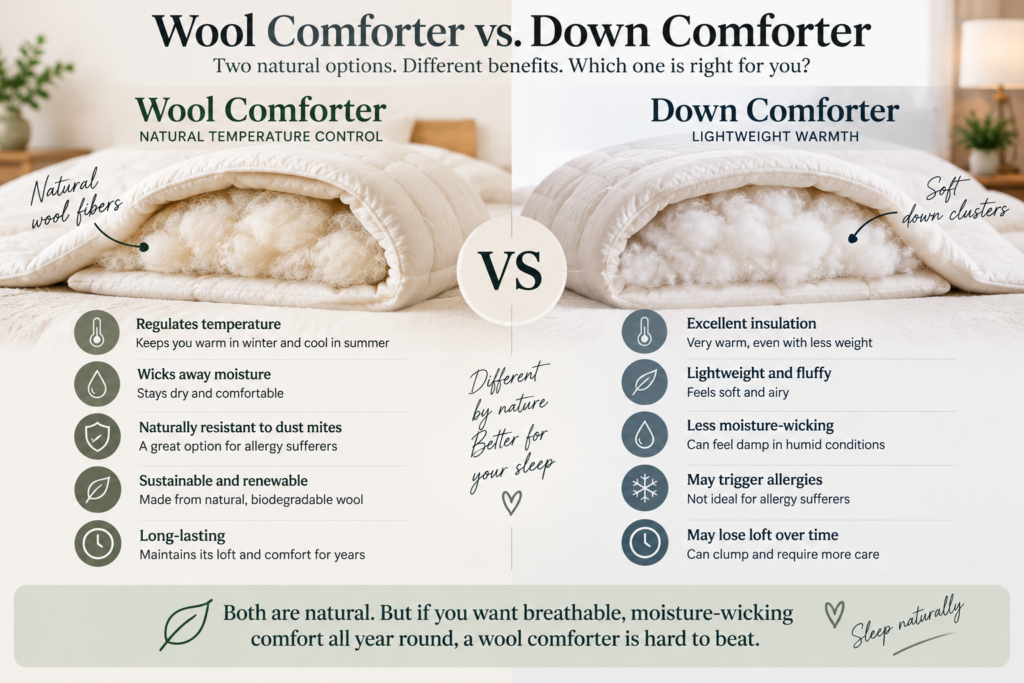
Both wool and down can provide effective insulation, but they feel different.
Down is prized for high loft and a light, fluffy sensation. Wool comforters tend to feel flatter and more grounded because wool batting behaves differently from clusters of down.
Wool is particularly attractive for shoppers who value moisture management, natural fibers, or an alternative to animal feather/down bedding.
Down may appeal more to someone who specifically wants maximum loft with relatively little weight.
Neither material is universally superior.
The better choice depends on the sleeping sensation, care requirements, sourcing preferences, and warmth level you want.
Wool Comforter vs. Wool Duvet: Is There a Difference?
In everyday shopping, the terms often overlap.
In the United States, comforter is common terminology. In other markets, similar wool-filled bedding is frequently called a duvet.
A duvet insert is typically intended to sit inside a removable duvet cover, while a comforter can sometimes be used on its own.
But manufacturers do not apply these labels consistently.
Instead of deciding based on the word “comforter” or “duvet,” compare:
- Fill material
- Fill weight
- Shell fabric
- Dimensions
- Corner ties or loops
- Washing instructions
- Intended warmth
Those specifications tell you more than the name.
How to Care for a Wool Comforter
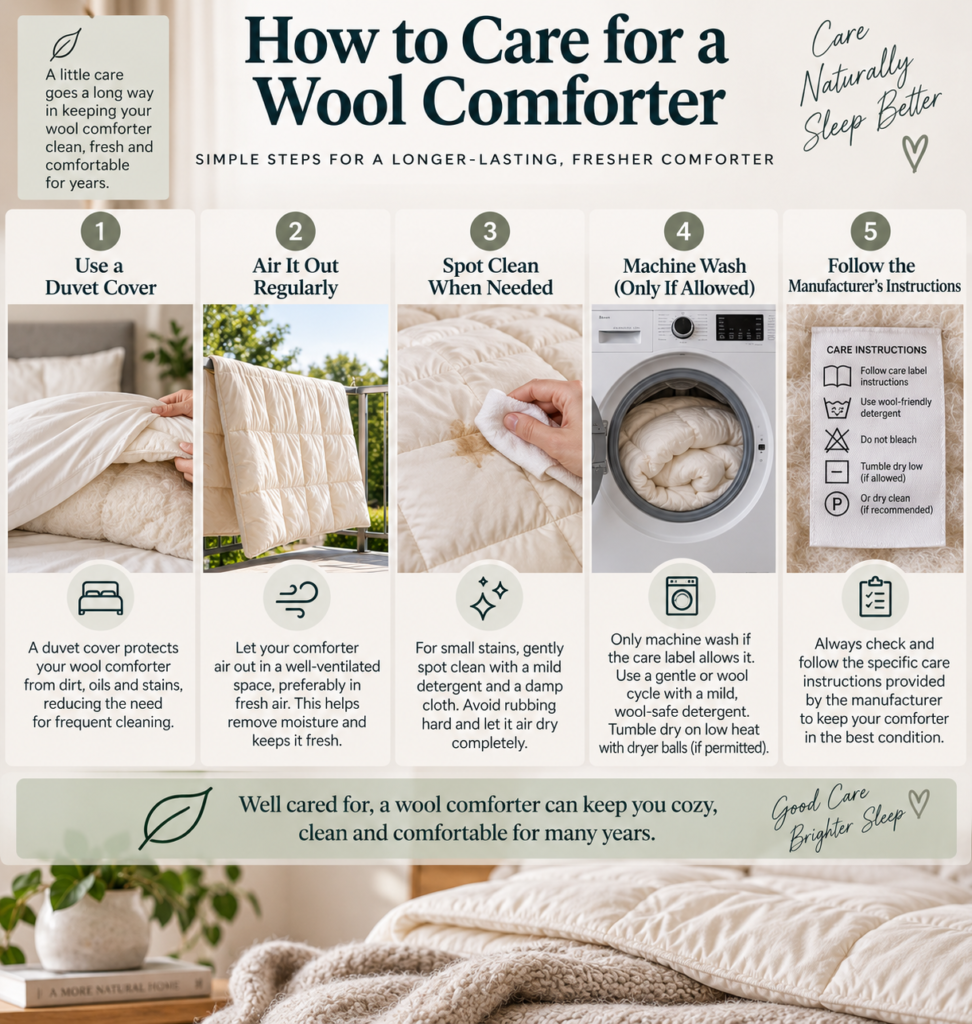
Wool bedding can last a long time when cared for correctly, but care instructions vary dramatically between products.
For a deeper look at cleaning and maintaining wool bedding, read our wool bedding care guide.
Use a duvet cover when practical
A removable duvet cover can protect the comforter from body oils, spills, and everyday dirt, reducing how often the insert itself needs cleaning.
Air it periodically
If the manufacturer’s instructions allow it, airing wool bedding can help freshen it between cleanings.
Spot clean when recommended
Some organic wool comforters are specifically designed for spot cleaning rather than machine washing.
Do not put them through a normal wash cycle simply because another wool comforter is washable.
Follow washable-wool instructions exactly
If your comforter is machine washable, check:
- Water temperature
- Cycle type
- Detergent requirements
- Maximum spin speed
- Whether tumble drying is allowed
- Whether line drying is required
The care label for your specific comforter should always take priority over generic wool-washing advice.
For more practical wool-care advice, see our guide on how to wash wool safely without damaging the fibers.
Frequently Asked Questions
Are wool comforters good for hot sleepers?
They can be, but fill weight matters.
Warm sleepers should generally investigate lightweight wool comforters rather than assuming every wool comforter will perform the same way. Models around 200–250 GSM provide much less fill than 400–500 GSM alternatives.
Are wool comforters heavy?
Some are, but not all.
Wool batting generally creates a different feel from lofty down, and heavier wool fills can feel substantial. Lightweight wool comforters are available for sleepers who prefer less insulation and less fill.
Can you machine wash a wool comforter?
Some wool comforters are machine washable and others are not.
Woolroom, Sleep & Beyond, Coyuchi, and Nest Bedding currently offer washable wool or wool-blend comforters, but their care instructions are not identical.
Always follow the manufacturer’s instructions for the specific product.
What is the best wool comforter for summer?
A lightweight wool comforter is generally the most logical option for summer.
In this guide, the Woolroom Organic Washable Wool Comforter – Light uses a 200 GSM wool fill and is specifically positioned for warmer sleeping conditions.
What is the best wool comforter for winter?
Cold sleepers should consider higher fill weights or adjustable layered designs.
The right winter comforter still depends on room temperature and personal preference, so the heaviest option is not automatically the best choice for everyone.
Is an organic wool comforter worth it?
It can be if certified organic materials and sourcing standards are priorities for you.
However, “organic” does not automatically tell you whether a comforter will be warm enough, washable, or suitable for your climate.
Evaluate certification alongside fill weight, construction, care, and comfort preferences.
Does a wool comforter need to be Merino wool?
No.
Merino is well known for its fine fibers, particularly in next-to-skin clothing, but a comforter’s wool is enclosed inside an outer shell.
Other wool types can work well as bedding fill.
Construction, fill weight, wool processing, sourcing, and overall product quality may matter more than simply seeing “Merino” in the product name.
Should I put a duvet cover over a wool comforter?
In many cases, yes.
A duvet cover can protect the comforter from dirt and stains and reduce the need to clean the wool insert itself.
Check for corner ties or loops that help keep the insert positioned inside the cover.
Final Verdict: Which Wool Comforter Should You Choose?
For an all-around combination of certified organic materials and substantial wool fill, the Naturepedic Organic Wool Duvet Insert is our top pick.
But it is not automatically the right comforter for every sleeper.
If you sleep warm, the Woolroom Organic Washable Wool Comforter – Light offers a much lighter 200 GSM construction and machine washability.
Sleep & Beyond myMerino® Comforter offers a substantial 530 GSM organic Merino wool fill, but requires specialized care. If easy home care is your biggest priority, Coyuchi offers a washable option using a wool-and-plant-based blend.
For changing seasons, the Holy Lamb All-Season Wool Comforter provides two separable layers. And for couples who disagree about nighttime warmth, Holy Lamb’s Dual-Weight Comforter offers different insulation levels on each side of the same bed.
The most important lesson is simple: don’t choose a wool comforter based on the word “wool” alone. Compare the wool content, fill weight, care requirements, construction, and intended warmth. The best wool comforter is the one whose specifications match the way you actually sleep.