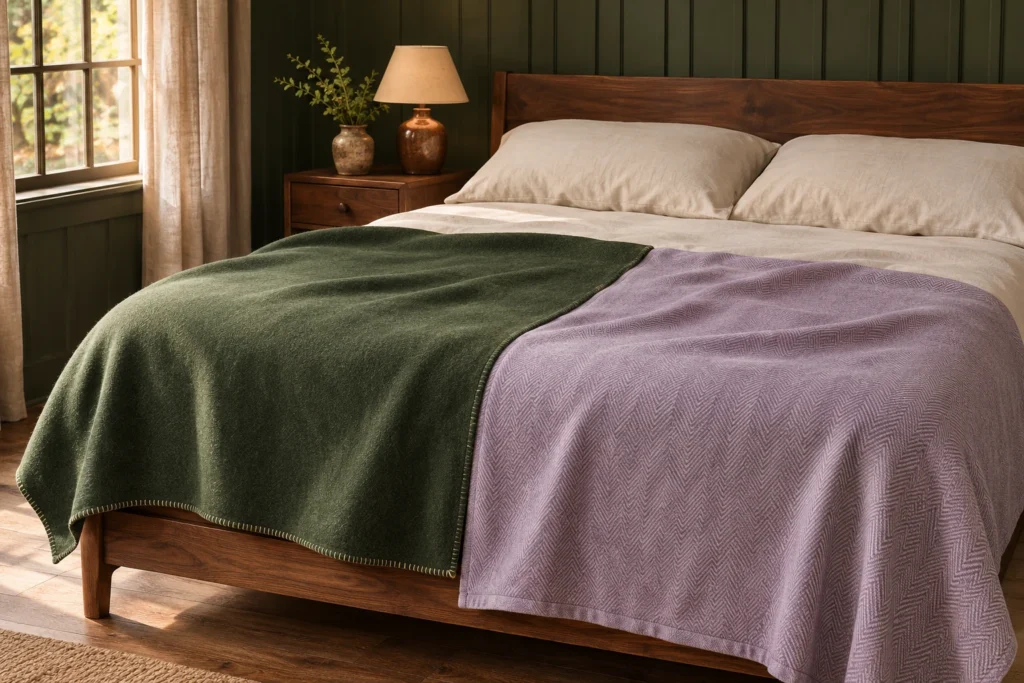
A wool blanket can be a good choice for a resilient, insulating layer; a cotton blanket is worth considering for a smooth feel and convenient laundering. The deciding details are the finished blanket’s thickness, construction and care label. A light wool throw and a heavy cotton bed blanket can behave very differently from the usual “wool for winter, cotton for summer” rule.
The most useful wool vs cotton blanket comparison starts with your room, your preferred weight and your washing routine. Here is how to judge the products in front of you without assuming that the fiber name answers everything.
Research note: The Editorial Team reviewed textile references and official US-facing product information on November 5, 2026. This is a researched comparison, not a hands-on blanket test. Product examples illustrate specifications and care differences, not a tested performance ranking.
Wool vs cotton blanket: the practical differences
| Buying priority | Wool blanket | Cotton blanket |
|---|---|---|
| Warmth | Crimp and loft can help create an insulating fabric. Thin, open constructions still differ from dense winter blankets. | Can provide substantial warmth when thick or layered. “Cotton” does not automatically mean a summer blanket. |
| Weight and feel | Look for the amount of loft, surface finish and actual finished weight. | Compare airy weaves with dense, flatter constructions; both are sold as cotton blankets. |
| Skin contact | Fineness and protruding fibers matter. Some people prefer a sheet between wool and skin. | A smooth surface may suit someone who dislikes wool prickle, but texture and finishing still vary. |
| Moisture and airflow | Can absorb and release moisture vapor. This does not establish airflow or guarantee cool sleep. | Absorbs moisture too. Weave, thickness and the surrounding bedding affect drying and comfort. |
| Laundry | Some models allow machine washing; others require different care. Washing permission does not establish drying permission. | Machine-washable designs are available. Confirm the label rather than assuming all cotton blankets tolerate the same cycle. |
| Long-term value | Depends on workmanship, maintenance and whether you like using it. | The same applies; a lower price or a higher cotton percentage is not a lifespan guarantee. |
Start with construction, not just the fiber label
A conventional blanket is itself a fabric layer, usually woven or knitted. A comforter has filling inside a shell. Advice about a wool-filled comforter’s fill weight or quilting cannot be transferred directly to a woven wool blanket.
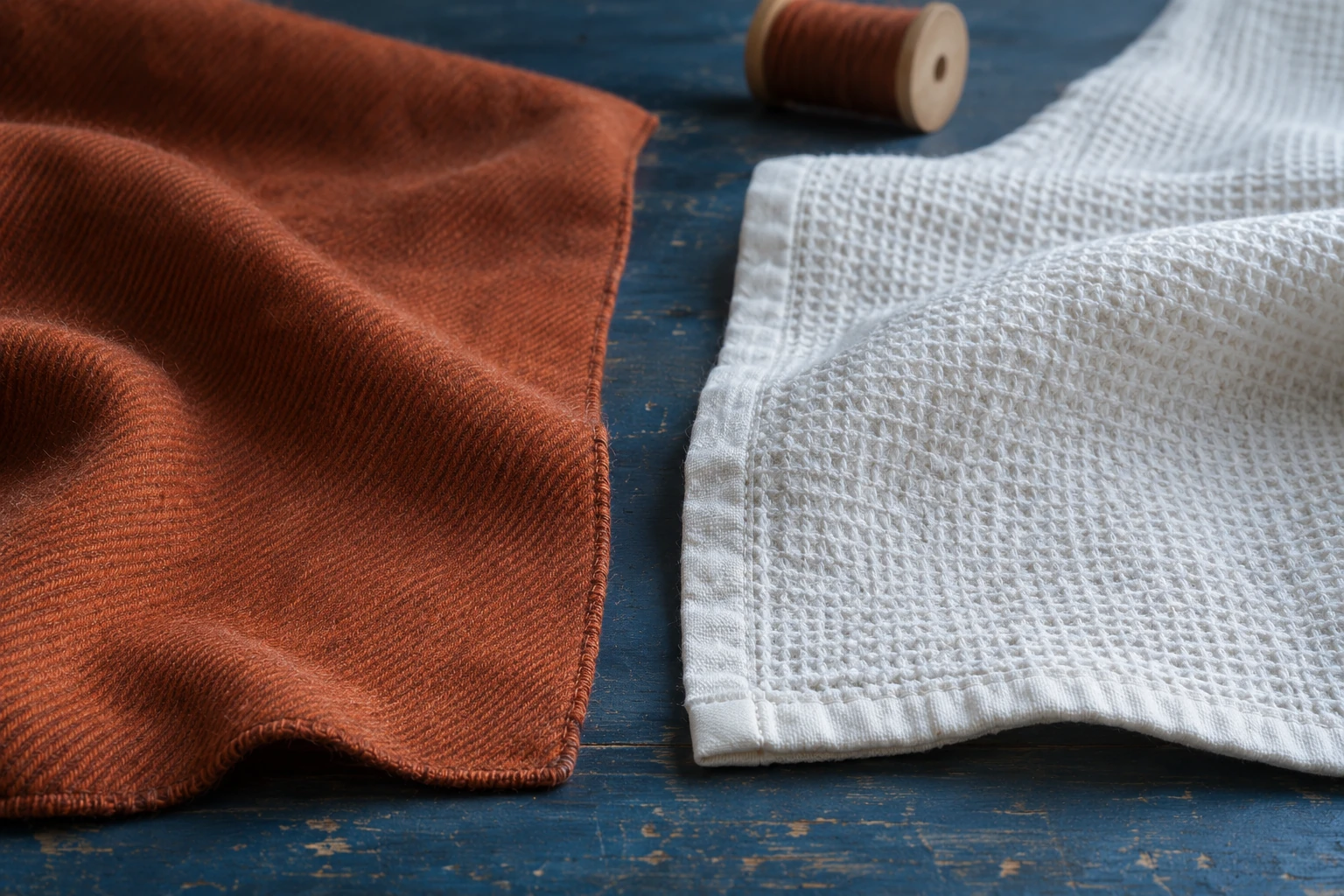
Woven blankets interlace yarns; knitted blankets form loops. Either can be open or compact, light or substantial. Brushing raises a surface nap, while the yarn, stitch or weave and finishing affect drape. Look at close photographs of the fabric and edge, but use the written specification to establish composition.
Product names can be misleadingly simple. L.L.Bean’s Cozy Cotton Blanket is listed as 58% cotton, 35% acrylic and 7% polyester, with a brushed jacquard construction. It is not a 100% cotton example. Those other fibers and the brushing prevent you from attributing every aspect of its feel or care to cotton.
Before comparing two blankets, match their dimensions and intended use. Then check thickness, construction and finished weight if disclosed. GSM means grams per square meter: it describes mass per area, not a warmth rating. A seller’s “lightweight” or “all-season” description is useful context, but it is not a standardized comparison with another brand.
Which is warmer, and which works for summer?
Wool’s natural crimp helps a fabric hold insulating air, as Woolmark’s fiber explanation describes. How much air the finished blanket holds—and how much it compresses—depends on how that wool becomes fabric. A thick cotton blanket can also insulate well.
Blanket-specific evidence supports looking beyond fiber names. A 1944 National Bureau of Standards study of 156 blankets found a strong relationship between thickness and thermal resistance under its test conditions; fiber type did not independently explain thermal transmission in that sample. This is historical physical evidence, not a performance test of today’s products.
For a cold bedroom, investigate a loftier or more substantial blanket with enough coverage to tuck around you. Wool is a sensible candidate, but the listing should tell you more than “100% wool.” For a warm bedroom, start with less insulation: a lighter, relatively open blanket over a sheet. Cotton offers useful options, and a sufficiently light wool design need not be ruled out.
For changeable weather, two removable layers give you more control than one heavy blanket. You can remove a layer without replacing all the bedding. An air-conditioned summer bedroom may need a different setup from an uncooled room in the same climate.
Separate weight, softness and surface texture
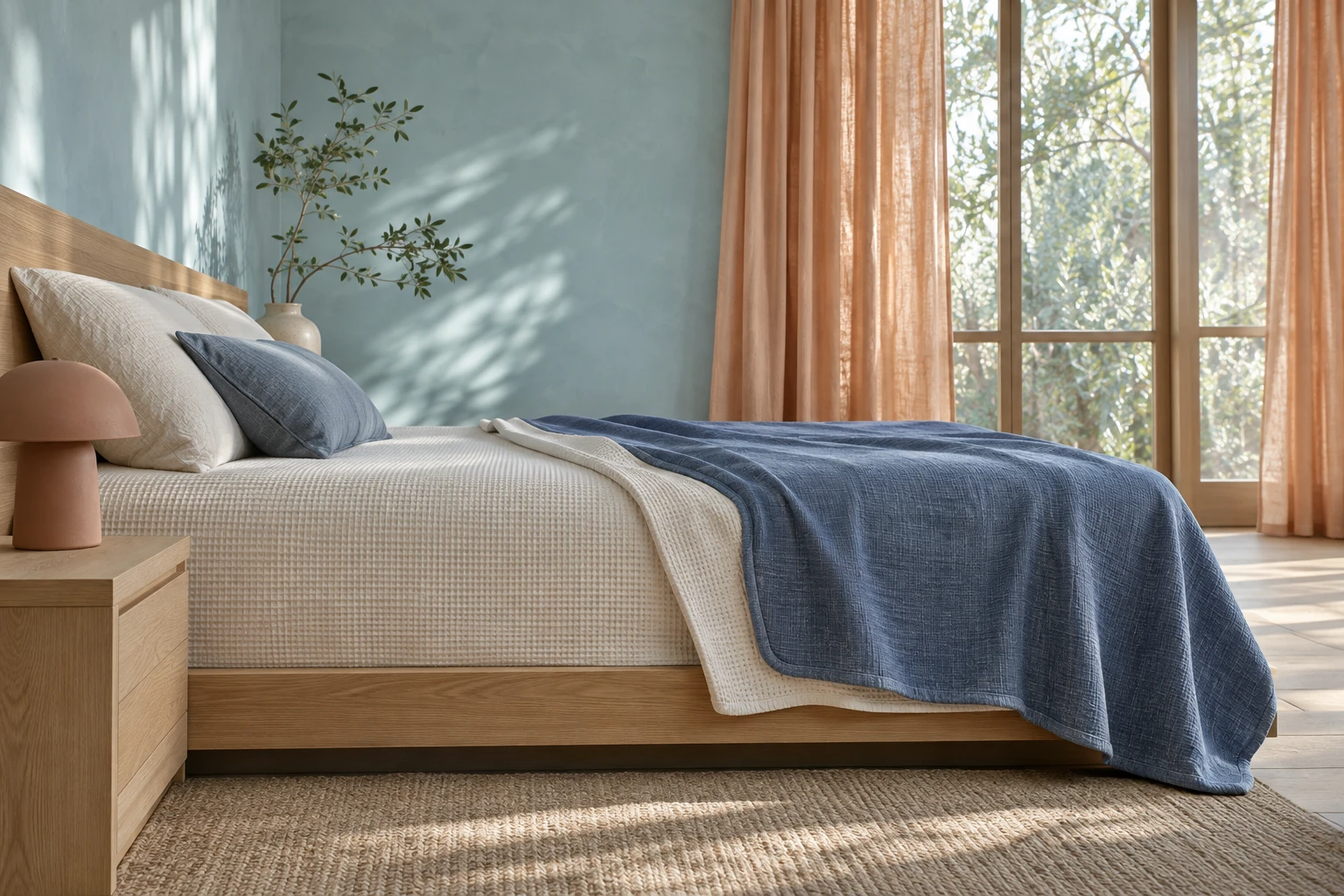
“Light” can mean low weight, low warmth or simply a thin-looking fabric. Ask which one the seller means. A fluffy blanket may look substantial without feeling as heavy as a dense, flatter blanket of the same size. If you dislike pressure on your legs, finished weight is more informative than a styled photograph.
For softness, consider what will actually touch your skin. Woolmark’s summary of skin-comfort research associates prickle with coarse fibers protruding from fabric. “Wool” therefore does not identify one fixed level of scratchiness, and a soft-looking nap does not prove fine fiber diameter.
Someone who has disliked direct contact with wool may prefer a smooth cotton blanket or use wool over a comfortable sheet. That changes contact, not the wool itself. Our guide to making wool feel less itchy explains this distinction. For a sofa throw that touches bare arms and the neck, a swatch or a workable return policy is especially useful.
Breathability is more than moisture absorption
Airflow, moisture absorption and insulation describe different things. The International Wool Textile Organisation explains wool’s ability to absorb and release moisture vapor. Cotton Incorporated’s technical guide describes cotton’s porous fiber structure and ability to take up liquid and vapor. Neither property alone tells you how much air passes through a particular blanket.
An open fabric structure can allow more air movement than a compact one, while finishes and the layers above and below it also matter. A blanket over a sheet and under a heavy bedspread is part of that whole system. Changing its fiber may do less than removing an unnecessarily warm layer.
If you tend to feel too warm, prioritize suitable thickness and removable layers before paying extra for a cooling claim. If dampness is the concern, ask for evidence about the finished blanket’s moisture behavior. General research on wool clothing does not establish that an unrelated wool blanket will keep you dry or prevent sweating.
Check washing and drying before you buy
Home laundering can decide the purchase, particularly for a frequently used throw. Read both parts of the care instruction: how to wash and how to dry. These verified examples show why a simple wool-versus-cotton rule is insufficient.
Pendleton Eco-Wise Wool Solid Blanket: the current manufacturer listing specifies 100% virgin wool, a separate cold gentle machine wash, no bleach and line drying. This is a washable wool option, but it still needs an appropriate drying arrangement. Our Eco-Wise blanket guide covers that model in more detail.
L.L.Bean Organic Cotton Blanket: the official listing identifies a 100% organic cotton herringbone blanket and permits machine washing and drying. Follow the supplied label for settings; the online wording does not justify inventing a universal wash temperature.
Even the size names are not identical measurements. Pendleton lists its Full/Queen at 90 × 96 inches; L.L.Bean lists 90 × 90 inches. These are useful examples of materials and care, not two blankets established to deliver equivalent warmth.
Both need appropriate care, for different reasons
Some wool constructions can felt or change dimensions when exposed to unsuitable washing and mechanical action. Shrink-resistant processing changes the risk, but does not cancel the finished product’s instructions. See why wool shrinks for the distinction between relaxation and felting.
Cotton can shrink too. CottonWorks’ shrinkage guidance identifies yarn, construction, processing and finishing as relevant factors, with knitted structures often more dimensionally unstable than woven ones. Do not assume that cotton permits a hot wash or that prewashing makes every blanket permanently stable.
Check that your equipment can accommodate the blanket and that you can follow its drying instructions. Woolmark’s blanket-care guidance emphasizes consulting the care label and handling a wet wool blanket carefully. Airing may freshen lightly used bedding; it is not a substitute for cleaning spills or contamination.
Durability and pilling have no automatic winner
Pilling is not a reliable fiber-ranking system. Woolmark explains that rubbing, fiber length, yarn twist and fabric cover influence pill formation. A softly brushed surface and a tightly constructed fabric can age differently even when both contain wool.
For either material, inspect the edge finish, stitching and openness of the structure. Consider whether long fringe or loose loops suit a household with pets or frequent snagging. A dense weave may suit rougher everyday use better than an open decorative knit, but a photograph cannot establish abrasion resistance or years of service.
Manufacturer statements about resisting pilling or shrinkage should be read as claims about that model. They do not demonstrate that all wool outlasts cotton, or vice versa. There is no matched long-term durability test of the featured examples in this guide.
Which blanket is worth buying for your home?
Compare the selected size, delivered price and likely cleaning cost. A wool blanket that needs paid professional cleaning may be a poor everyday choice if frequent washing is unavoidable. A cotton blanket that is too small or too heavy is not good value simply because its initial price is lower.
A higher price can reflect fiber selection, weaving, finishing, origin or branding. It does not establish extra warmth, a softer feel or a longer lifespan. Check the seller’s current return conditions, including whether trying or washing the blanket affects eligibility.
For frequent laundry and limited drying space: begin with a blanket explicitly approved for your washer and dryer. The cotton example above fits the broad machine-wash-and-dry requirement; other models need their own check.
For a cold room and a springier insulating layer: shortlist wool blankets with suitable thickness, coverage and manageable care. Our washable wool blanket comparison is a next step once you have decided on wool.
For warm nights: choose a light construction and use it as a removable layer. A thick cotton blanket may still be too warm, despite cotton’s reputation as a summer choice.
For direct skin contact or a sofa throw: prioritize a comfortable surface, practical dimensions and the ability to return an unsuitable feel. The best purchase is the blanket that meets those needs and has care instructions you can realistically follow.