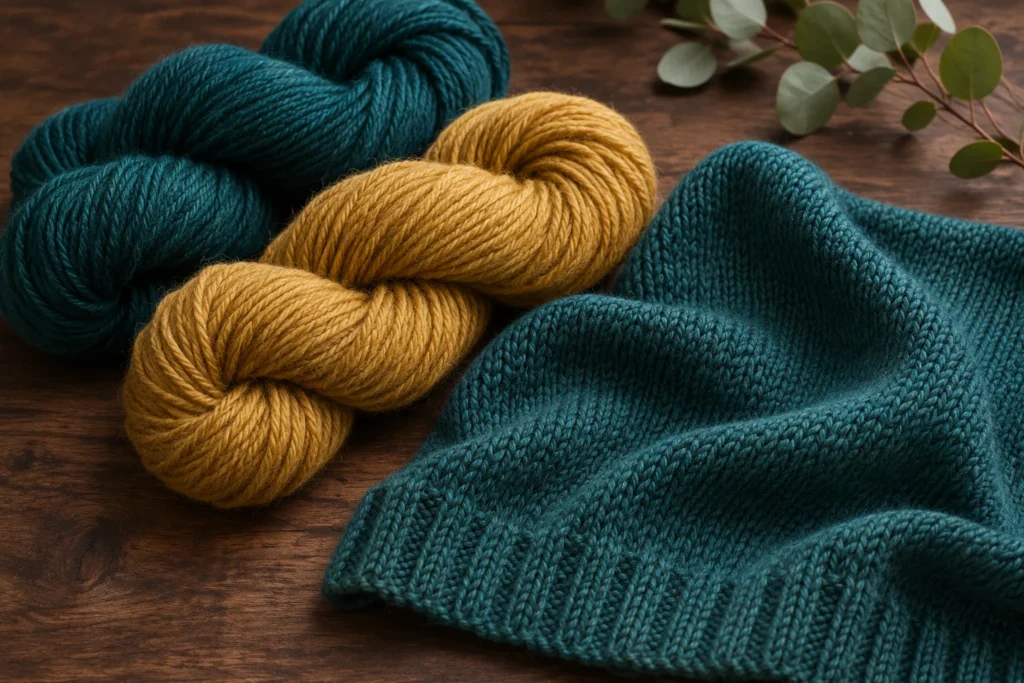
What is superwash wool? It is wool treated to resist felting shrinkage, usually so it can tolerate specified machine-washing conditions. The treatment changes the fiber surface; it does not turn wool into a different animal fiber or make every finished item safe for every wash cycle.
For a sweater, sock yarn or handmade gift, the useful question is what the exact product permits. Superwash can simplify care, but drying instructions, yarn construction and the way the fabric changes after washing still matter. Here is how to read the claim without expecting more than it promises.
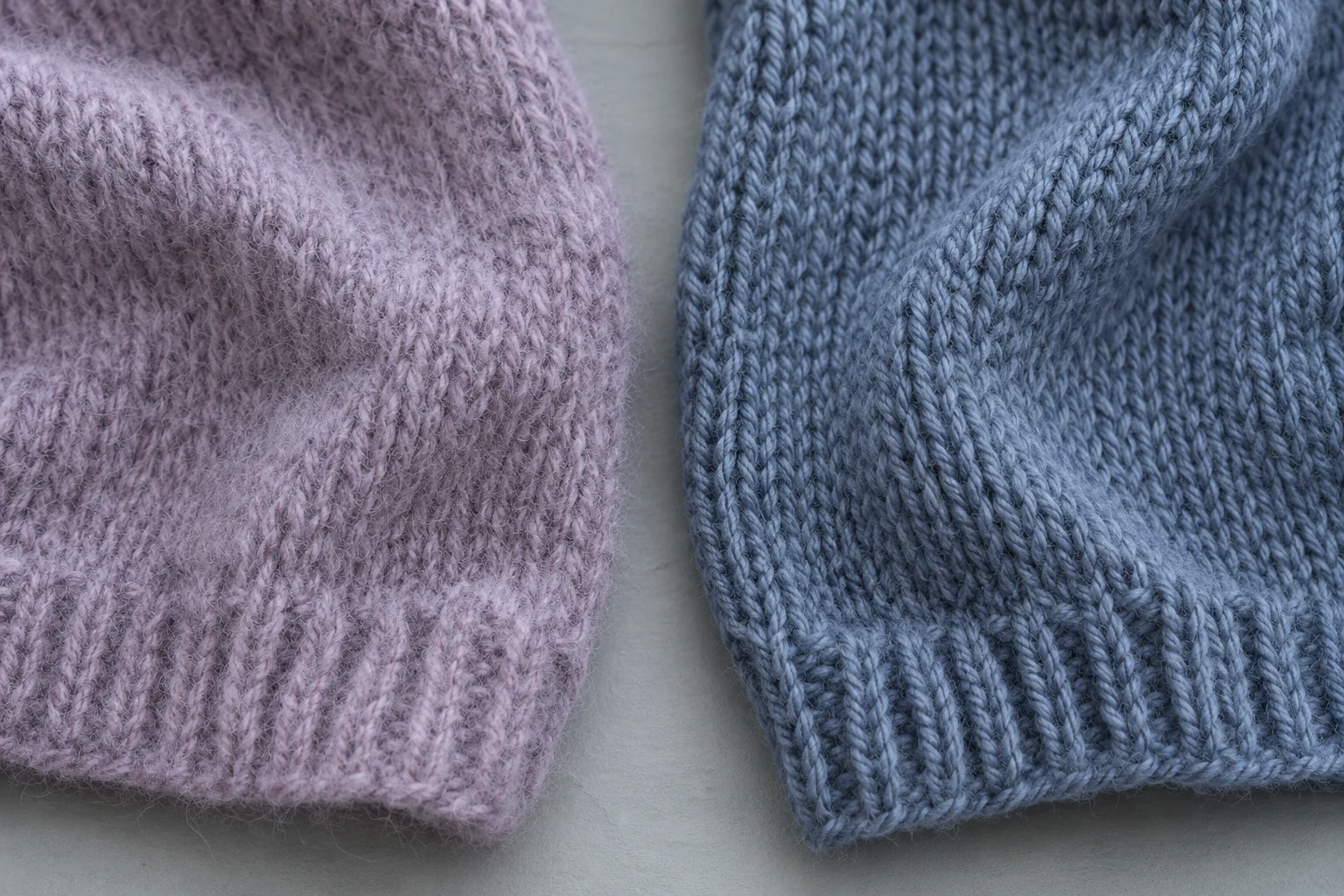
Editorial approach: This guide draws on textile research and manufacturers’ documentation. We have not personally tested the yarns discussed. The images are AI-generated editorial illustrations, not product photographs or evidence of a particular treatment.
Superwash wool: the quick answer
Think of “superwash” as a processing description. It tells you to look for shrink-resistant wool and then check the actual care instructions. It does not specify a sheep breed, a softness grade, a yarn thickness or a universal drying method.
Before buying, check three things: the full fiber composition, the washing and drying directions, and—if you are making a garment—the washed gauge. A convenient wash routine is only useful if the finished piece also keeps the fit and feel you want.
What is superwash wool, and is it still wool?
Woolmark describes superwash as wool given a shrink-resist treatment to support machine washing. The underlying fiber remains sheep wool, although its surface has been modified and a treatment may add a polymer finish.
Superwash Merino is Merino wool with that additional treatment. “Merino” identifies the wool source; “superwash” describes processing. A Merino yarn can be treated or untreated. Similarly, virgin wool describes the fiber’s previous-use history, not whether it is machine washable.
Read beyond the product name. A superwash yarn might contain only wool, or it might blend treated wool with nylon, silk or another fiber. “100% wool” is not the same claim as “untreated,” and a blend name alone does not establish the care requirements of the whole project.
How is superwash wool made?
Changing the surface that contributes to felting
Wool fibers have overlapping surface scales. Moisture and mechanical movement can encourage fibers to migrate and interlock, compacting a fabric. Shrink-resist processing modifies the scales, changes friction between fibers, or combines approaches to reduce this behavior.
A widely used system is chlorine–Hercosett: a chlorine pretreatment modifies the surface, followed by a thin bonded resin layer. Hercosett is a polyamide-epichlorohydrin polymer. Describing the entire yarn as “plastic” obscures the wool underneath; describing it as completely unmodified wool obscures the finishing process.
Not one recipe for every yarn
Chester Wool’s explanation of its process describes chlorine treatment followed by a bonded resin structure. That is useful supplier documentation, but it does not establish how a different brand’s yarn was processed.
A review of shrink-resist technologies examines alternatives involving enzymes, plasma, oxidation and different polymers. Methods differ in wash durability, effects on the fiber, processing speed and cost. A laboratory result is not proof that a technique is used in the skein on a store shelf. Ask the supplier for the named treatment if avoiding a particular process matters to you.
Superwash vs regular wool: practical comparison
Here, “regular” means wool without a shrink-resist treatment. These are buying considerations, not guarantees for every yarn.
| Question | Superwash wool | Untreated wool |
|---|---|---|
| Felting resistance | Designed to reduce felting shrinkage under specified care conditions | Usually requires more protection from felting conditions |
| Machine washing | Often permitted; check the exact cycle and temperature | Do not assume permission; follow the finished-item label |
| Tumble drying | Some products allow it; others require flat drying | Use only when explicitly authorized |
| Feel and drape | Treatment can change handle; fiber and construction still matter | Varies with fiber grade, spinning and fabric construction |
| Finished dimensions | Washed gauge and supported drying remain important | Washed gauge and careful handling remain important |
| Intentional felting | A poor default choice for a project intended to felt | Choose a specific feltable yarn recommended by the pattern |
Benefits and trade-offs: softness, stretch and durability
The clearest benefit is access to a more convenient care routine when the product permits one. That can make frequently washed garments and gifts easier to live with. The trade-off is that “easy care” still leaves decisions about cycle settings, drying space and fabric behavior.
Surface finishing may change the feel of wool. LANGYARNS describes a smoother surface and a softer, shinier handle in its explanation of superwash. Do not turn that into a ranking of all treated and untreated yarns. Compare the actual washed fabrics against the skin, particularly for a neckline or scarf.
Stretch and recovery are also separate questions. A fabric can stretch easily yet fail to return to the dimensions you expected. Conversely, a treated yarn can produce a stable fabric when its construction and gauge suit the project. DROPS specifically links the elasticity of its Merino Extra Fine yarn to its multistrand construction and stresses correct tension.
Superwash is not an anti-pilling guarantee. Woolmark’s pilling guidance identifies friction, fiber length, yarn twist and fabric density as relevant factors. Avoid predicting service life from the treatment label alone. For existing bobbles, our Merino wool pilling guide explains careful removal and when to stop.
Does superwash wool shrink—or grow?
Shrink resistance addresses felting; it is not a promise of unchanged measurements. A knitted structure may relax during washing or become distorted through handling. An unexpected size change therefore does not, by itself, tell you that the shrink-resist finish failed.
Check the kind of change. A longer, looser fabric suggests a different problem from a smaller, dense, matted fabric with obscured stitches. Our explanation of why wool shrinks separates relaxation from felting. Neither a hot wash nor a speculative dryer cycle is a reliable way to correct the fit.
For handknits, use the measurements of a washed and fully dried sample to plan the garment. For purchased clothing, save the label and check the dimensions before laundering if fit is particularly important. Contact the maker when the result differs substantially despite following its instructions.
Can superwash wool go in the washing machine?
Often yes, but the product’s instructions decide the method. Two current manufacturer examples show why the word alone is insufficient:
Cascade 220 Superwash: the listing specifies 100% superwash wool, 220 yards per 100-gram ball, a cool machine wash and low-temperature tumble drying.
DROPS Merino Extra Fine: this superwash-treated Merino yarn specifies a gentle machine cycle at 40°C/104°F, no fabric softener and flat drying. Its detailed guidance also warns against prolonged soaking and recommends detergent without enzymes or optical brighteners.
These are examples of different instructions, not recommendations to substitute one yarn for the other. Check the label supplied with your own yarn and any updated manufacturer guidance. A finished garment may also contain trims, linings or other yarns that require a more restrictive routine.
How to wash and dry superwash safely
Choose the routine before the detergent
Start with the finished-item label, or all yarn labels for a handmade project. Identify the permitted wash method, temperature and drying method together. A machine-wash symbol does not grant permission to tumble dry. If instructions conflict or are missing, ask the manufacturer before laundering an important piece.
Use the specified wool or gentle cycle rather than assuming a normal cycle is equivalent. Do not replace a manufacturer’s machine-washing recommendation with a long soak: the DROPS example shows why familiar wool-care habits do not apply universally. For broader garment preparation, see our Merino washing guide.
Woolmark recommends a mild, neutral detergent and advises against heavy-duty, enzyme-containing and bleach-containing products. Choose a detergent explicitly suitable for wool and for your machine. Follow its dose, and omit fabric softener when the yarn maker prohibits it. Shrink-resistant wool still needs wool-appropriate cleaning chemistry.
Support the fabric while drying
When flat drying is required, support the wet item as you lift it and arrange it on a suitable flat surface. Do not leave a heavy sweater dangling from its shoulders or stretch it aggressively to a target measurement. Brooklyn Tweed’s blocking guidance explains supported handling and gentle water removal without wringing.
Use a dryer only when the exact item’s instructions allow it, at the stated setting. Do not borrow Cascade’s drying permission for another superwash yarn. Once the piece is dry, assess its shape before deciding whether further handling is necessary.
Choosing superwash yarn for knitting and crochet
Start with the intended fabric rather than the treatment alone. A fitted cardigan needs dependable washed dimensions; a scarf may prioritize drape and skin comfort. A yarn that works beautifully for one can still be an awkward substitute for the other.
Brooklyn Tweed recommends swatching under conditions that reflect the project and measuring after finishing. Make a sample large enough to measure away from its edges. Use the intended stitch pattern and needles or hook, then wash and dry it according to the yarn directions.
Record the dry sample’s width, height and gauge before and after washing. Also assess its feel and whether the fabric is too loose or stiff. For crochet, make the sample in the actual crochet stitch; a knitting gauge on the label cannot stand in for it. If the result is unsuitable, reconsider the yarn or tool size before committing to the whole garment.
For substitutions, check yardage, construction and the pattern’s requirements together. Our wool yarn guide explains why skein weight, yarn thickness and ply count answer different questions. Keep a spare label with the finished gift so the recipient can repeat the intended care routine.
Environmental considerations: ask about the actual process
Conventional chlorine–resin processing raises legitimate questions about chemical use and effluent. The textile review cited above discusses adsorbable organic halogens, or AOX, in wastewater and the limitations of alternative treatments. Avoid translating “chlorine-free” into “impact-free”: the replacement chemistry, energy use and production controls still need assessment.
Ask a supplier which process is used, where it happens and what evidence supports its wastewater claims. A statement about one mill should not be extended to the whole industry. Choosing untreated wool avoids that particular shrink-resist finishing step, but does not by itself settle the environmental footprint of farming, dyeing, manufacturing or use.
Biodegradability deserves similar precision. A 2024 study of textile fibers in simulated marine conditions found that both untreated and chlorine–Hercosett-treated wool biodegraded, with the treated sample degrading more extensively. The researchers found no evidence of persistent non-degraded residues from that treated sample. The work was funded by Australian Wool Innovation.
That finding is evidence about the tested materials and conditions, not a disposal instruction or proof for every finish and blend. It does not establish how a complete garment will behave in a landfill or home compost. Keep fiber composition and the scope of the test in view.
Certification language also has boundaries. OEKO-TEX STANDARD 100 concerns testing for harmful substances. Do not use that label alone as proof that a yarn is organic, untreated or made without chlorine. Verify the certificate’s scope when a specific claim influences your purchase.
Which type should you choose?
Consider superwash when a documented machine-washing routine will make a frequently worn garment more practical, or when the recipient is unlikely to hand wash. Confirm drying requirements first: flat-dry-only yarn may still be inconvenient in a home with little drying space.
Consider untreated wool when you prefer a particular untreated yarn’s feel, want to avoid shrink-resist finishing, or are following a pattern designed for intentional felting. Accept its care requirements and choose the specific yarn for the project, rather than assuming all untreated wool behaves alike.
Frequently asked questions
Does superwash mean softer wool?
No. Treatment can change handle, but the word is not a softness grade. Judge the actual fiber, yarn and washed fabric. A sample is more useful than assuming a treated yarn must feel better against skin.
Can I use superwash wool for a felted project?
It is usually the wrong starting point because the treatment aims to resist felting shrinkage. Choose the untreated, feltable yarn specified by the pattern instead of trying to overcome a protective treatment with harsher washing.
Can superwash wool contain nylon?
Yes. A yarn can blend superwash wool with nylon or other fibers. Read the percentages rather than assuming “superwash” means 100% wool. The blend also matters when evaluating care and environmental claims.
Can you recognize superwash by touch or appearance?
Not reliably. A smooth surface or clear stitches can result from fiber choice, spinning and finishing. Look for supplier documentation and care instructions; a photograph cannot establish which treatment was used.
The practical takeaway
Superwash wool offers useful resistance to felting, but choosing well still requires the full label and a realistic care plan. For handmade items, wash a sample before committing to the finished dimensions. Choose the specific yarn or garment whose feel, construction and maintenance suit its intended use.