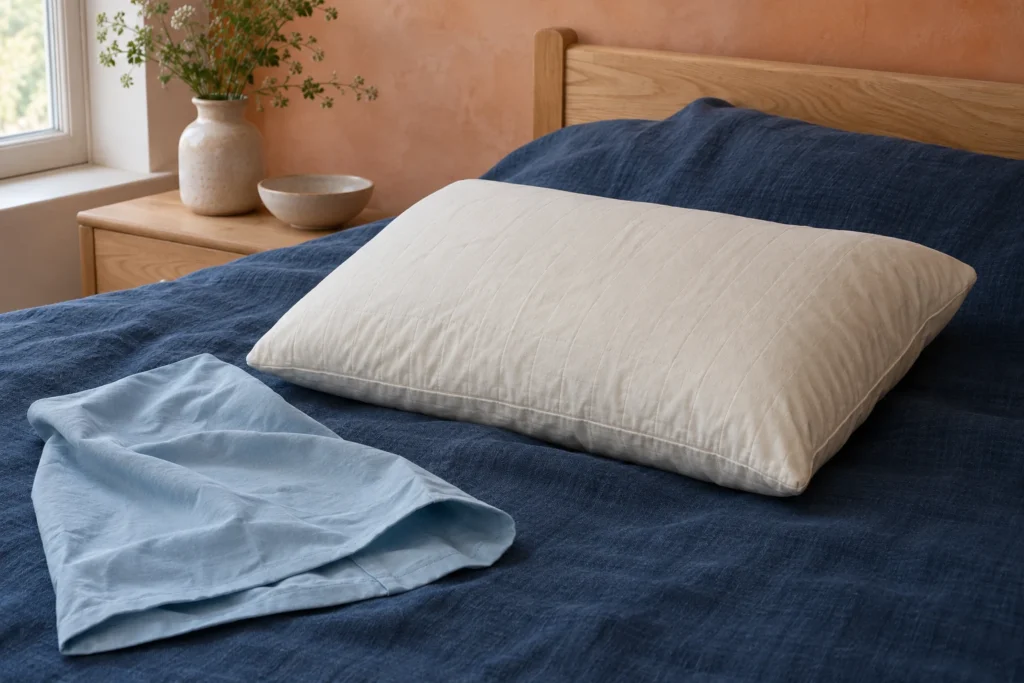
To learn how to wash wool pillows safely, first establish whether the instructions allow washing the empty cover, the wool filling or the complete pillow. These are different permissions. Some models require spot cleaning; others allow hand washing or a restricted machine cycle. A washable cotton case does not make the filling washable.
For a fresh spill, remove the ordinary pillowcase and blot with a clean, absorbent towel. Before adding water or detergent, find the care instructions for the exact pillow. If you cannot identify it, ask the maker rather than trying a generic wool-washing recipe.
Researched by the Editorial Team using manufacturer instructions checked November 2, 2026. We have not washed or tested these pillows. The models below illustrate care differences; they are not a product ranking.
Identify which part of your wool pillow needs cleaning
Take off the everyday pillowcase and examine the construction without cutting seams or pulling the pillow apart. Product descriptions sometimes use “case” and “cover” interchangeably, so match the instructions to the actual component.
- Everyday pillowcase: the separate fabric case against your face. Follow its own washing label.
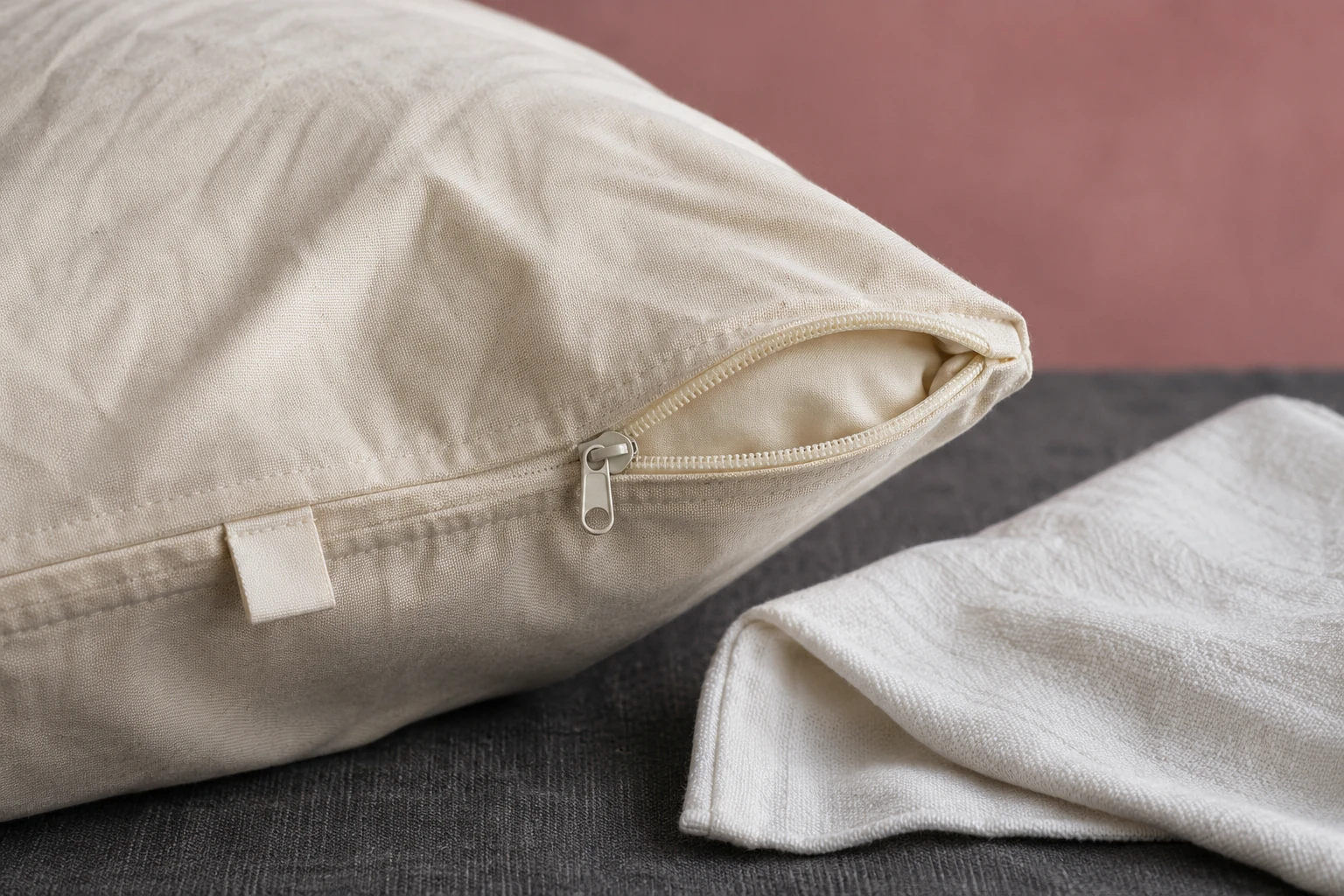
- Removable outer cover: a zippered shell that may contain quilting or wool batting of its own. It can have different instructions from both the pillowcase and the inner pillow.
- Loose wool filling: clusters or puffs that some adjustable pillows let you remove. Removable does not automatically mean washable.
- Fixed wool batting: layers held inside a sewn or quilted casing. Do not treat this as loose fill or open seams to remove it.
- Complete filled pillow: casing and filling together. Look for explicit permission to wash this assembly.
A zipper can provide access to an inner pillow or directly to the filling. Check before emptying anything. If the instructions are missing, send the manufacturer the model name and photographs of the label and construction. Ask which components may get wet and how each must dry.
What current wool-pillow care instructions actually allow
The differences are substantial, even between pillows with similar names. Use this table to identify the right question for your pillow, then follow its label and the linked model-specific directions.
| Exact model | What may be washed? | Drying or other limitation |
|---|---|---|
| Woolroom Deluxe Washable Wool Pillow — US | Remove the wool balls; wash only the empty outer cover on a wool/delicate cycle with specialist wool wash. | Hang-dry the cover; no tumble drying. The calico storage bag is not permission to wash the filling. |
| Holy Lamb Organics Organic Wooly Down Bed Pillow | Remove the wool puffs. Cold-machine-wash the empty case; filling is not washable. | Product page allows line drying or low tumble drying; the general care page says hang-dry. See the discrepancy below. |
| Holy Lamb Organics Certified Organic Wool Bed Pillows | Fixed wool-batting pillows: spot-clean only. | Do not transfer separate pillowcase-washing instructions to the filled pillow. |
| Shepherd’s Dream Customizable Wooly Down Pillow | Hand washing is permitted for this model. Detailed directions include separating the filling for drying. | Air-dry according to the model instructions; the detailed care page describes a limited dryer finish only after the fill is mostly dry. |
| Sleep & Beyond myWoolly Pillow | Complete pillow: cold wool/delicate machine cycle, without agitation; approved wool detergent; no spin. | Air-dry or tumble-dry on low as specified. Frequent washing can clump the puffs. |
A current instruction conflict: Holy Lamb Organics’ general care page specifies hanging the Wooly Down case to dry, while its product page also permits low tumble drying. Air drying is common to both. Check your label and ask the company before using a dryer if your instructions disagree. The same general page excludes pillows from its broader soak-and-spin washing method.
How to wash wool pillows when only the cover is washable
If the maker permits washing the empty cover, keep the filling out of that wash. This is often the most useful distinction for someone who wants to clean surface soil without wetting the whole pillow.
- Confirm what comes off. Remove only the parts intended to be removed. Keep fixed batting and sewn inner casings intact.
- Keep removable filling clean and dry. Set it aside in the manufacturer’s supplied bag or another clean, dry container while you care for the cover. Do not assume a storage bag belongs in the washer.
- Follow the cover’s complete instructions. Check cycle, temperature, detergent and drying method. A quilted cover containing wool needs the care specified for that construction, even when its visible fabric is cotton.
- Reassemble only when fully dry. Check seams, quilting and corners before putting dry filling back inside. Close the zipper without catching wool in the teeth.
Washing an empty case will not remove contamination inside the filling. If a spill went through both layers, identify what reached the wool before deciding that the job is finished.
How to spot-clean a nonwashable wool pillow
For a fresh accident, blot first: press a clean absorbent towel against the affected area and replace it as it becomes wet. Avoid rubbing, twisting or spreading the liquid across a larger patch. Holy Lamb Organics’ care guidance emphasizes prompt absorption and gentle handling.
Then use the spot-cleaning method specified for your model, if one is provided. “Spot-clean only” is a restriction, not a complete detergent recipe. It does not tell you that any household stain remover, amount of water or soaking time is safe.
Where the maker permits a damp cloth or cleaning solution, apply only the directed treatment to the affected area and follow its drying instructions. Do not improvise extra rinsing that saturates the filling. If the directions are too vague to use confidently, ask the manufacturer before adding chemicals.
Stop treating the surface as the whole problem when moisture has reached the center. A stain on the cover and liquid inside nonwashable fill need different decisions. Persistent odor after surface cleaning is a reason to reassess the depth of contamination, not a reason to keep adding fragrance.
Can wool pillows go in the washing machine?
Some can, but only under their own model-specific conditions. A wool cycle does not make every wool-filled pillow machine washable. Equally, a blanket rule that wool pillows must never be washed would contradict some manufacturers’ instructions.
Read beyond the words “machine washable”
Sleep & Beyond specifies a wool or delicate cycle “without agitation” and separately prohibits spinning for its myWoolly Pillow. If your washer cannot meet those conditions, ask the company which process it approves for your appliance. Do not substitute a standard delicate cycle on the strength of its name alone.
Check the appliance manual as well: the load must be suitable for the machine and permitted program. Do not pack a pillow tightly into a drum, bypass a load restriction or add an extra spin to speed drying when the pillow maker prohibits it.
Hand washing is also model-specific
For its customizable pillow, Shepherd’s Dream describes cool-water hand washing with wool wash, gentle handling and pressing rather than wringing. Its detailed process separates damp filling for drying and permits an air-dry tumble finish after it is mostly dry. That sequence applies to this model; it does not override Holy Lamb Organics’ prohibition on washing its similarly named Wooly Down filling.
Before wetting any washable filled pillow, make sure you can complete the entire drying process. Permission to wash is of little practical use if you have no suitable way to dry the center.
Why an unsuitable wash can change the pillow
Wool’s surface scales affect how fibers move against one another. Wet mechanical action can encourage untreated fibers to entangle and felt; Woolmark explains how shrink-resist treatments alter this behavior. The filling, casing and quilting still form a finished product with its own limitations. Cold water alone cannot cancel an unsuitable process.
Our explanation of wool shrinkage separates these mechanisms in more detail. For pillows, the immediate concern is preserving the filling’s distribution and the shape of the whole assembly, not simply preventing a cotton cover from shrinking.
Choose detergent only after confirming washability
For washable wool, Woolmark recommends a mild, neutral wool detergent and advises against heavy-duty detergents, enzyme-containing “bio” detergents, and chlorine or oxygen bleach. Follow both the pillow maker’s requirements and the detergent’s directions.
That guidance concerns the fiber; it does not authorize washing a pillow labeled spot-clean only. Nor should a wool-safe detergent’s hand-washing recipe override a pillow’s restrictions on soaking, movement or rinsing.
Our wool-detergent guide can help you compare suitable products once you know washing is allowed. This article does not recommend vinegar, baking soda, steam or homemade mixtures as substitutes for the model’s approved process.
Dry the filling completely before using the pillow
A dry-feeling shell does not establish that the center is dry. Do not put a pillowcase back on, return the pillow to bed or seal it away while moisture remains inside.
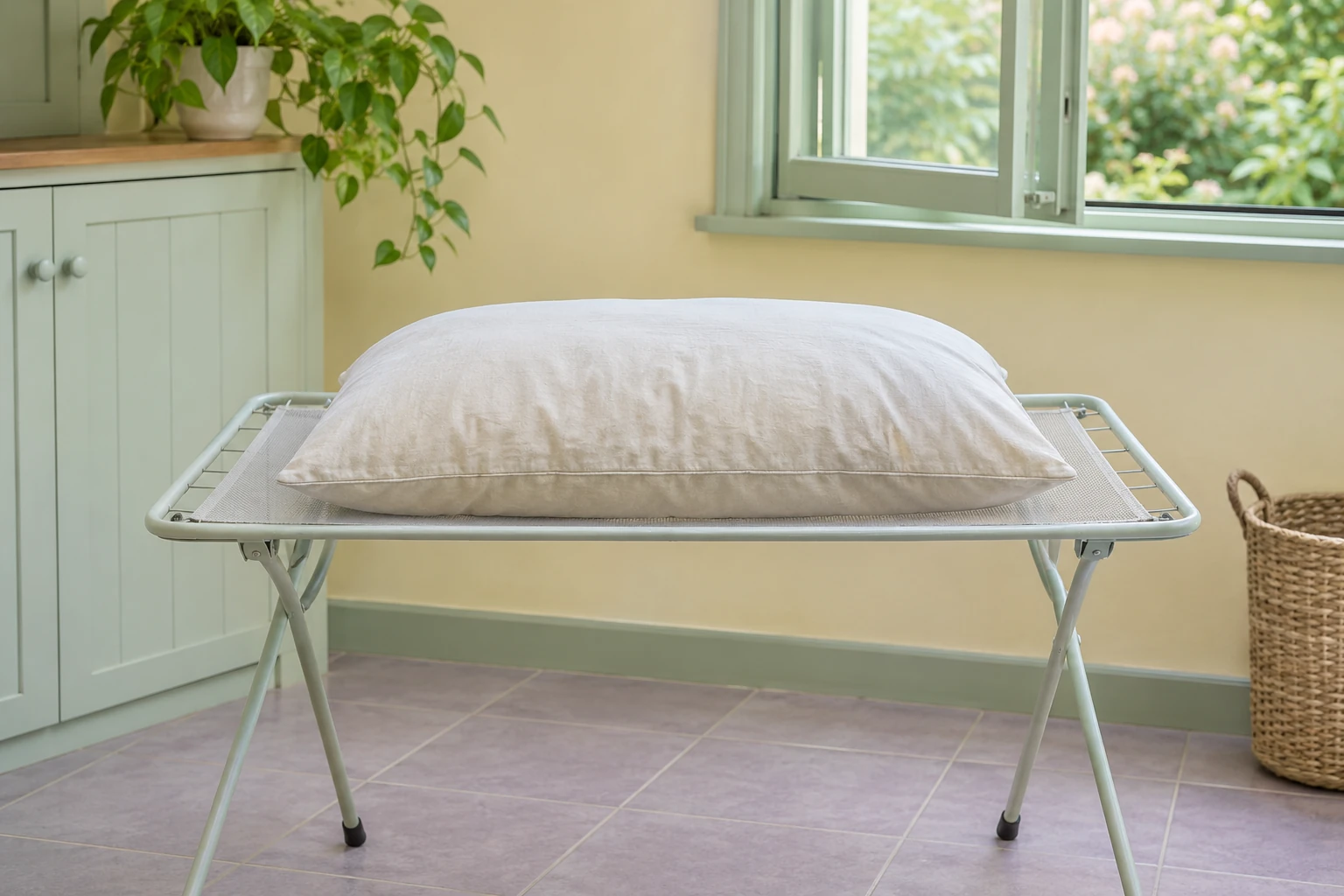
Follow the specified drying method and support the pillow as directed. For permitted air drying, arrange clean support and air circulation rather than leaving the underside against a damp surface. If the manufacturer instructs you to remove adjustable filling for drying, follow that process; do not open a fixed pillow to imitate it.
There is no reliable universal drying time for all pillow sizes, fill densities and rooms. Check the interior where it is designed to be accessible. If you cannot establish that a thick pillow is dry throughout, seek the maker’s advice before use.
Do not turn up dryer heat or place a pillow against a heater to hurry matters. Low-heat tumble drying, an unheated air setting and no tumble drying are different instructions. A manufacturer’s permission for one model is not evidence for another. Direct sunlight is likewise not a universal drying requirement.
Maintain loft without unnecessary washing
Wash the everyday pillowcase and any washable protector according to their labels, and deal with spills promptly. Keeping an appropriate removable layer clean can reduce the need to wet the pillow itself.
Use only the loft-maintenance method intended for your construction. Holy Lamb Organics allows owners of its adjustable Wooly Down pillow to separate the puffs; that does not mean fixed batting should be pulled apart. If the fill has become persistently compacted, ask whether it can be refreshed or replaced rather than forcing it back into shape.
Airing can be part of routine maintenance where the maker recommends it. It should not be treated as verified disinfection or as adequate cleaning of a pillow contaminated through its filling. A fresher smell alone does not establish that contamination has been removed.
When to ask a professional—or replace the pillow
Contact the manufacturer when a spill has soaked nonwashable filling, odor persists after the permitted care, the shell is damaged, or you cannot dry the pillow thoroughly. Describe the model, affected component and what you have already applied. A qualified cleaner needs that information before deciding whether a suitable process exists.
Professional cleaning is not automatically synonymous with dry cleaning. Holy Lamb Organics prohibits dry cleaning in its care guide. Sleep & Beyond recommends a specified professional dry-cleaning process for major stains in myWoolly. Ask the manufacturer and cleaner to agree on the process for your exact pillow.
If contamination cannot be addressed through an approved process, or the filling remains unusable after permitted care, replacement may be the more practical option. There is no guarantee that cleaning will restore its former loft or remove every stain or odor.
For a replacement, make the care policy part of the decision. Our wool-pillow buying guide covers construction choices; check that the exact version you buy has a cleaning and drying routine you can realistically follow.