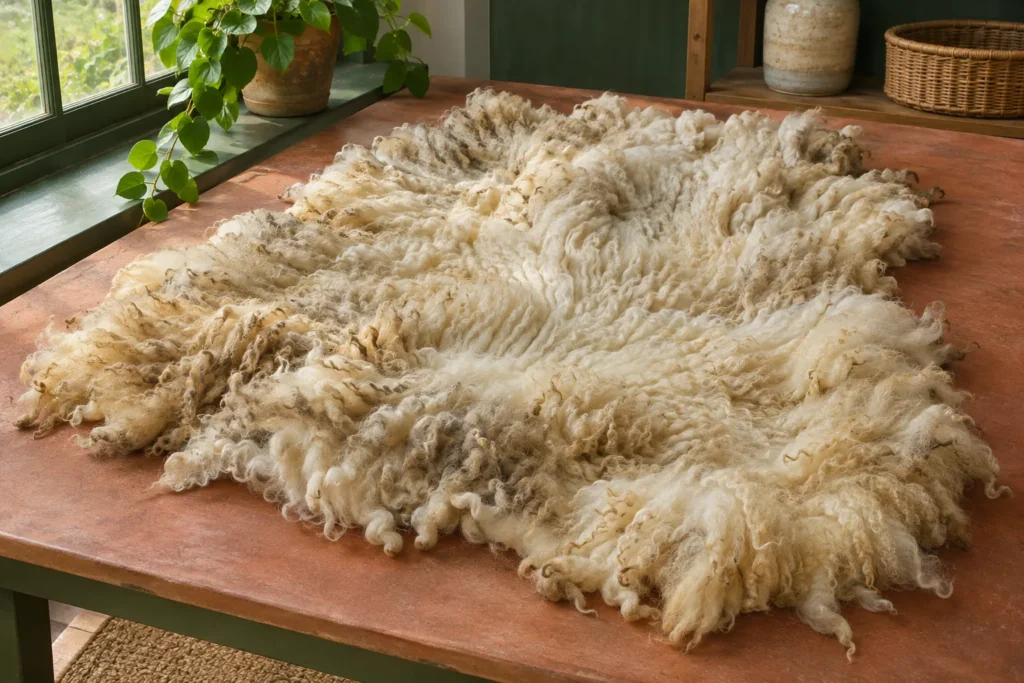
Learning how to wash raw wool fleece starts with two ideas: remove what does not belong in the fleece before it reaches the water, and minimize movement once the fiber is wet. A small, well-skirted batch is easier to clean than an entire fleece, while calm soaking and careful rinsing reduce the risk of matting. The exact water temperature, detergent dose, and soak time should come from the scouring product you choose—not from a single universal recipe.
This beginner’s guide covers sheep’s wool intended for hand processing. It explains how to assess and skirt a fleece, wash it in manageable batches, rinse without unnecessary handling, dry it thoroughly, and decide whether a difficult fleece is worth processing at home.
Quick answer: how to wash raw wool fleece
- Read the scouring product’s instructions and set up a dedicated, clean work area.
- Skirt the fleece thoroughly, removing manure tags, matted edges, second cuts, heavy vegetable matter, and weak or badly stained wool.
- Test-wash a small sample before committing the whole fleece.
- Fill a basin with the product-specified amount of hot water and wool-scouring wash. Add a small, loose batch without crowding it.
- Let the fiber soak without stirring, scrubbing, or running water directly onto it.
- Lift and drain the batch gently. Repeat the wash only if the remaining grease and soil justify it.
- Rinse in clean water, keeping baths reasonably consistent and avoiding agitation.
- Press out water without wringing, then dry the fleece in a thin layer on a clean mesh rack with good airflow.
Hot water requires care. Use a thermometer, protect your hands, keep children and pets away, and follow the chosen cleaner’s label. A product-specific method may call for a particular temperature or concentration, but that does not make the same settings appropriate for every detergent or fleece.
Know what stage of wool you have
Fiber terms can sound interchangeable, but they describe different stages. Washing instructions for a skein of yarn or a sweater are not a substitute for scouring freshly shorn fleece.
| Term | What it means | Ready to spin? |
|---|---|---|
| Raw or greasy fleece | Freshly shorn wool containing grease, suint, soil, and possibly vegetable matter | No |
| Skirted fleece | Raw fleece after the least useful and most contaminated sections have been removed | Usually still needs scouring |
| Scoured fleece | Loose wool washed to remove most grease and soluble soil | Needs drying and usually preparation |
| Carded or combed fiber | Clean fiber opened and organized into rolags, batts, roving, or top | Generally yes |
| Yarn or garment | Fiber that has already been spun or made into fabric | Use yarn or garment care guidance instead |
If you are still choosing material, our guide to raw versus washed wool fiber explains the trade-offs in cost, labor, control, and waste. The broader wool fiber guide shows where scouring fits into the journey from sheep to usable fiber.
What scouring removes—and what it does not
Raw fleece contains wool grease, often called lanolin, plus water-soluble suint and ordinary dirt. Woolmark’s overview of commercial scouring describes staged washing and rinsing designed to remove these contaminants while controlling entanglement.
Scouring is not a cure for every problem. Soap does not dissolve burrs, hay, seeds, paint, or sound but permanently stained fiber. Some remaining particles may loosen during later preparation, and carding can remove additional contaminants, but heavy vegetable matter should be rejected or removed before washing. A fleece with extensive cotting, skin flakes, weak fibers, or severe contamination may not justify the time and water required.
Before washing: assess, sort, and skirt the fleece
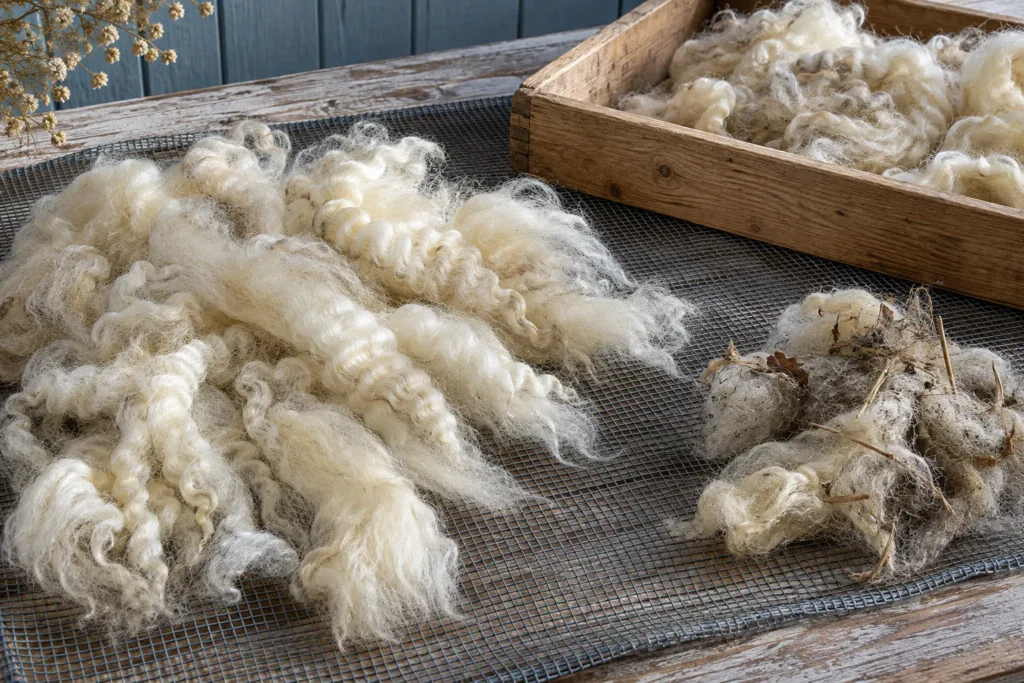
Work outdoors or in a well-ventilated utility area on a mesh surface or clean sheet. Keep raw fleece away from food-preparation surfaces. The University of Maine Cooperative Extension recommends removing tags, contaminated areas, very short fibers, second cuts, matted wool, and other low-value material during skirting.
Check these four things
- Strength: Hold a small lock near each end and pull gently. Repeated breaks at the same point can signal tender fiber that may create excessive waste.
- Staple and tips: Separate brittle or weathered tips and very short second cuts. Group noticeably different areas of the fleece rather than washing everything together.
- Contamination: Discard manure tags and heavily soiled edges. Pick out large vegetable matter without shredding it through the locks.
- Odor and condition: Normal sheep and grease odors are expected. Persistent putrid odor, visible mold, insects, or unknown chemical contamination calls for caution and often disposal or professional advice.
Items associated with animals can carry germs. The CDC recommends handwashing after handling animals and items from animal environments. Cover cuts, consider gloves for dirty fleece, clean the workspace afterward, and do not reuse a fleece basin for cooking.
Equipment for a small-batch fleece wash
- Two dedicated heat-safe basins or a basin and utility sink
- A thermometer suitable for water
- A wool-scouring cleaner or detergent whose maker provides raw-fleece directions
- Heat-resistant gloves or another safe way to handle the container
- Mesh laundry bags or baskets, optional, to support locks without packing them tightly
- Clean towels and a raised mesh drying rack
Avoid chlorine bleach, fabric softener, and products without clear compatibility or dosing information for wool. Enzyme-containing laundry detergents may be unsuitable for protein fibers; choose a product intended for wool and follow its current label. More cleaner is not necessarily more effective and can make rinsing harder.
How to wash raw wool fleece step by step
1. Test a representative sample
Choose several locks from a useful part of the fleece, not only the cleanest edge. A test batch reveals how much grease remains, whether the tips open, how the color changes, and how easily the fiber tangles. Record the product, dose, bath temperature, soak time, and result so you can repeat a successful process.
2. Fill the wash bath before adding fleece
Use enough water for the wool to remain loose rather than compressed. Measure the detergent according to the product instructions, then disperse it in the water before the fiber enters. Do not run a tap directly onto raw locks.
There is no responsible one-number temperature rule for every method. For example, Unicorn Clean’s current raw-fleece directions describe a temperature and dose for its own product. Treat that as manufacturer-specific guidance, not a universal formula. Very hot water can scald, and product performance changes with water volume, mineral content, fleece grease, and batch size.
3. Add a loose, small batch
Lower the wool onto the bath and press only enough to wet it. Do not stir, scrub, twist, or repeatedly lift it. Wool fibers have overlapping surface scales; moisture and mechanical action can encourage irreversible entanglement. Woolmark’s explanation of felting shrinkage is a useful reminder that movement is a major part of the risk—not temperature change alone.
4. Soak, then lift rather than pour
Use the cleaner maker’s time range. Let the bath work while it is warm enough for that product. Support the fiber from underneath when removing it, allow water to drain, and set it aside. Pouring fleece and dirty water together can compress locks and redistribute soil.
5. Decide whether another wash is needed
A very greasy fleece may need a fresh wash bath. Do not judge only by brown water; soil color varies, and some clean-looking water can still contain grease. Rub a cooled, dry sample between clean fingers. If it feels sticky or leaves obvious residue, repeat with fresh solution rather than extending a spent bath indefinitely.
6. Rinse calmly in clean water
Prepare the rinse before moving the fleece. Keep successive baths reasonably similar and avoid sudden rough handling. Lower the wool in, let it rest, then lift and drain. Repeat with fresh water until the rinse no longer feels soapy and the fiber does not show obvious cleaner residue. Crystal-clear water is not always necessary if natural color or fine debris remains.
7. Remove water without wringing
Support the wet fleece, press gently against the basin, and place it on a clean towel. Roll and press the towel if needed, but do not twist the fiber. A washer’s spin-only cycle is sometimes used by experienced processors with suitable equipment, yet machine settings vary; beginners can avoid that variable and drain by hand.
Drying washed fleece safely
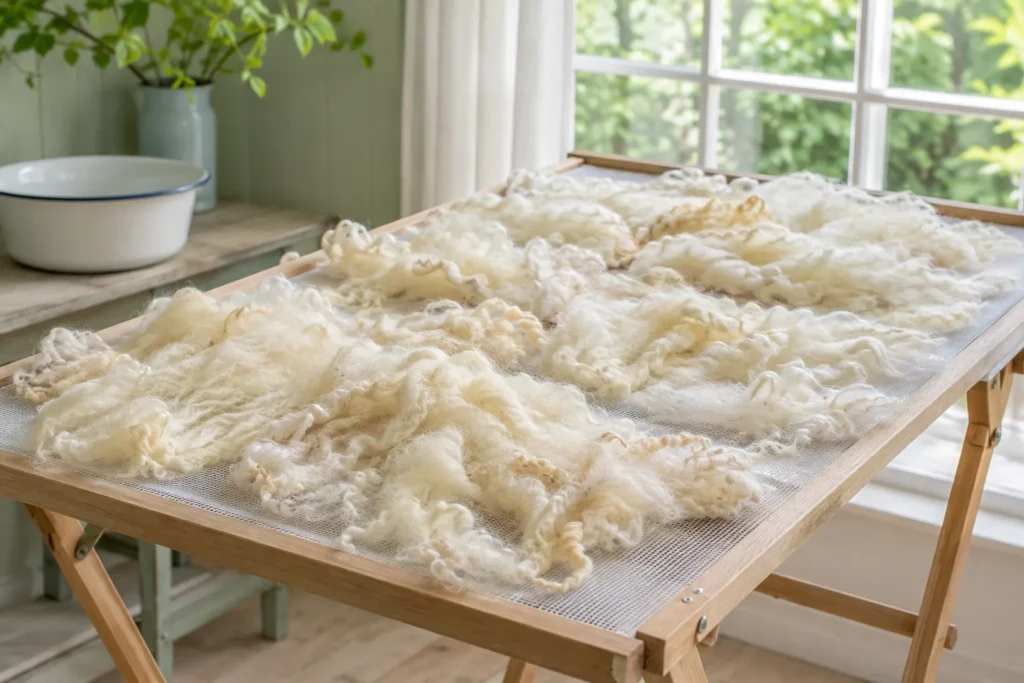
Spread the fleece thinly on a clean mesh rack so air reaches both sides. Keep it away from pets, dust, smoke, cooking areas, and strong wind that could scatter locks. Shade and moving air are usually more useful than intense direct heat. Turn or loosen sections only after they have drained enough to handle without compression.
Drying time depends on humidity, fiber density, grease left in the wool, and how thickly it is spread. Check dense centers and lock bases, not just the surface. Bagging damp fiber invites odor and microbial growth. Store only when the fleece is fully dry and cool in a breathable, pest-conscious setup until it is ready for preparation.
Common problems and what they mean
| Problem | Likely cause | Safer next step |
|---|---|---|
| Fiber feels sticky after drying | Residual grease, too little cleaner, crowded bath, or water that cooled too much for the chosen method | Test a small second wash using the product’s measured directions |
| Locks are matted | Agitation, crowding, repeated handling, or pre-existing cotting | Stop manipulating them; let them dry, then assess whether gentle preparation can recover usable fiber |
| Rinse keeps foaming | Too much cleaner or an overloaded batch | Use fresh rinse water and calm soaks; reduce the next batch or dose as the label allows |
| Vegetable matter remains | Scouring does not dissolve plant debris | Remove it by hand and during carding or combing; reject heavily contaminated sections |
| Fiber smells musty after storage | It was bagged before the interior was fully dry | Unpack immediately, inspect for mold, and discard questionable fiber rather than trying to mask the odor |
| Tips stay dark | Staining, weathered tips, embedded dirt, or remaining grease | Test a few locks; do not keep washing if the fiber is clean but permanently discolored |
Mistakes that waste fleece
- Washing before skirting: This consumes cleaner and water on fiber you may discard later.
- Overfilling the basin: Packed wool cannot release soil evenly and is harder to move without compression.
- Agitating to “help” the cleaner: Stirring and rubbing increase entanglement risk.
- Guessing detergent amounts: Underdosing may leave grease; overdosing creates unnecessary rinse work.
- Chasing white color: Natural cream, gray, brown, and stained tips do not prove the fiber is dirty.
- Drying in thick piles: The surface can feel dry while the center remains damp.
When home washing is not the best option
Professional fiber mills can be a better choice for a valuable fleece, a very large quantity, or fiber you are not equipped to evaluate. Ask what contamination limits the mill accepts, whether it requires skirting, how it handles fine or longwool breeds, and how it charges for incoming versus finished weight.
Discard rather than home-process fleece with visible mold, active insect infestation, severe manure contamination, unknown pesticide or chemical exposure, or extensive weakness. Sentimental value does not make unsafe or structurally unsound fiber usable.
What comes after scouring?
Once clean and completely dry, locks can be opened, carded, or combed according to fiber length and the yarn you want. Our wool spinning guide explains the larger workflow, while the drop spindle guide covers an accessible way to begin. For finished results and terminology, see the guides to wool yarn and handspun wool yarn.
Frequently asked questions
Can I wash an entire raw fleece at once?
Small batches are safer for most beginners. They give grease and soil room to leave, make the water easier to manage, and reduce the weight of wet fiber you must lift without compressing it. Test first, then repeat consistent batches.
Does hot water alone felt wool?
Felting is not explained by heat alone. Moisture, fiber-scale behavior, mechanical action, compression, and the condition of the fleece all matter. Hot water may be needed to remove grease under a particular method, but it must be handled carefully and paired with minimal movement.
Can I use dish soap on raw fleece?
Some experienced processors use particular unscented dish products, but formulas can change and dosing guidance for fleece may be absent. A wool-scouring product with current raw-fleece instructions gives a beginner clearer information about concentration, temperature, and rinsing.
Do I need to remove all the lanolin?
That depends on the next process and your preference, but sticky grease can interfere with carding, attract soil, and make consistent spinning difficult. “Clean” does not require stripping the fiber harshly. Evaluate a dry sample and avoid repeated washing after it is usable.
Why does my washed fleece still contain hay?
Detergent removes grease and soluble soil; it does not dissolve plant material. Skirting, hand-picking, opening, carding, and combing remove different amounts. A heavily contaminated fleece may never become efficient handspinning fiber.
How do I know when washed fleece is fully dry?
Check the thickest locks and the fiber closest to the rack, not only the fluffy surface. The fleece should feel dry and room-temperature throughout, with no cool damp center. When uncertain, give it more airflow before storage.
The safest beginner approach
The best way to learn how to wash raw wool fleece is to make the process smaller and more observable: skirt firmly, test a representative sample, measure the product you chose, keep wet fiber calm, rinse without crowding, and dry every lock completely. The goal is not to force every fleece to look identical. It is to produce clean, structurally sound fiber that remains pleasant to prepare and spin.