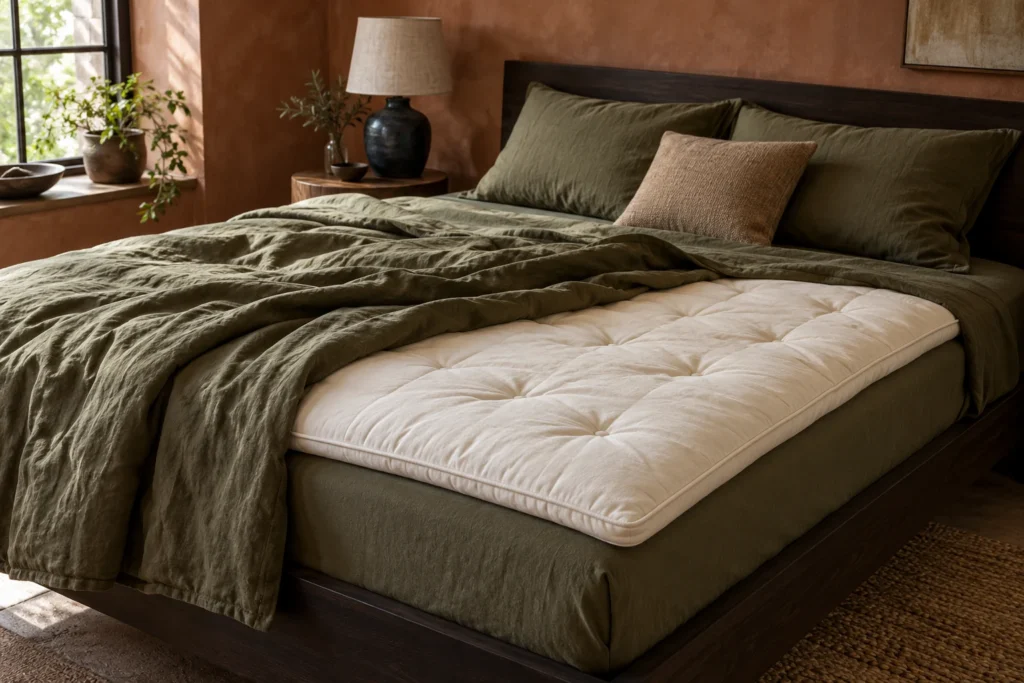
How to clean a wool mattress topper depends on the care instructions for the filled topper itself. Many models permit only local spot cleaning; some are machine washable under specific conditions. Blot a fresh spill promptly with a clean absorbent cloth, avoid rubbing or soaking, and do not remake the bed until the affected bedding is completely dry.
The important distinction is what needs cleaning: a removable protector, the topper’s sewn-on fabric shell, or contamination inside the filling. A washable cotton cover does not make the wool-filled layer beneath it washable.
Researched by the Editorial Team using manufacturer care instructions and Woolmark guidance, checked November 1, 2026. We have not washed or physically tested these toppers. The examples explain model-specific differences, not a universal cleaning recipe.
How to clean a wool mattress topper: identify the affected layer
Remove the sheets and any separate protector, keeping wet bedding away from clean layers. Look at both sides of the topper and the mattress beneath it. A spill contained by the protector calls for a different response from one that has reached the wool filling.
Find the model name on the attached label or order record. Then check washing, drying and professional-cleaning instructions together. Woolmark’s care-symbol guide helps interpret the symbols, but its garment examples do not supply a washing program for a bulky topper.
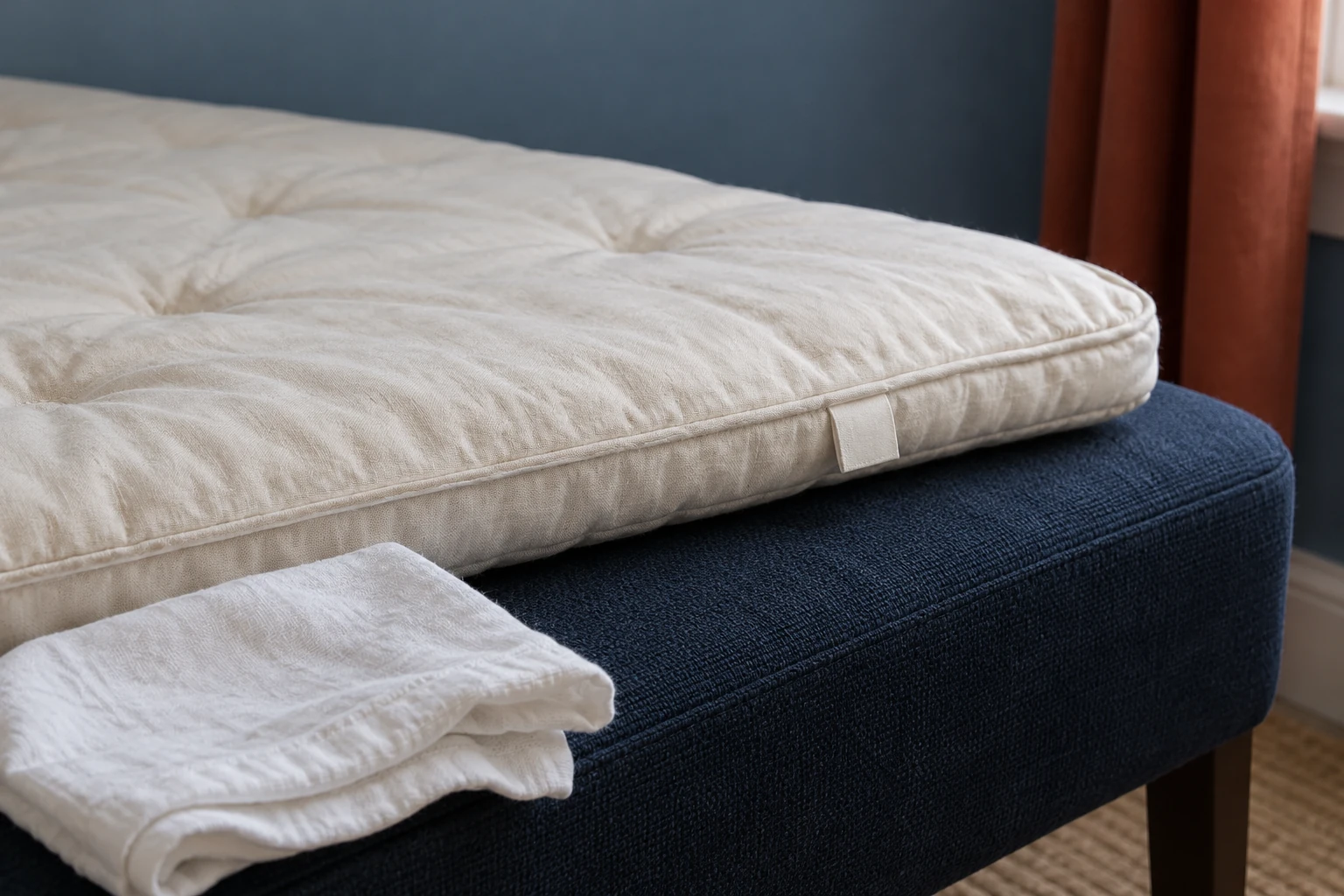
Keep these parts separate:
- Protector or removable encasement: a separate layer with its own care instructions. Remove it before washing when directed.
- Sewn-on shell: the fabric enclosing the filling. Permission to spot-clean this surface is not permission to immerse the whole topper.
- Filling and internal construction: wool batting, quilting and, in some models, other materials. A zipper alone does not prove the cover is intended for home removal.
Some wool toppers incorporate latex or springs. Identify those components rather than borrowing advice for a plain wool pad; our wool versus latex topper comparison explains the construction differences.
If the label is missing or conflicts with the website, send the manufacturer a label photo, model name and purchase date. Until it clarifies the instructions, pause wet cleaning.
What current manufacturer instructions actually allow
These examples concern the named filled toppers, not similarly named protectors. They show why “wool” and “organic” cannot determine a cleaning method.
| Exact topper | Published care route | Important boundary |
|---|---|---|
| Sleep & Beyond myMerino Topper | Spot-clean the cotton shell; complete air drying. Specified dry cleaning for major stains. | Its care page does not authorize whole-topper machine washing. |
| Sleep & Beyond myTopper | Machine washable under restricted conditions; local cleaning also permitted. | The wash and drying directions below apply to myTopper, not myMerino. |
| Naturepedic Wooly Organic Wool Mattress Topper | Spot cleaning only; dry fully afterward. | No machine washing, ironing or bleach. |
| Woolroom Wooly Mattress Topper, US model | Damp cloth and wool detergent for local cleaning. | Machine washing and dry cleaning are both prohibited. |
| Holy Lamb Organics Certified Organic Quilted Topper, Deep Sleep and Ultimate | Spot cleaning; not machine washable. | Do not apply the brand’s instructions for a different product or size. |
Read the product-specific section even when a brand also publishes general bedding instructions. Holy Lamb Organics’ broader care page discusses washing some items, but separately restricts mattress toppers to spot cleaning. Naturepedic’s phrase “natural cleaners” is not a list of approved household ingredients; ask which product it recommends for your stain.
Handle a fresh spill before adding water
When deciding how to clean a wool mattress topper after a spill, first absorb the liquid already there. Ecodownunder’s wool-underlay care instructions start with a dry, soft cloth or sponge. That is a useful first-response principle; its later cleaning directions remain specific to its own underlay.
- Lift away wet sheets or the protector. Check whether liquid reached the topper rather than automatically treating every layer.
- Blot with a clean, dry, white absorbent cloth. Press gently and lift. Move to a dry section as it absorbs liquid; do not scrub the mark across the shell.
- Check the extent. Look at the underside, seams and mattress. Dampness through the depth, several affected areas or a substantial spill warrants manufacturer advice before adding more liquid.
- Choose the permitted next step. A small surface mark may suit local cleaning. A soaked filling is not just a larger surface stain.
Tell the manufacturer what spilled, roughly how much, when it happened and anything already applied. A phone photo can help explain the affected area, although it cannot establish how far contamination has traveled inside.
Spot cleaning means local treatment, not saturation
Once the model permits it, use the maker’s specified cleaning product and application method. Woolroom’s Wooly instructions, for example, call for a damp cloth with wool detergent. Sleep & Beyond describes a soft brush and mild detergent for the myMerino cotton shell. Neither instruction justifies vigorous scrubbing or pouring solution into the filling.
Use the amount and any dilution directed for that application; a laundry dose for a full washer is not a spot-cleaning recipe. Test a permitted treatment in an inconspicuous area when the product instructions require it. Stop if color transfers, the shell changes texture or the treatment spreads the mark. Remove residue only by the method the maker allows, then follow its drying instructions.
For washable wool, Woolmark recommends mild, neutral detergent and advises against bleach-containing and heavy-duty enzyme detergents. Our wool-detergent guide explains formulation differences. Neither a wool-safe label nor a no-rinse claim authorizes a particular product on every topper.
Avoid experimenting with vinegar, baking soda, peroxide, enzyme sprays or combinations of products. Some manufacturers publish specific stain treatments, but those are not interchangeable permissions for another shell or filling. For an old stain with an unknown treatment history, ask for advice instead of repeatedly wetting it. A remaining discoloration does not necessarily mean that stronger treatment will remove it safely.
Can you machine wash a wool mattress topper?
Yes, if that exact finished topper is labeled for machine washing and your equipment can meet all its restrictions. Sleep & Beyond’s myTopper is a documented example: its current instructions specify cold water, a wool or delicate program without agitation, approved wool detergent and no spinning. Air drying or low-heat tumble drying is allowed; bleach and ironing are not.
That wording needs to be matched to the actual washer. If its “delicate” program includes movement or a spin you cannot disable, ask Sleep & Beyond to confirm a suitable program before proceeding. A reassuring cycle name is not enough.
Check capacity against both the washer manual and the topper manufacturer’s advice. Do not pack the drum tightly just because the door closes. Arrange the approved drying space and help with handling the wet item’s weight before starting. Do not wring it or pull it out by one corner.
For a spot-clean-only topper, hand washing in a bathtub is not a safer workaround. Nor should a household steam cleaner or carpet extractor be substituted for an approved process.
Woolmark explains that wet agitation can cause untreated wool to felt and shrink; shrink-resist processing changes that risk. Cold water does not remove the effects of unsuitable mechanical action. Excess moisture also creates a drying problem in a thick filled item.
The shell and stitching matter too. Woolmark’s bedding specification evaluates the finished product, including filling appearance and dimensional changes that may come from the filling, cover or stitching. A cotton exterior therefore cannot establish whole-item washability.
Airing and rotation between cleanings
When the topper is dry and unsoiled, routine maintenance need not mean laundering it. At sheet changes, inspect the shell and seams, look underneath and check for uneven settling. Follow the model’s directions for airing, flipping and rotation; rotating head-to-foot is different from turning it over.
Holy Lamb Organics’ care guidance recommends leaving bedding uncovered to let moisture evaporate and gives topper-specific rotation advice. Its general care page and individual product page describe different intervals, so use the instructions supplied with your model or ask the maker which schedule applies. Do not impose one calendar on every topper.
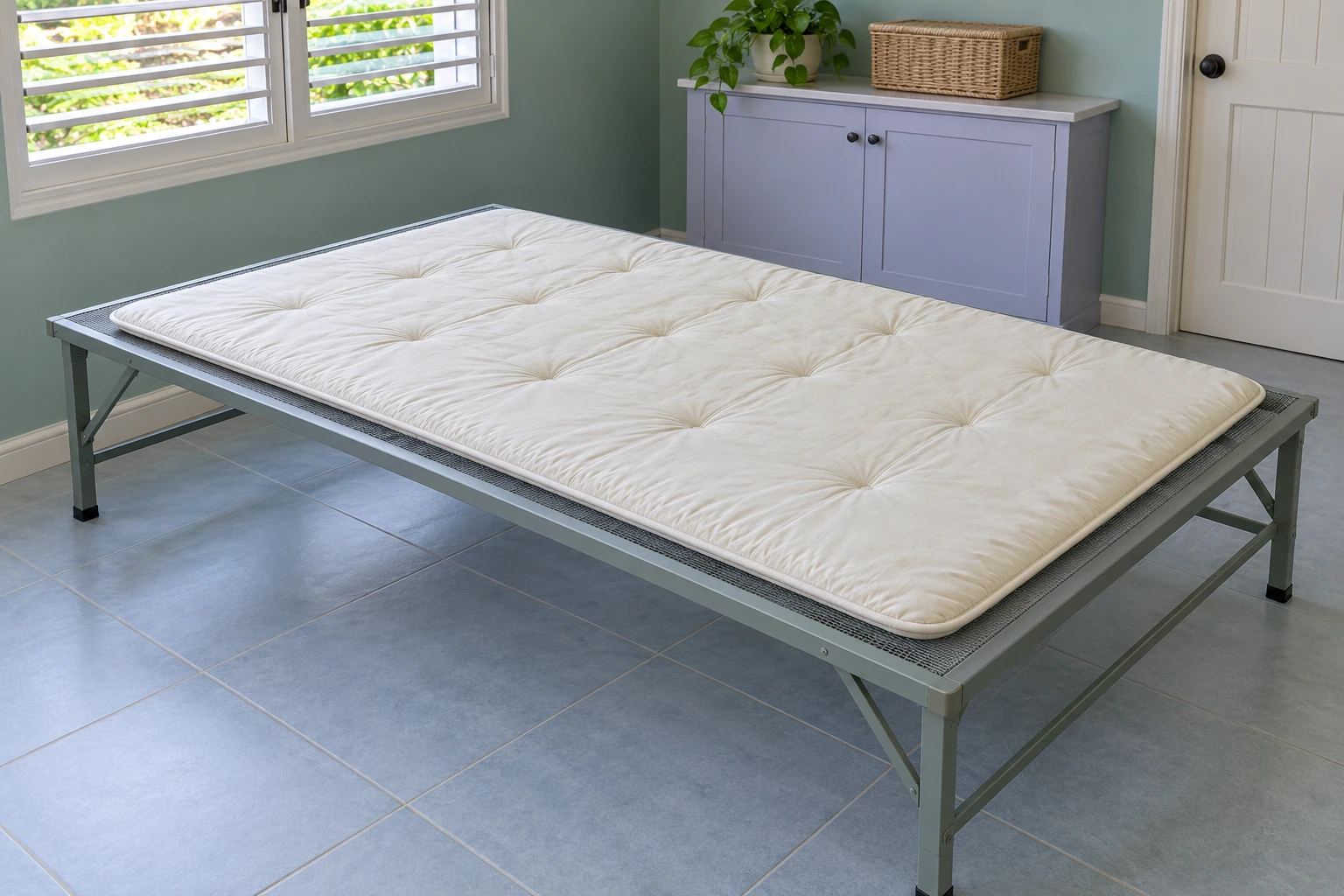
For airing, use a clean, dry, well-ventilated place and the support arrangement the maker permits. Keep a bulky topper securely supported rather than letting its weight pull on a corner or seam. If instructions recommend sunlight, confirm they apply to your complete construction, especially when latex or other materials are present.
Airing can refresh bedding; it is not evidence that bodily fluids, mold or other contamination have been removed or disinfected. Fluffing and rotation also do not guarantee restoration of the original loft: Holy Lamb Organics notes that wool batting settles with use.
Dry completely and take persistent odors seriously
Drying is part of cleaning, not the final few minutes after a stain disappears. Naturepedic expressly requires its Wooly topper to be fully dry after local treatment. Keep a treated area uncovered and use the approved drying arrangement with airflow around it.
As a practical check, examine both faces, bound edges, seams and thicker sections. A dry-feeling shell alone cannot certify that the filling is dry. If you suspect moisture inside, do not hide it under a protector or store it in a bag. Ask the manufacturer how to assess it and continue the permitted process.
There is no dependable drying time for every thickness, room and weather condition. Do not improvise with a radiator, hair dryer or hotter tumble setting to make the bed usable that evening. Plan to leave the topper off the bed while it dries if necessary.
A mild scent in a newly unpacked wool product is a different situation from an odor following urine, a spill or prolonged dampness. Describe that history rather than assuming every smell is normal wool. If odor persists after permitted surface cleaning and complete drying, the source may be beyond the shell. Repeated spraying can add moisture without resolving it.
Keep visibly moldy, persistently damp or deeply contaminated bedding out of use while obtaining advice. Fragrance, a cleaner-looking surface or a few hours of airing cannot confirm that it is suitable to sleep on.
When professional cleaning is appropriate
Contact the maker before booking a cleaner if liquid reached the filling, an odor returns, the cover has torn, quilting is loose or the topper has developed hard clumps after cleaning. Ask whether the problem can be addressed without a prohibited process and whether replacement may be necessary.
Professional cleaning is not synonymous with dry cleaning. Sleep & Beyond recommends a short, limited-moisture dry-cleaning process for major myMerino stains. Woolroom prohibits dry cleaning the Wooly, and Holy Lamb Organics’ general care guidance also rules it out. “Eco-friendly” on a cleaner’s sign does not resolve that difference.
Give the cleaner the label, model details and stain history. Ask which process they propose, whether it respects the maker’s restrictions, and how they will support and dry the filled construction. Do not authorize treatment solely because a business cleans wool clothing or carpets. Some contamination cannot be removed acceptably without damaging a nonwashable topper; no method here promises complete stain or odor removal.
Prevent the next stain without trapping a damp topper
Use a removable protector that fits the combined mattress-and-topper depth and meets the topper maker’s recommendations. If spills are the concern, check for an actual waterproof claim rather than assuming that a fitted sheet or wool moisture barrier provides equivalent protection. Follow the protector’s separate washing directions.
Wash the removable bedding as needed, inspect underneath at changes and replace it only when every layer is dry. Keep drinks away from the bed when practical. Before storing the topper, check its seams and cleanliness and follow the maker’s storage instructions.
Other wool bedding needs its own decision. If you are stripping the whole bed, our guide to washing a wool comforter explains how to distinguish the removable duvet cover from the filled insert. Do not give both items the same cleaning treatment simply because both contain wool.