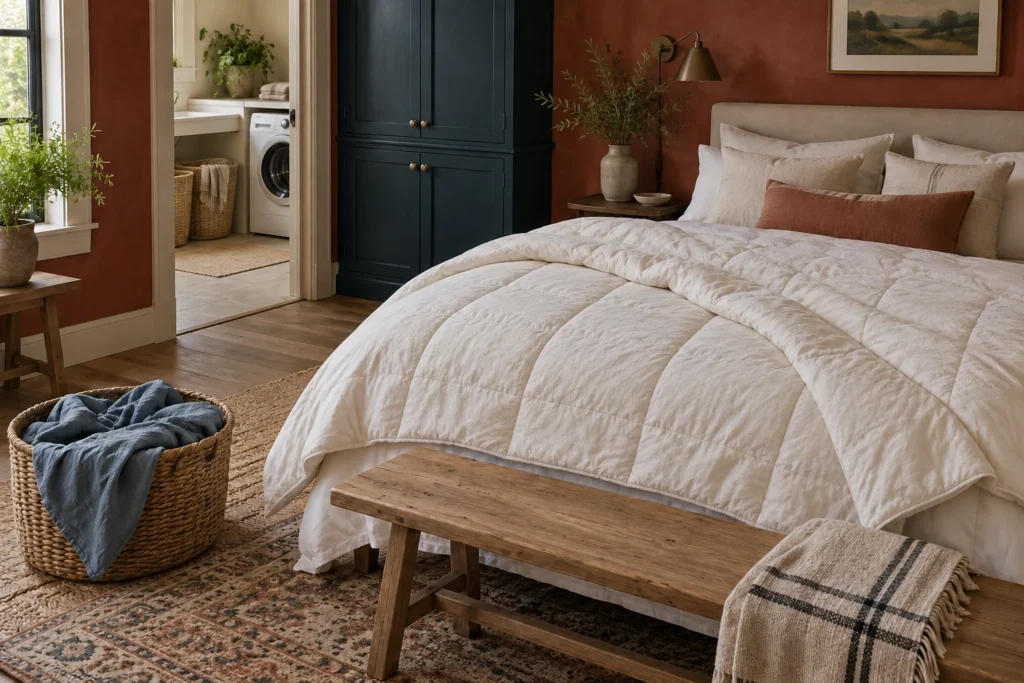
You can wash a wool comforter only if the care label on the filled insert permits it. Remove the duvet cover and check its instructions separately. A machine-washable insert needs the specified wash program and drying method; a spot-clean-only insert should not go into the washer or bathtub. If the label is missing, identify the model before wetting the whole comforter.
Knowing how to wash a wool comforter means caring for several parts together: the wool filling, its outer fabric and the stitching that holds everything in place. A cotton shell does not make the wool inside machine washable.
Researched by the Editorial Team using manufacturer instructions and Woolmark guidance, checked October 27, 2026. We have not laundry-tested these comforters. Examples below explain product-specific differences; your own item’s label and current model instructions take precedence.
Start with the insert’s care label
A removable duvet cover is the fabric enclosure you can take off. The insert is the filled bedding inside it, often also called a comforter. Washing the cover may be all that is needed when the insert remains clean.
Check washing, drying and professional-cleaning instructions together. Permission to wash does not imply permission to tumble dry. Woolmark’s care-symbol guide helps interpret the symbols; do not transfer its general garment temperatures or load advice to a bulky comforter.
| What the label allows | Your next step | Where to stop |
|---|---|---|
| Removable cover is washable | Remove it and follow the cover’s own label. | Do not assume the insert has the same instructions. |
| Machine washing | Match the cycle, water conditions, spin restrictions and drying method. | Stop if the machine or drying space cannot meet them. |
| Hand washing | Use the maker’s specific whole-item procedure. | Hand washing is not permission to soak, wring or machine-spin. |
| Spot cleaning only | Limit treatment to the permitted local area and method. | Deep or widespread contamination needs manufacturer advice. |
| Dry cleaning or specified professional care | Show the label to a cleaner experienced with wool-filled bedding. | Do not substitute home washing or a different cleaning process. |
| Missing, unreadable or conflicting instructions | Find the model through the order record and contact the maker. | Do not guess from the fiber content or appearance. |
Photograph the label before arranging cleaning. If it conflicts with a website, send the manufacturer the label photo, model name and purchase date. An older insert may not share the care instructions of today’s similarly named product.
Why the filling, shell and quilting matter
Wool fibers have a scaly surface. Moisture and mechanical action can encourage fibers to migrate and interlock, producing felting and shrinkage; heat can contribute to unsuitable laundering conditions. Shrink-resist processing changes that risk, but it does not make every finished wool item suitable for every wash program. Cold water alone is not a guarantee against damage.
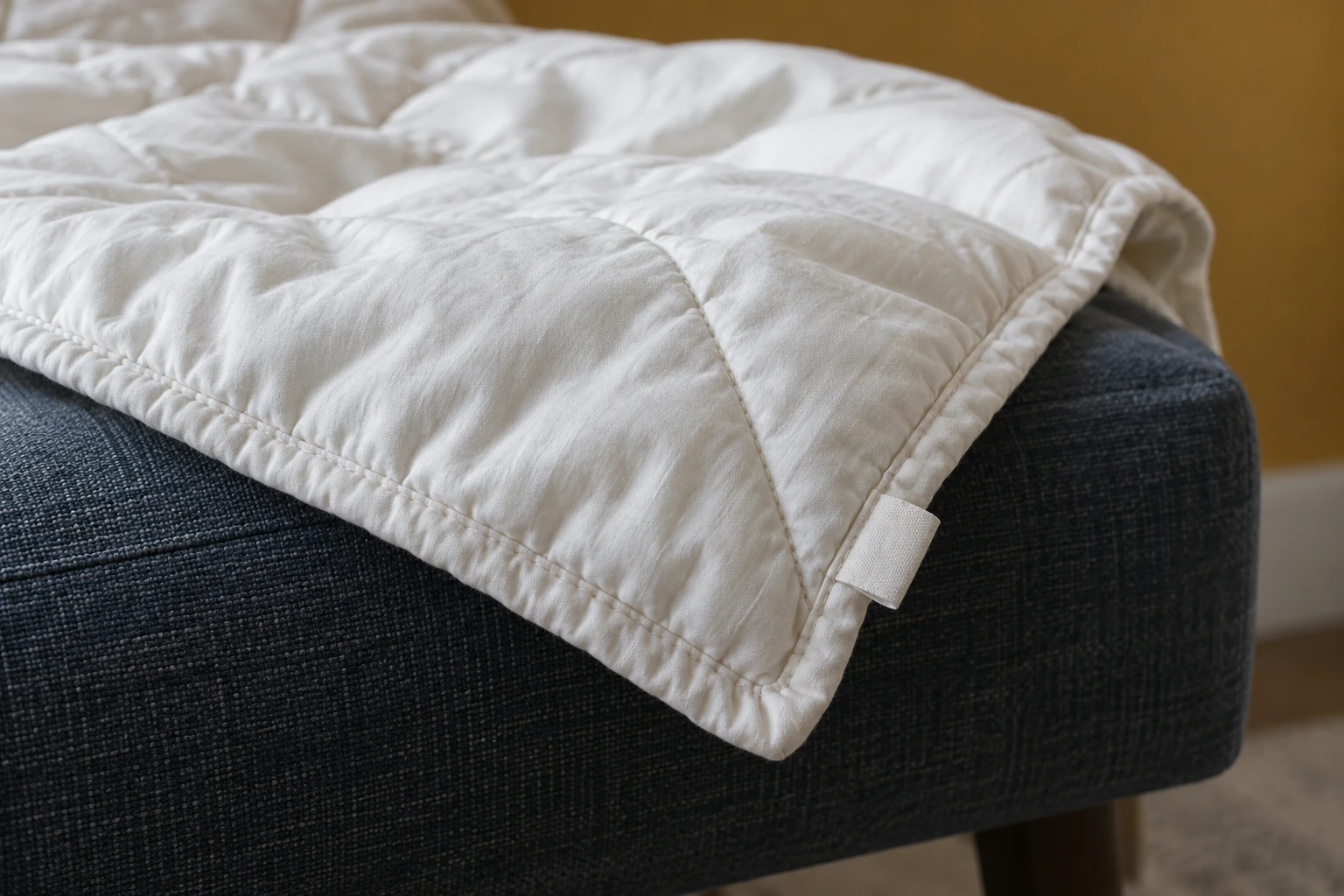
A comforter also has a shell and internal construction to protect. Woolmark’s specification for wool-filled bedding evaluates dimensional changes in the complete product: the filling, outer fabric or stitching can contribute. It also considers the filling’s appearance after the claimed cleaning process and requires it to be secured against movement.
That is why a washed insert can develop puckered seams or uneven filling even when its cover looks clean. Quilting helps keep the wool distributed; it does not grant permission for vigorous washing. Our explanation of why wool shrinks covers the fiber mechanism in more detail.
What actual manufacturer instructions show
These examples illustrate why a single wool-comforter washing recipe is unreliable. They are care examples, not product rankings.
- Woolroom Deluxe Washable Wool Comforter — Medium: the US product page identifies it as machine washable. Woolroom’s washable-comforter guidance calls for a wool or very gentle cycle, wool detergent and hanging to dry, without tumble drying.
- Woolino: its dedicated comforter instructions specify a cold wool/delicate wash, prohibit spinning and agitation, prohibit tumble drying and allow dry cleaning. Those restrictions need checking against your machine’s actual program, not just its cycle name.
- Sleep & Beyond myComforter: its care section permits a cool or warm wool/delicate wash without agitation or spinning, followed by air drying or low-heat tumble drying. The manufacturer cautions against frequent washing because batting can separate within the quilted pockets.
- Organic Textiles All-Natural Australian Wool Filled Comforter: the specific product instructions call for a cold gentle wash, recommend a large-capacity washer and require complete line drying. A short fluff cycle is optional only after the insert is already dry.
- Frankenmuth Woolen Mill Lightweight Wool Comforter: the product page specifies hand washing without agitation, permits line or flat air drying and prohibits a dryer or direct heat. The mill also offers professional laundering.
- Naturepedic Organic Wool Duvet Insert: its care instructions allow spot cleaning only, with a protective duvet cover and occasional airing.
Conflicting instructions are a reason to ask, not improvise. Sleep & Beyond’s separate myMerino Comforter page prohibits washing. Its FAQ allows an air-only dryer cycle for refreshing, while its care section says not to machine dry. Owners should get clarification before using a dryer; the washable myComforter’s instructions do not apply to myMerino.
Similarly, if a maker says to use a machine cycle but also prohibits agitation or spinning, ask how that instruction applies to your washer. Do not invent a manual sequence of interrupted cycles to reconcile the wording.
Before washing: a short preparation checklist
- Separate the cover and insert. Identify which one is actually stained or needs cleaning.
- Inspect the construction. Note torn seams, loose quilting, existing clumps or thin patches. Ask about repairs or professional assessment before laundering damaged bedding.
- Check the washer manual. Confirm that the comforter size and the permitted wool program are compatible. A drum that closes around the insert is not evidence of adequate capacity.
- Choose the detergent the instructions permit. Follow both the comforter maker’s requirements and the detergent’s directions for the approved process.
- Arrange drying before adding water. Make sure you can support the entire item in the required way and leave it until fully dry.
A commercial washer may provide more room, but a larger drum does not make a prohibited wash safe. Check its available programs and restrictions too. There is no universal washer capacity that suits every comforter size, fill weight and construction.
Woolmark recommends a mild, neutral wool detergent and advises against bleach-containing and heavy-duty enzyme detergents. Our wool-detergent guide explains product differences. A wool-safe detergent still cannot make a nonwashable insert washable, and hand-washing directions on a detergent bottle are not a comforter-care procedure.
How to Wash a Wool Comforter When the Care Label Allows It
For a machine-washable model, set the permitted program, water conditions and any spin restrictions before starting. Use the specified detergent amount for that process. Leave out extra laundry if it would exceed the approved load, and do not substitute a heavy-duty bedding cycle merely because the item is bedding.
When the cycle ends, support the wet comforter’s weight as you transfer it to its approved drying arrangement. Avoid pulling it out by one corner. Do not add a high-speed spin or a hotter drying cycle simply to save time.
For a hand-washable model, obtain the manufacturer’s instructions for washing, water removal and handling the wet insert. A bathtub may hold it, but that alone does not tell you how to drain or lift it safely. If you cannot manage the weight and drying space without wringing or dragging the comforter, use the maker’s recommended professional service instead.
For dry-clean-only bedding, choose a cleaner who accepts that exact care requirement and understands wool-filled construction. Explain stains and any previous treatment. An item that prohibits machine washing is not automatically suitable for solvent dry cleaning: the label must permit that process too.
When spot cleaning or airing is enough
For a small mark limited to the shell, follow the model’s local-cleaning instructions. Spot cleaning means treating a limited area; it does not mean saturating the filling beneath it. Avoid scrubbing or repeatedly adding liquid while hoping a deep stain will disappear.
If the maker provides no procedure, ask which product and application method it approves before treating the mark. Do not borrow a vinegar mixture, peroxide treatment or soaking routine from instructions for another comforter. Even manufacturer stain advice can be specific to a particular shell and filling.
If a spill has soaked through, an odor persists inside the filling or several areas are soiled, describe the problem to the manufacturer or an experienced bedding cleaner. Surface treatment may not reach the contamination; whole-item washing may still be prohibited.
Airing can be useful for routine refreshing when the maker recommends it. Follow its directions for exposure and support, and choose dry conditions. Airing is not proof that a contaminated insert has been cleaned or disinfected. Wash the removable cover separately as needed under its own label rather than automatically washing the insert at the same time.
How to dry a wool comforter completely
Drying permission is separate from washing permission. Some washable models require line drying; others explicitly allow low-heat tumble drying. An optional fluff cycle after drying is not permission to put a wet insert in the dryer.
Organic Textiles’ care guidance warns that inner layers retain moisture and need thorough drying. A shell that feels dry is therefore an incomplete check of a filled comforter.
For permitted air drying, use the instructed line or flat arrangement, with stable support and air circulation around the bedding. Avoid leaving it piled in a basket or folding it for storage while it is still damp. If tumble drying is expressly allowed, follow the model’s heat and process restrictions rather than importing instructions for down bedding.
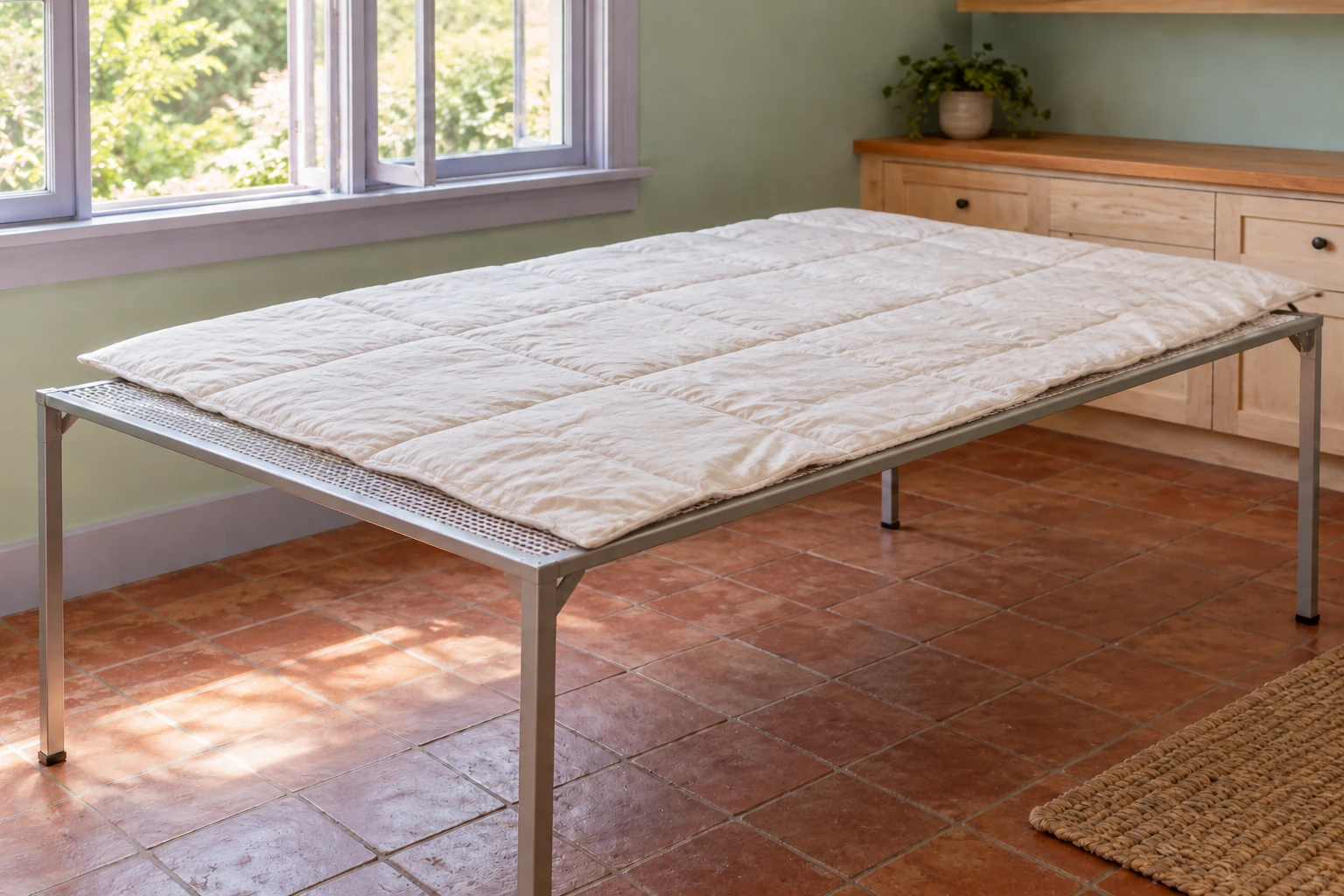
As a practical precaution, check both sides, seams, edges and thicker sections before replacing the cover. Any dampness is a reason to continue the approved drying process. Touch and smell cannot certify that every internal layer is dry, and there is no reliable drying time for all comforters, rooms and weather conditions. If you cannot establish complete drying, seek model-specific advice before using or storing it.
A new musty smell after washing deserves attention. Keep the insert out of its cover and storage bag while you assess it. Tell the maker how it was washed and dried, how long it stayed damp and whether you can see discoloration or feel changes in the filling. Do not mask the smell with fragrance or repeatedly rewash an unsuitable insert.
When to stop and get advice
Stop home treatment if the care method is uncertain, the machine cannot meet the restrictions, contamination reaches the filling or the item remains damp despite the permitted drying process. Newly tight quilting, persistent lumps, thin areas or a distorted shell also warrant assessment rather than another experimental wash.
Neither washing nor adding dryer balls guarantees that the original loft will return. Severely felted filling may be permanently altered. Ask whether repair, professional cleaning or replacement is realistic for that particular item.
If replacement becomes necessary, compare the care requirements of specific wool comforters before choosing. A washable label is useful only when the permitted washing and drying routine fits your home.