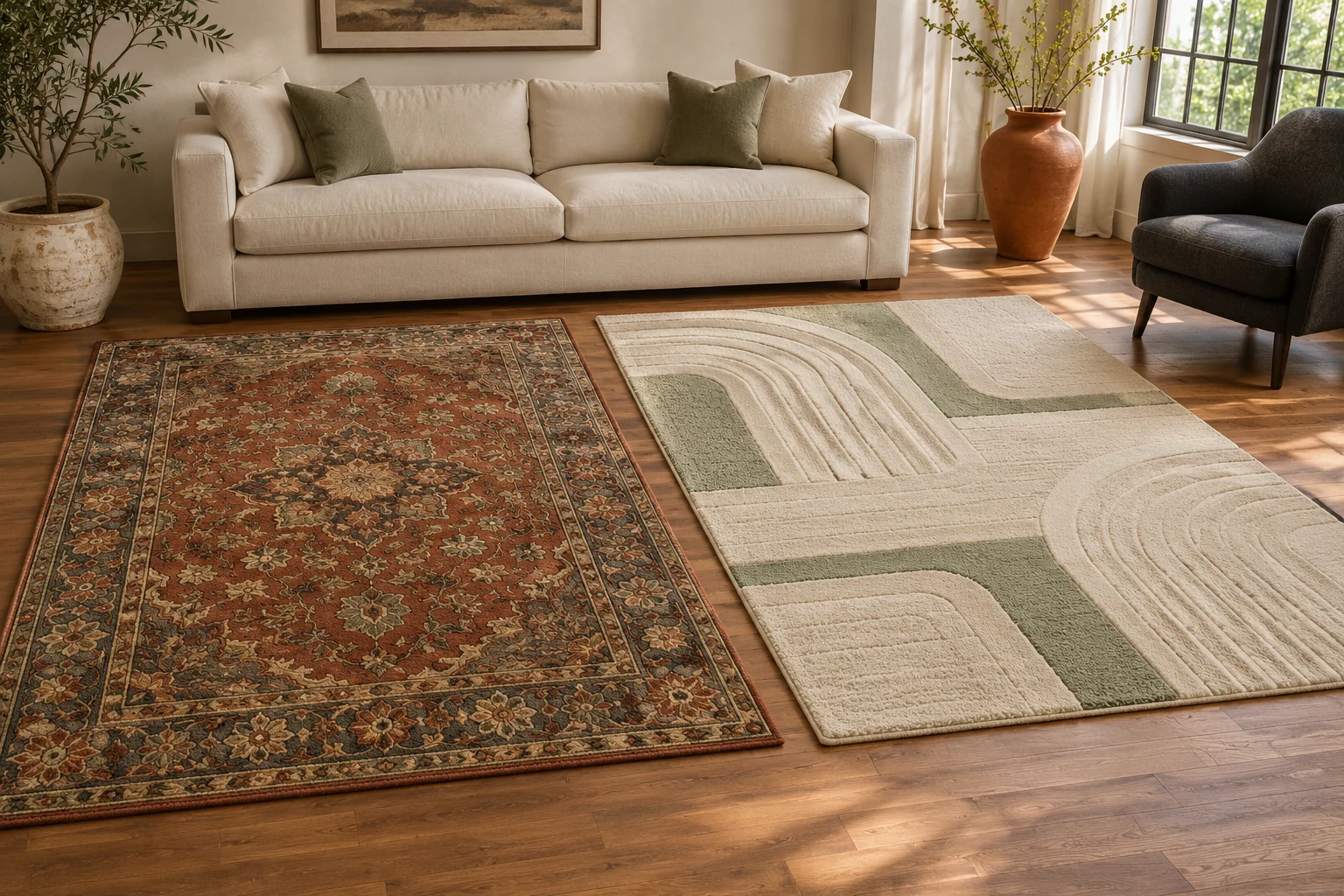
Hand-Knotted vs Hand-Tufted Rugs: What’s the Difference?
A hand-knotted rug has individual pile knots tied into a woven foundation. A hand-tufted rug has yarn inserted through fabric with a hand-guided tool, usually secured with adhesive and a secondary backing. Both can be handmade. When comparing hand-knotted rugs vs hand-tufted alternatives, that difference matters more than whether the surface looks traditional or modern: it affects labor, price, cleaning decisions and possible repairs.
A well-made hand-knotted rug can suit long-term ownership, while a hand-tufted rug can offer appealing texture and design at a lower initial cost. Neither label guarantees quality. Start with the exact rug’s materials, backing, condition and care instructions, then decide what fits your household.
Research-based editorial guide: this comparison draws on textile references, manufacturer documentation and professional rug-care guidance. We have not personally tested these rugs. Images are AI-generated editorial illustrations, not photographs of tested products.
Hand-Knotted vs Hand-Tufted Rugs at a Glance
These are common construction patterns, not specifications for every rug. Confirm exceptions with the seller.
| Consideration | Hand-knotted | Hand-tufted |
|---|---|---|
| Construction | Individual knots tied around warp threads | Yarn punched through primary fabric |
| Handmade status | Hand knotting on a loom | Hand-guided tufting tool |
| Pile attachment | Knots within the foundation | Tufts commonly secured by adhesive |
| Typical reverse | Visible foundation and reverse pattern | Often covered by secondary cloth |
| Adhesive | Generally unnecessary to secure pile | Common; formulation varies |
| Fringe | May extend from foundation warps | If present, usually added separately |
| Labor and detail | Slow knotting; fine knots allow fine motifs | Faster production; cut, looped or sculpted effects |
| Price positioning | Often higher for comparable size and materials | Often more accessible; designer exceptions exist |
| Durability | Depends on pile, foundation and workmanship | Also depends on backing and adhesive condition |
| Repair | Specialist structural repairs may be possible | Rebacking may be possible; assess feasibility |
| Cleaning | Check dyes, foundation, condition and repairs | Check those factors plus adhesive-backed layers |
| Buyer priority | Craftsmanship and potential for extended ownership | Design, texture and initial budget |
What Is a Hand-Knotted Rug?
Lengthwise threads, called warps, form the starting framework on a loom. The maker ties pile yarn around these threads, then passes crosswise weft yarn between rows. The exposed pile ends create the surface and its design. Encyclopaedia Iranica’s technical account explains how these elements build the structure together.
Because the pile is incorporated into that foundation, a separate glued cloth is generally unnecessary to hold it in place. Knots and a version of the design can often be seen underneath. The foundation still matters: its fiber, tension and condition are part of the rug, even when the sales description emphasizes only the pile.
More knots can allow finer drawing, but a knot count is not a standalone durability rating. The Metropolitan Museum’s analysis of the Emperor’s Carpet connects dense knotting with detailed motifs. That illustrates design resolution; it does not prove that every densely knotted modern rug will outlast one made with thicker yarn.
What Is a Hand-Tufted Rug?
Hand tufting starts with fabric stretched on a frame. A maker guides a tufting tool across it, inserting yarn through the fabric. The surface may have cut pile, uncut loops or a combination. Adhesive commonly secures the yarn, and a secondary cloth covers the reverse.
Jaipur Living’s construction guide describes this hand-punched process and distinguishes cut from looped finishes. Tufting does not tie individual pile knots, but it still involves hands-on production. Calling it fake handmade misrepresents the method.
Safavieh’s construction guide also distinguishes tufted backing from knotted construction. Faster production helps explain the price difference; it does not make every tufted rug poorly made. Ask about the exact adhesive and backing rather than assuming all products use natural latex or the same materials.
How to Tell Hand-Knotted and Hand-Tufted Rugs Apart
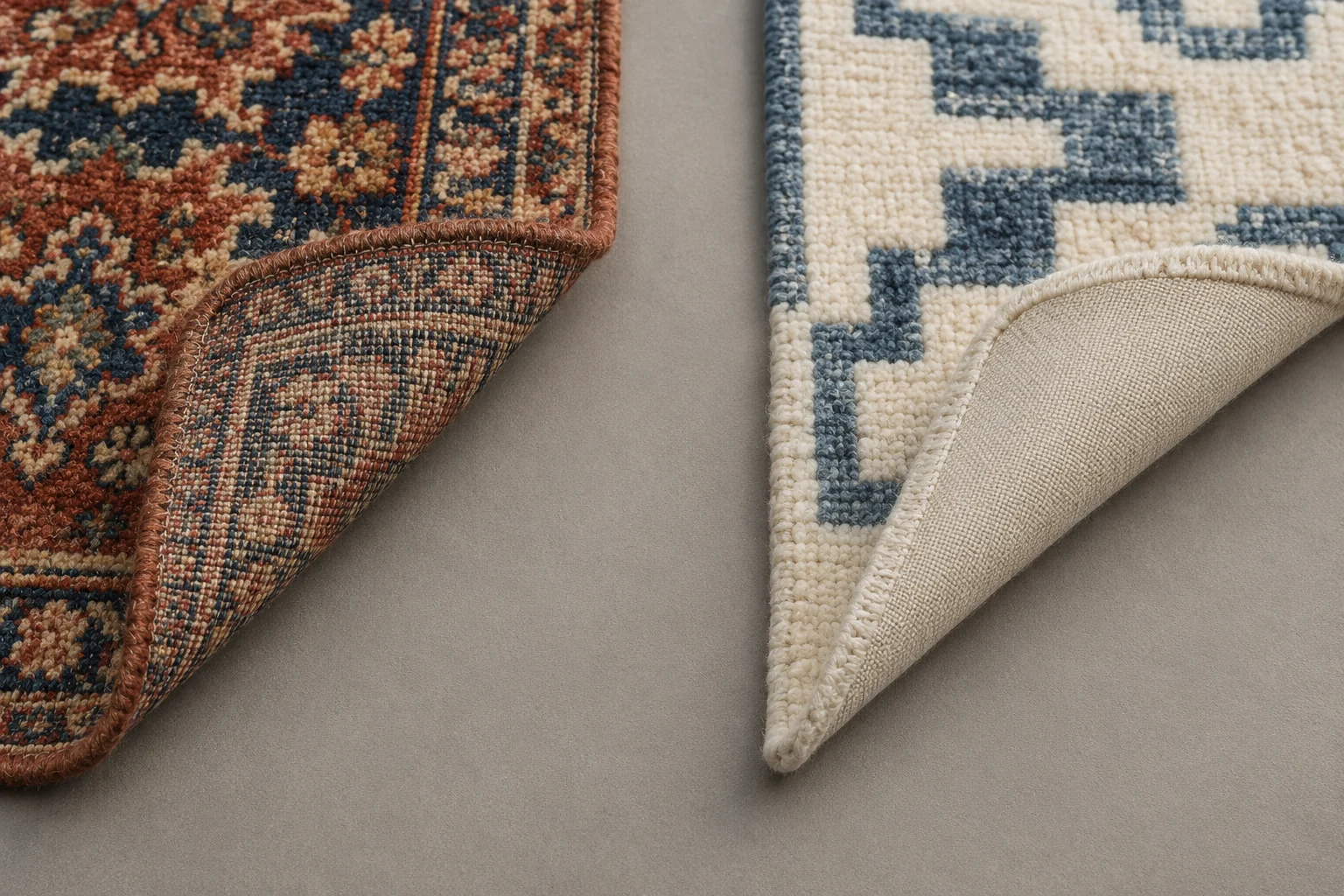
Use several clues together, then confirm the construction in writing:
- Look underneath. A visible reverse pattern suggests an exposed woven structure; a plain cloth may indicate a backed rug. Neither observation alone proves hand knotting or hand tufting.
- Look for the structure. Clear close-ups can reveal individual knot backs and foundation threads. A printed-looking pattern or regular surface alone is insufficient.
- Examine the fringe. Fringe continuous with the foundation is useful evidence. However, fringe can be decorative, repaired or replaced, and some rugs have none.
- Read separate specifications. Request the construction, pile fiber, foundation fiber and backing description. “Handmade wool rug” leaves important questions unanswered.
- Request photographs. Online buyers should ask for the actual rug’s reverse, edges, label and any repairs, rather than relying only on a styled room image.
Do not pull fringe, peel backing or force a sharp fold to investigate. Older rugs may also have conservation backing: the Met documents an added support fabric on a historic knotted carpet. That is another reason a cloth-covered reverse is a clue, not an absolute verdict.
Which Type Is More Durable?
For a buyer prioritizing continued use and specialist repair, a sound hand-knotted rug is often worth investigating first. Its pile does not normally depend on a glued backing. Nevertheless, weak yarn, damaged foundation threads, worn edges or unsuitable cleaning can undermine that advantage.
Hand-tufted rugs have another component to assess: the bond between layers. The Association of Rug Care Specialists explains that adhesive deterioration can cause separation, rippling or powdering. Some backing problems also produce persistent odors. These are possible problems, not inevitable defects in every tufted rug, and odor alone does not establish a health risk.
Rebacking or renewed adhesive may help some rugs; others are not economical or feasible to restore. Get a specialist’s assessment before buying a damaged bargain. For either method, compare fiber quality, edge finishing, foundation condition, traffic suitability and cleaning history. Neither a “generations” promise nor a fixed replacement countdown is reliable for an unspecified rug.
Shedding, Pilling and Surface Wear
Loose fibers in the vacuum are different from yarn coming out of the structure. WoolSafe’s care guide explains that new cut-pile carpets can release manufacturing-related loose fibers. This does not establish a universal shedding period or make every tufted rug a heavy shedder.
Pilling means small tangles of fibers on the surface. Ruckstuhl’s product-specific care guidance discusses how friction can aggravate it. Raised yarn ends, widening bare patches and loose tufts need a different assessment from occasional fluff. Powder coming from the backing is not wool shedding.
Photograph a changing area and contact the seller or cleaner if pile loss persists or the backing separates. Do not pull attached yarn or aggressively brush the rug to accelerate shedding.
Cleaning and Maintenance Differences
Neither construction label is permission to soak, steam-clean or machine-wash a rug. Dyes, foundations, adhesives, previous repairs and the floor underneath all matter. Our wool-rug cleaning guide explains the care decisions in more detail.
Match the vacuum to the rug
Remove loose soil regularly using the maker’s permitted setup. Adjustable suction helps you avoid a head that grips or drags the rug; keep fringe out of rotating parts. Brush instructions genuinely vary: Loloi’s Highgrove description recommends no beater bar, while some Ruckstuhl wool instructions specify powered brushing. Follow the exact product’s directions and ask for clarification when they conflict. Our guide to vacuum floorheads and controls covers that selection.
Keep spill response controlled
Lift solids carefully and blot fresh liquid with a clean white absorbent cloth. Avoid rubbing. Apply a spot product only if both the rug instructions and product directions permit it, testing an inconspicuous area first. A wool-compatible cleaner does not automatically suit every dye or backing.
Ask about professional cleaning before purchase
The IICRC’s area-rug guidance highlights dye migration, shrinkage and the advantages of controlled cleaning conditions. Ask a rug specialist to assess valuable, unstable or adhesive-backed pieces. Excess moisture and incomplete drying can complicate a backed rug’s condition; a hand-knotted foundation can also react badly to unsuitable treatment. Explain any powdering, odor or existing damage before cleaning, rather than expecting washing to repair it.
Cost: Why Are Hand-Knotted Rugs Often More Expensive?
Tying individual knots requires substantial skilled work. Size, yarn preparation, design complexity, materials, finishing and sourcing also influence cost. For example, Tufenkian describes hand carding, spinning and finishing alongside knotting in its own production. That is a manufacturer’s process account, not independent proof that its rugs offer better value.
Compare like sizes and disclosed materials, then include a suitable pad, delivery, cleaning and potential repair in your budget. A lower purchase price may matter more than hypothetical future restoration if you regularly change decor. Conversely, paying for craftsmanship may make sense when you plan to keep the rug and maintain it. Neither high retail pricing nor “handmade” establishes resale value or ethical sourcing.
Wool Hand-Knotted vs Wool Hand-Tufted Rugs
Wool is a fiber; hand-knotted and hand-tufted describe construction. Either method can use wool, other fibers or blends. Two wool labels do not establish identical yarn quality, feel or performance.
A concrete example is Loloi Highgrove HIG-03 Blue: its specifications list hand-tufted construction, wool and cotton backing. The backing specification should be read separately from the face-fiber description. It does not, by itself, disclose the adhesive formulation.
For broader material choices, use our wool-rug buying guide and silk-versus-wool comparison. Decide on both fiber and construction rather than letting one label answer both questions.
Best Choice by Room and Household
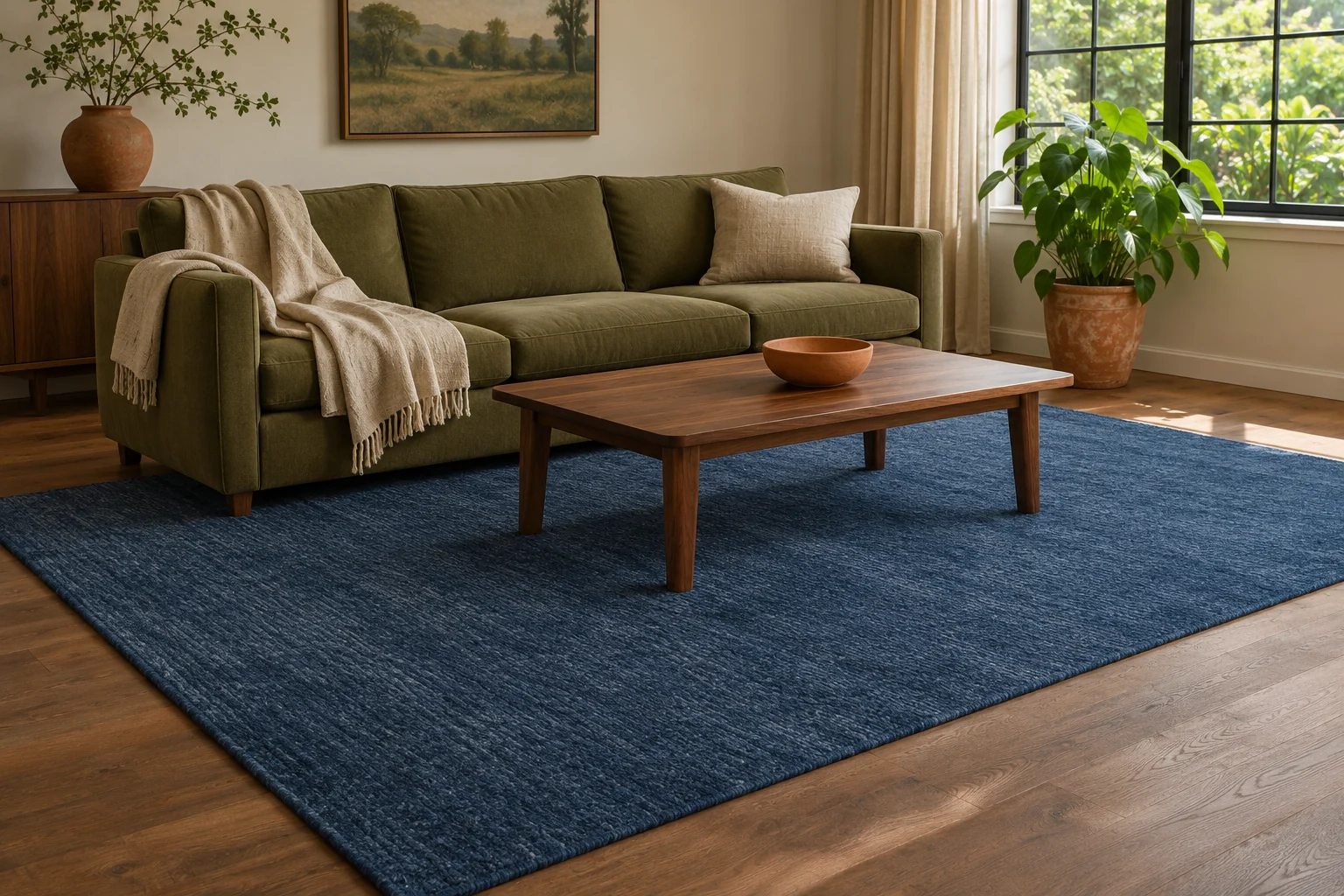
These are buying priorities, not performance ratings for unnamed rugs:
- Living room: Consider a well-made knotted rug for extended ownership, or a documented tufted design for texture and budget. Check the actual traffic recommendation.
- Bedroom: Comfort and appearance may take priority over heavy-traffic performance. Either construction can work; feel a sample instead of assuming tufting always means plushness.
- Dining area: Favor a manageable surface, sufficient chair clearance and realistic spill care. Intricate craftsmanship is not protection against stains.
- Busy families and pets: Investigate snag-prone loops, exposed fringe and permitted cleaning. Neither method is claw-proof or accident-proof.
- Seasonal decor changes: A less costly tufted rug may fit your plans, provided you accept its care needs.
- Long-term ownership: Ask about foundation condition and available repair expertise, especially for secondhand pieces.
Support either rug appropriately. Our rug-pad selection guide covers matching the pad to both backing and floor, rather than choosing by wool content alone.
Questions to Ask Before Buying
- Is the construction explicitly hand-knotted or hand-tufted?
- What are the pile, foundation, secondary backing and adhesive materials?
- What are the actual dimensions, pile height and fringe measurements?
- Can I see close photographs of the reverse, edges and any repairs?
- What traffic, vacuum and cleaning methods does the maker approve?
- What does the written warranty cover, and what is excluded?
- What are the return deadline, shipping costs and restocking conditions?
- Who can assess or repair this construction locally?
Frequently Asked Questions
Are hand-tufted rugs handmade?
Yes. A maker guides the tufting tool and finishes the rug. The process differs from hand knotting, so ask for the specific construction rather than only “handmade.”
Are hand-knotted rugs always better?
No. A poorly maintained knotted rug may be a worse purchase than a sound tufted rug that suits your budget, room and care routine.
Do hand-tufted rugs contain glue?
Commonly, adhesive holds the tufts and backing assembly together. Ask for the actual materials; “latex” does not necessarily mean natural rubber latex.
How can you recognize a hand-knotted rug from its back?
Look for the foundation, individual knot structure and reverse design. Combine these clues with the label and seller’s confirmation; machine-woven rugs can also show a reverse pattern.
Do hand-tufted rugs shed more?
Construction alone cannot predict which of two rugs sheds more. Yarn, pile and finishing matter. Persistent bare patches deserve investigation rather than being dismissed as normal fluff.
Can a hand-tufted wool rug be professionally cleaned?
Often, yes, subject to its instructions and condition. The cleaner should inspect the backing, dyes and existing damage before selecting a method.
Are hand-knotted rugs worth the extra money?
They can be when you value the craftsmanship and can support long-term care. Compare specific rugs and total ownership costs, not an assumed financial return.
Can a hand-tufted rug last a long time?
It can remain useful with suitable construction, placement and care. No single lifespan applies across different fibers, adhesives, traffic levels and maintenance histories.
Final Verdict
Choose the rug you can understand and care for. For continued ownership and potential structural repair, investigate a sound hand-knotted piece. For design and a more accessible initial budget, consider a well-specified hand-tufted rug. Before paying, obtain the reverse photographs, material breakdown and written care instructions. An attractive surface is a starting point; the construction underneath completes the buying decision.