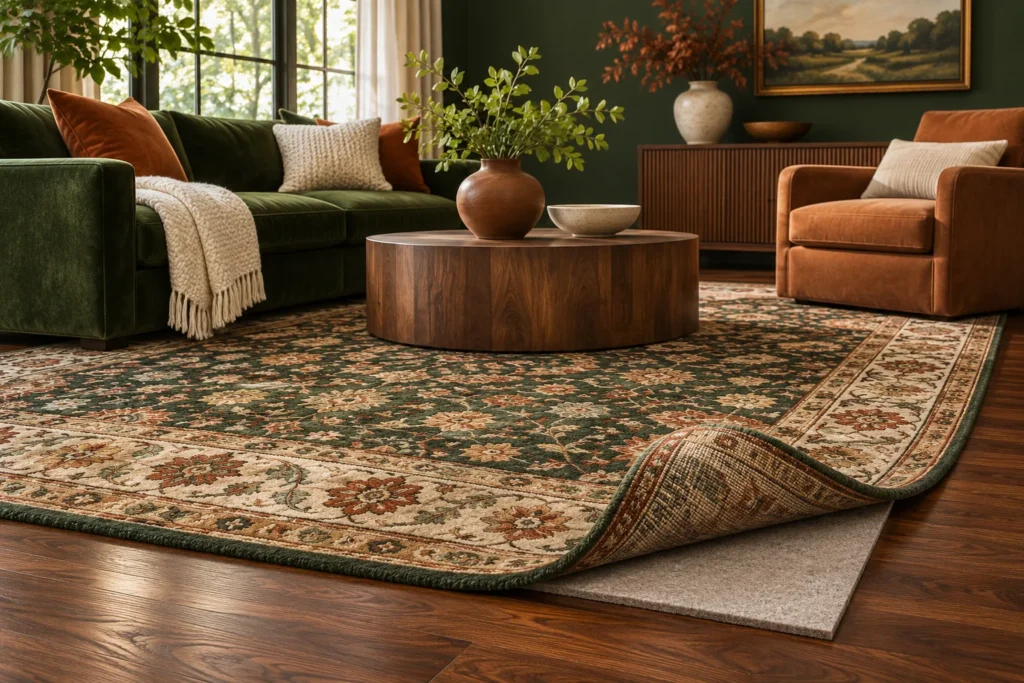
The best rug pad for wool rug use is not one universal material. It is the pad that supplies the grip or cushioning your rug needs without conflicting with the flooring manufacturer’s care and warranty rules. A thin felt-and-grip pad often suits a small flatweave, while a large rug held by furniture may benefit more from dense felt cushioning. Vinyl, freshly finished wood and heated floors require an extra compatibility check.
Start with three facts: the rug’s construction, the exact floor beneath it and the clearance available at doors and furniture. Then compare backing chemistry, thickness and sizing. A pad manufacturer’s “safe for all floors” language should not override written instructions for your specific floor finish.
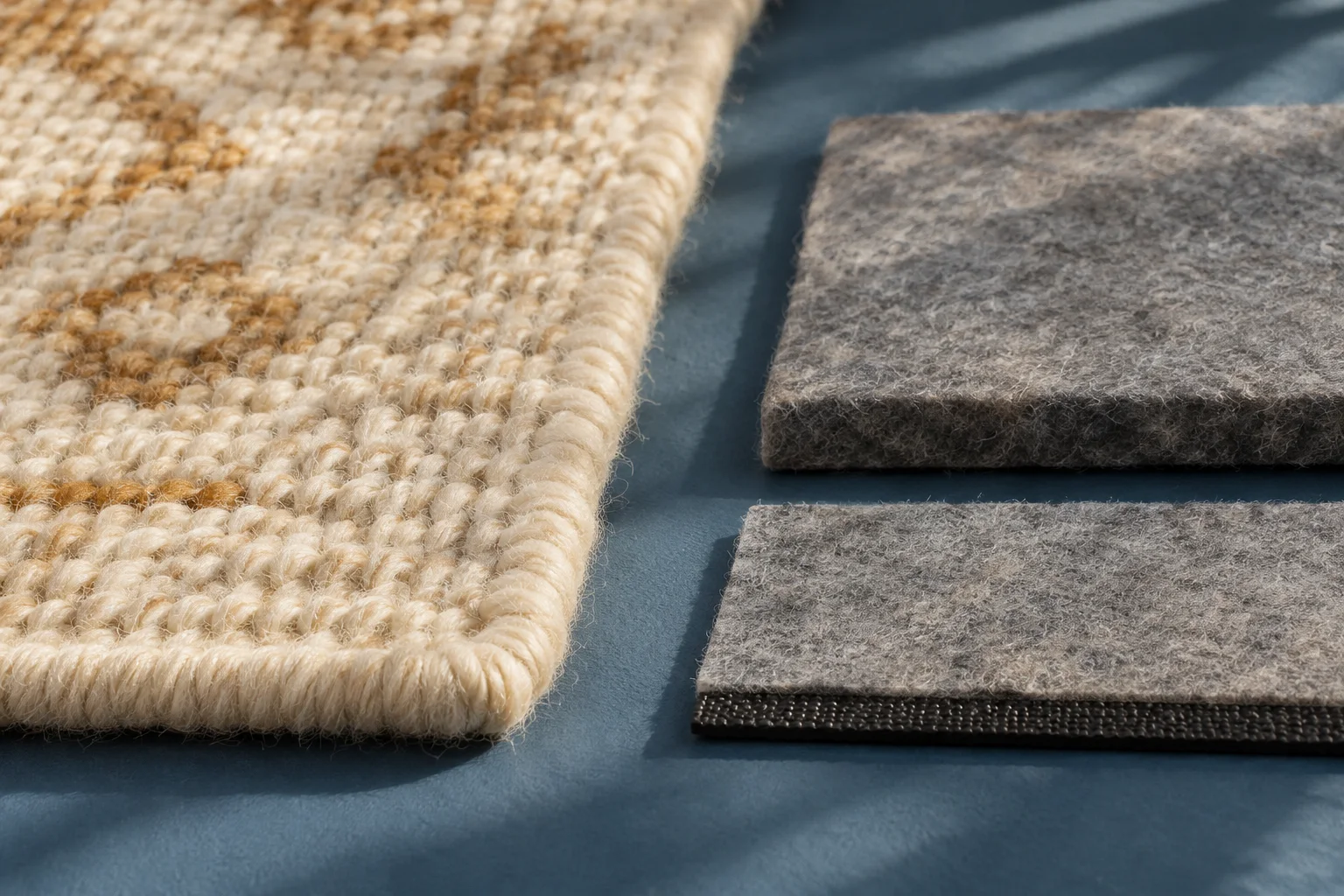
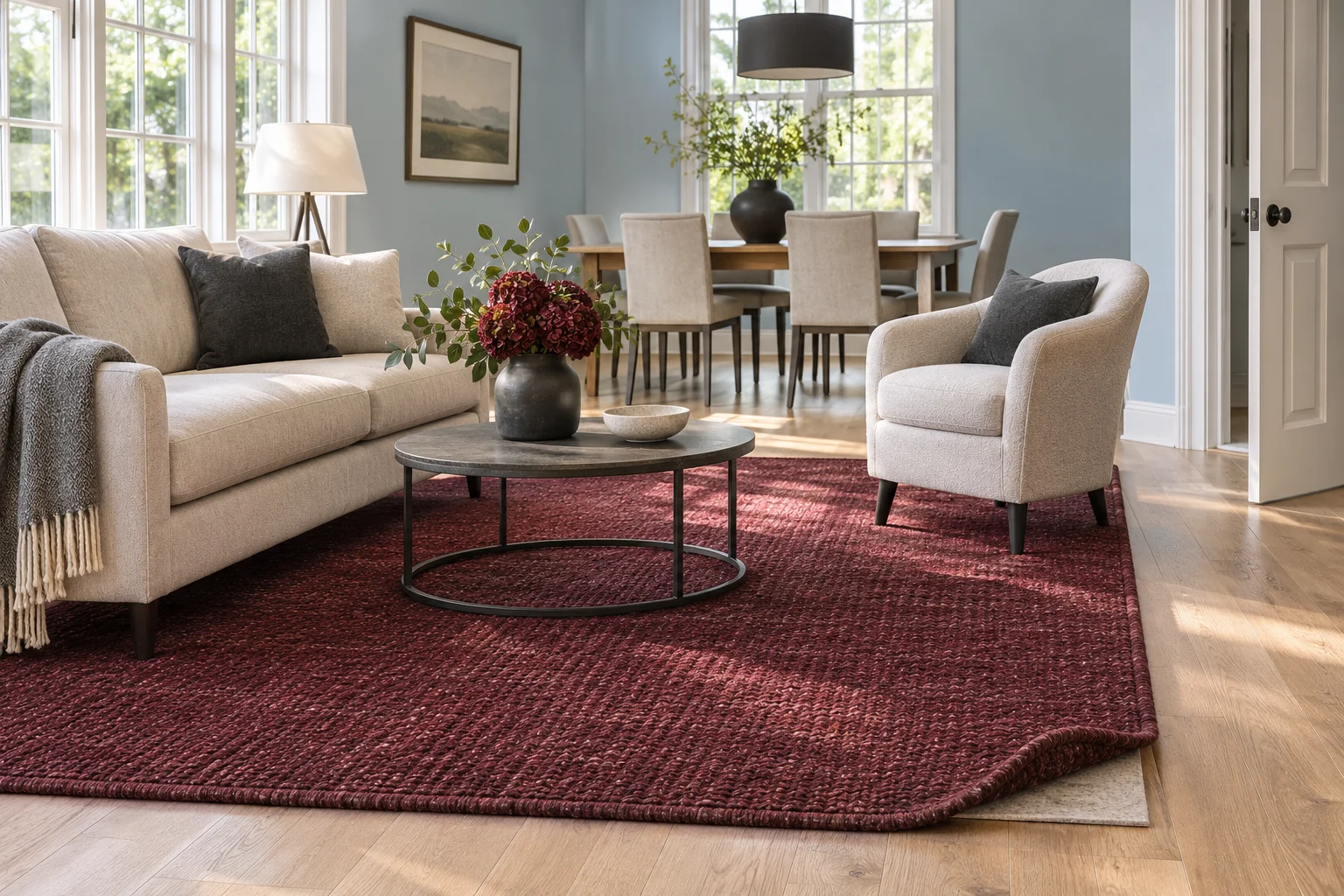
About this guide: We did not physically test these rug pads. The comparisons below use current US manufacturer specifications, flooring-care documents and rug-maker guidance. Product formulas, warranties and availability can change, so verify the current listing before ordering. The three editorial images are AI-generated illustrations rather than photographs of the named products.
Best rug pad for wool rug use: quick comparison
These four options illustrate different buying decisions. None is automatically compatible with every wool rug or every floor.
| Current US option | Documented construction | Best reason to investigate it | Important limitation |
|---|---|---|---|
| RUGPADUSA Contour-Lock | Needle-punched felt with natural-rubber backing; 1/8-inch profile | Low-profile grip plus moderate cushioning for flatweaves, runners or rugs that bunch | Do not use where the floor maker prohibits rubber or latex; confirm finish compatibility |
| RUGPADUSA Anchor Grip | Felt with EVA non-slip backing; no rubber or latex; 1/8-inch profile | A thin option specifically marketed for vinyl and LVP | “Vinyl-safe” is the pad maker’s claim; the exact floor warranty still controls |
| RUGPADUSA Eco-Plush | 100% heat-pressed felt; offered in several thicknesses, including 1/4, 3/8 and 1/2 inch | Cushioning under a large rug already anchored by size or furniture | Felt alone does not provide the same non-slip grip; thicker versions affect clearance |
| Surya PAD-F | Felted pad with rubber backing; listed at 0.22 inch | A dual-surface design with many standard and custom sizes | Surya lists LVP/LVT compatibility, but some floor makers prohibit rubber-backed mats |
If you want one practical starting point, choose by function. Use a low-profile grip pad for a lightweight rug that moves, a dense felt pad for a large stable rug that needs cushioning, and a floor-specific pad when the flooring instructions restrict common backing materials. Then confirm the combination with both the rug and flooring manufacturers.
Why a wool rug does not determine the pad by itself
“Wool rug” describes the face fiber, not the complete construction. A hand-knotted rug, a latex-backed hand-tufted rug and a reversible flatweave can all contain wool, yet place different demands on a pad. Our wool rug buying guide explains those construction differences in more detail.
Hand-knotted wool rugs
A hand-knotted rug normally has a visible woven foundation rather than a glued-on secondary backing. The pad should support the rug evenly, reduce movement and stop grit from being ground between the rug and floor. A felt-and-grip construction can be useful when the rug is small or exposed, while a large, furniture-anchored rug may not need as much grip.
Hand-tufted wool rugs
Many hand-tufted rugs use adhesive and a cloth or latex-containing secondary backing. That backing can age differently from a woven foundation. Do not assume that adding another rubber or latex layer is harmless. Follow the rug maker’s instructions, avoid a pad surface that catches or abrades the backing, and investigate unusual dust, odor or flaking before covering it. The guide to wool-rug odors explains why construction and moisture need to be considered separately.
Flatweaves, kilims and runners
Thin reversible rugs often need grip more than extra loft. A low-profile pad helps keep the rug’s edges from sitting too high and can reduce interference with doors. Runners also need careful sizing so the pad does not show at the sides or create an abrupt ridge. For a delicate antique or loosely woven piece, ask a rug specialist whether the chosen pad surface could snag the foundation.
Choose the rug pad for the floor first
The surface under the rug can be the most restrictive part of the decision. Flooring finishes and pad backings can react over time, and two manufacturers may give different advice. Keep the product name, installation date, finish and warranty document for your floor before buying a pad.
| Floor | What to verify | Common mistake |
|---|---|---|
| Hardwood | Breathability, backing chemistry, finish cure time and written warranty rules | Assuming natural rubber is safe for every finish |
| Vinyl or LVP | A non-staining backing approved for the exact floor | Using rubber or latex when the floor maker prohibits it |
| Laminate | Finish compatibility, moisture rules and thickness at doors | Relying only on the pad seller’s broad compatibility list |
| Stone or tile | Grip, sealer compatibility, moisture and grout transitions | Treating all sealed stone as chemically identical |
| Wall-to-wall carpet | A pad designed for rug-over-carpet use and correct orientation | Putting a hard-floor grip side against carpet without instructions |
| Radiant-heated floor | Approval from the floor, heating-system, rug and pad makers | Assuming a thin pad is automatically heat-compatible |
Hardwood and engineered wood
Advice for wood floors is not uniform. Bruce’s hardwood FAQ calls for breathable, non-staining rugs and says not to use solid rubber or latex backings. Other pad sellers market natural-rubber products for hardwood. That conflict is exactly why the floor’s written instructions should come first. New or refinished floors also need to cure fully before they are covered.
Vinyl and luxury vinyl plank
Vinyl needs a product-specific check. Armstrong’s flooring FAQ directs buyers toward colorfast, non-staining backings and warns against rubber or latex-backed mats for certain resilient floors. Shaw’s vinyl-care page likewise tells owners to follow the complete care guide and lists materials and chemicals to avoid. A latex-free EVA-backed pad may be a useful candidate, but approval for one floor does not transfer automatically to every LVP formula.
Tile, stone and sealed surfaces
Grip is often the main priority on smooth tile, but the sealer matters on natural stone. Check for non-staining materials and confirm that the pad will not trap moisture from cleaning or entryway traffic. Uneven grout lines or stone transitions can also affect how a thin rug lies. Do not use the pad to disguise a loose tile, damaged finish or moisture problem.
Rugs over carpet
A pad made for hard floors may not control movement on carpet. Some dual-surface products reverse orientation for carpet; Mohawk Home’s guidance, for example, places the felt side down on carpet and the latex side down on hard flooring for its own Dual Surface pad. Treat that as a product-specific direction, not a rule for every pad.
Felt, rubber, EVA and PVC: what the backing changes
Felt-only pads
Dense felt adds cushioning and can distribute pressure under a substantial rug. It is often a sensible candidate under a large rug that is already held by furniture. It does not create the same floor-level grip as a non-slip backing, so it is a poor substitute for grip under a loose runner. Density and construction matter more than a soft-looking surface.
Felt with natural rubber
This combination pairs cushioning above with grip below. It can work well for many rugs on compatible hard floors. The limitation is the word “compatible”: some hardwood and vinyl manufacturers prohibit rubber or latex-backed mats. Natural rubber is not a universal warranty-safe answer simply because it differs from inexpensive synthetic mesh.
EVA-backed pads
EVA is used in some latex-free low-profile pads, including Anchor Grip. It may be worth investigating when an LVP maker restricts rubber, but the complete product formulation and the floor warranty still matter. Ask for written compatibility if the manufacturer’s care document does not name the material.
PVC and open-grid mesh
Low-cost mesh pads vary widely in formulation and quality. Some floors permit specific non-staining vinyl or polypropylene backings, while others warn about plasticizers, adhesion or discoloration. A generic “PVC pad” label is not enough to establish safety. Avoid old, sticky, brittle or crumbling pads and do not reuse a backing that has transferred residue.
Thickness, grip and cushioning
More thickness is not automatically better. A 1/8-inch pad keeps a flatweave or runner closer to the floor and is less likely to interfere with a door. A 1/4- or 3/8-inch felt pad can add noticeable cushioning under a larger rug. A 1/2-inch pad may feel plush, but it can raise furniture, create a steeper edge and reduce door clearance.
Consider the combined height of rug and pad. Dining chairs should remain stable when their legs cross the rug edge. A pad should not make a coffee table rock or leave one sofa leg noticeably higher. If a rug already has a thick pile or substantial backing, start with a thinner pad unless the rug maker recommends otherwise.
How to size a rug pad correctly
The pad should normally sit inside the rug perimeter so the rug edges can taper to the floor. Manufacturer instructions differ: Mohawk recommends its pad be at least two inches smaller on each side, while an Armadillo specification sheet describes a pad cut one inch smaller on each side. Follow the pad maker’s measurement convention, because “one inch smaller” can mean per side or overall depending on the seller.
- Measure the actual rug after it lies flat; do not rely only on the nominal size in the product name.
- Exclude fringe from the pad dimensions.
- Use the pad maker’s trimming allowance and keep the inset even around the rug.
- Test door swing, vents and furniture stability before final placement.
- Recheck the pad periodically for movement, residue, moisture or edge exposure.
A practical buying checklist
- Read the rug instructions. Note construction, backing, warranty and whether a proprietary pad is required. Ruggable’s warranty terms are a useful example of why system-specific requirements matter.
- Read the flooring instructions. Search the exact product line for “area rugs,” “mats,” “rubber,” “latex,” “non-staining” and “radiant heat.”
- Define the job. Decide whether the rug primarily needs grip, cushioning, floor protection or help staying flat.
- Choose the lowest practical profile. Add thickness only when cushioning is useful and clearance permits it.
- Confirm the current materials. Product names can remain while formulas change. Save the specification and receipt.
- Inspect after installation. Lift a corner occasionally and check for trapped grit, moisture, discoloration or residue.
Pad choice does not replace ordinary rug care. Use the rug-approved vacuum setup described in our best vacuum for wool rugs guide, and follow construction-specific advice when you clean a wool rug. If fibers are accumulating, check the distinctions in our wool rug shedding guide instead of assuming the pad is the cause.
Common rug-pad mistakes to avoid
- Buying by fiber alone: a wool rug can be hand-knotted, tufted or flatwoven, with very different backing needs.
- Calling every rubber pad floor-safe: written hardwood and vinyl restrictions vary.
- Choosing maximum thickness: a plush pad can create clearance and furniture-level problems.
- Letting the pad show: an exposed edge looks unfinished and can become a trip point.
- Covering a damp floor: allow cleaned, sealed or refinished flooring to dry and cure as instructed.
- Ignoring deterioration: replace a pad that becomes sticky, brittle, torn, compressed unevenly or transfers residue.
If you are still choosing the rug itself, compare the trade-offs in wool vs synthetic rugs and jute vs wool rugs. The right pad cannot correct an unsuitable rug construction, unstable backing or poor fit for the room.
Frequently asked questions
Do all wool rugs need a rug pad?
Many benefit from one, especially when they slide, bunch or sit on a finish that needs protection from grit. But the pad type depends on the rug and floor. A proprietary two-piece rug system may require its own pad, and a very large rug may need cushioning more than added grip.
Is felt or rubber better under a wool rug?
Felt is useful for cushioning; a non-slip backing is useful for grip. A felt-and-rubber pad combines both, but rubber is not permitted by every flooring manufacturer. Choose the function first, then confirm backing compatibility with the floor warranty.
What rug pad is safest for LVP?
There is no material that can be declared safest for every LVP product. Use the exact floor maker’s current care document. If it prohibits rubber or latex, investigate a non-staining latex-free option that the manufacturer approves in writing, and keep that confirmation with your warranty records.
Can a rug pad damage hardwood floors?
An incompatible backing, trapped grit, moisture or covering an uncured finish can cause problems. Hardwood finishes differ, so use a breathable, non-staining pad that meets the instructions for the exact floor. Inspect beneath the rug periodically.
How thick should a pad be under a wool rug?
Thin flatweaves and runners commonly need a low profile around 1/8 inch. Larger rugs may accommodate 1/4 or 3/8 inch of dense felt when clearance allows. A 1/2-inch pad is not automatically more protective and may be too thick near doors or dining furniture.
Can I put a wool rug and pad on radiant heat?
Only when the floor, heating system, rug and pad instructions all allow the combination. Thickness and insulation can affect heat transfer, and “safe on heated floors” from a pad seller does not replace the heating-system or flooring requirements.
Final recommendation
For a small or lightweight wool rug on a compatible hard floor, begin by comparing a low-profile felt-and-grip pad. For a large rug that is already stable, dense felt can add cushioning without an unnecessary grip layer. For vinyl, LVP, newly finished wood or radiant heat, start with the floor documentation rather than the rug-pad marketing.
The best rug pad for a wool rug is therefore the most compatible system, not the thickest or most expensive product. Match the rug construction, floor finish, required grip, practical thickness and correct inset size—and keep the written product guidance in case a warranty question arises.