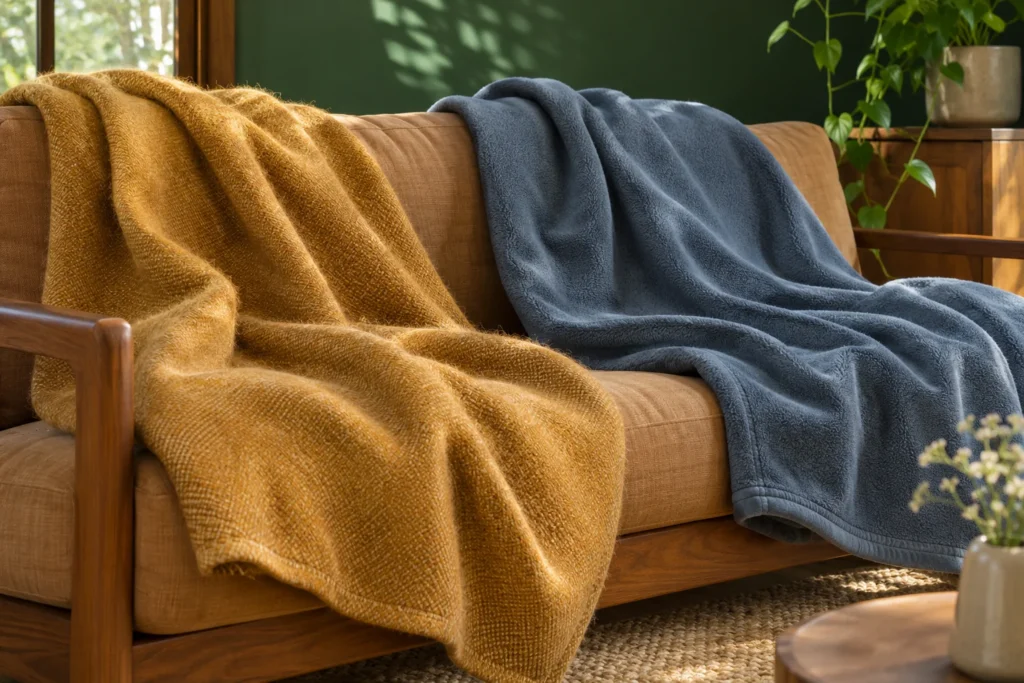
A wool vs fleece blanket comparison is most useful when it starts with your everyday needs. A sheep-wool blanket is worth considering if you like a woven feel and want a natural-fiber layer with moisture-absorbing properties. Synthetic fleece is often the more convenient choice for a soft couch throw, frequent washing, or lightweight travel. Neither is automatically warmer, more comfortable, or longer-lasting.
Here, wool means sheep wool, while fleece means synthetic fleece, usually polyester. We are not comparing wool with raw sheep fleece, shearling, or a wool-pile fabric. This research-based guide compares finished blankets using textile references and manufacturer specifications; it does not report hands-on testing.
Wool vs fleece blanket: quick comparison
| Buying priority | Sheep-wool blanket | Synthetic fleece blanket |
|---|---|---|
| Warmth | Crimp and fabric structure help hold insulating air. Thickness and weave matter. | Raised pile holds insulating air. A lofty fleece can be warmer than a thin wool throw. |
| Weight | Ranges from light throws to substantial bed blankets. | Often light for its bulk, but oversized or multilayer versions can be heavy. |
| Feel | Fine wool can feel soft; coarser fibers may prickle. | Typically fuzzy or plush; pile and finishing change the feel. |
| Moisture | Absorbs moisture vapor within the fiber; still becomes wet if soaked. | Polyester absorbs little water within the fiber; fabric can still hold liquid. |
| Care | May require dry cleaning, hand washing, or a specified machine cycle. | Often machine washable; drying temperature is product-specific. |
| Wear | Can pill, shed, felt, or snag depending on construction and treatment. | Can pill, shed, or develop flattened pile; quality varies. |
| Best starting point | A natural-fiber bed layer with a care routine you can manage. | A soft, convenient everyday throw with a suitable wash-and-dry label. |
Understand the material and construction first
Wool is the fiber; woven or knitted describes how a blanket is made. Many wool blankets use interlaced yarns, sometimes brushed to raise a softer surface. Merino, lambswool, and other wool descriptions do not tell you the finished blanket’s thickness, density, or care requirements. Check the complete fiber percentages, especially on wool blends.
Synthetic fleece is usually a knitted fabric with a raised surface. Polartec explains its fleece construction as a knit transformed into pile through surface finishing. Smooth microfleece, conventional polar fleece, and deep plush versions can feel and perform quite differently. “Sherpa” describes a fleece-like pile style, not proof of sheep wool.
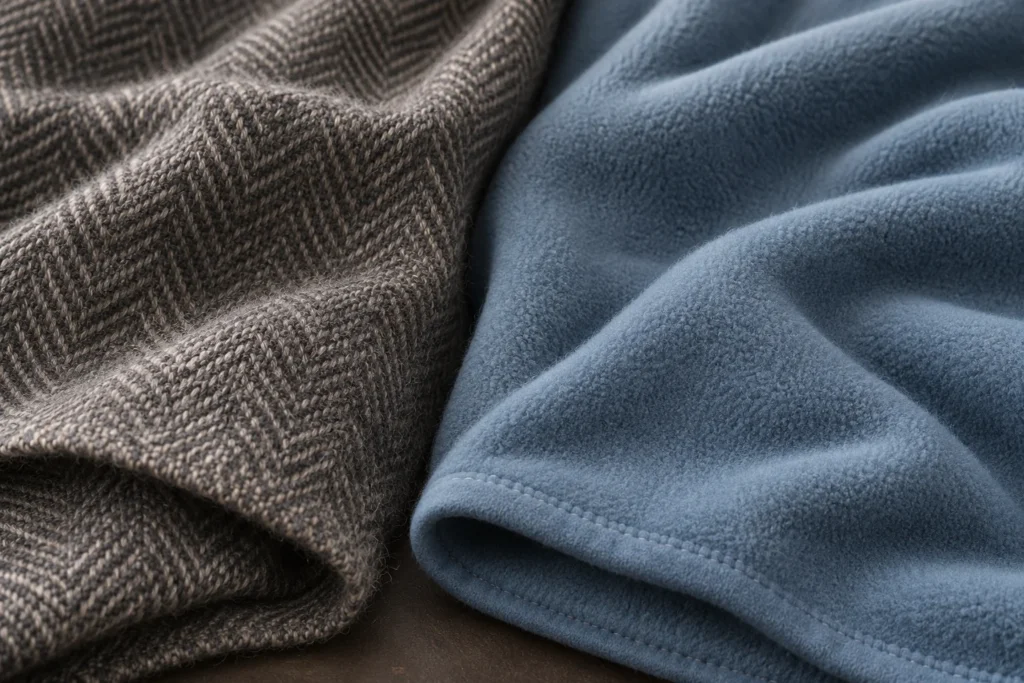
Read the face, backing, and trim specifications separately on a reversible blanket. A wool-rich face attached to polyester fleece is a different purchase from a single-layer wool blanket. Two layers also change bulk and drying demands. Photographs can illustrate weave and pile, but they cannot establish fiber content; use the composition label.
Warmth: compare trapped air, coverage, and layers
Both materials insulate partly by holding still air. Woolmark’s explanation of wool structure describes how natural crimp contributes to air spaces. Fleece creates insulating space through its raised pile. Neither fiber generates a permanent supply of heat: the blanket helps slow heat loss from your body.
For a cool bedroom, compare loft, coverage, and the layers already on your bed. A substantial fleece blanket can provide more insulation than a loosely woven wool throw. A dense wool blanket may suit someone who likes a closer drape. A narrow throw that leaves your feet uncovered can be disappointing regardless of material.
In a heated home, start with a removable layer rather than the thickest blanket available. For a drafty room, look at how easily air moves through the finished fabric and whether the blanket wraps around you. An open knit and a tightly constructed blanket should not receive the same warmth prediction simply because their labels match.
What happens when the blanket becomes damp?
Wool can take up moisture vapor inside its fibers, which helps explain why it may feel comfortable before it feels wet. This does not make a wool blanket waterproof. A soaked blanket is heavier, needs drying, and should not be treated as dependable cold-weather protection just because it contains wool.
Polyester is relatively water-repelling at the fiber level. Polartec’s technical-fleece documentation describes hydrophobic fibers, air-holding loft, and quick drying. However, liquid can remain between fibers and in thick pile, seams, or a backing. Low fiber absorption and a completely dry blanket are different things.
For camping, keep either blanket dry and treat it as part of a complete sleep setup. Neither an ordinary wool blanket nor fleece is a substitute for a temperature-rated sleeping bag and suitable ground insulation. Our wool blanket camping guide covers coverage, transport weight, and supplementary use in more detail.
Weight, packability, and GSM: compare like with like
The useful number for carrying a blanket is its finished weight at the size you will buy. Also check packed dimensions if available. Lightweight fleece can be convenient for a road trip, but a large double-layer plush blanket may occupy more space than a compact woven throw.
GSM means grams per square meter: fabric mass divided by area. It is not a warmth rating. At the same GSM, different yarns, pile heights, and constructions can trap different amounts of air. A listing might describe one fleece layer, while another includes a backing; shipping weight can include packaging. Those figures are not directly interchangeable.
For a fair comparison, match dimensions, confirm whether the weight covers the whole product, and ask about layers. Do not infer a fleece blanket’s weight from a similarly named jacket fabric. If a seller gives no finished weight, record it as unknown instead of guessing from photographs or fabric labels.
Softness, breathability, and next-to-skin comfort
Fine wool fibers tend to bend more easily against skin than coarse fibers, reducing prickle; Woolmark discusses the role of fiber diameter. That makes fine Merino a sensible option to investigate, not a guarantee that every Merino blanket will suit you. Yarn, finishing, and individual texture preferences still matter.
Fleece commonly offers a fuzzy, immediately plush surface. Some people prefer that to the more defined texture of woven wool; others dislike deep pile against warm skin. If you cannot handle a sample, check the return policy and close-up photographs. A top sheet can separate your skin from a wool blanket, although it will not change the blanket’s underlying texture.
Breathability needs more than one question. Wool’s ability to absorb and release vapor is different from air passing through a fabric or liquid moving across its surface. Woolmark’s moisture-management explanation concerns the fiber; the entire bedding system also matters. Fleece can be air-permeable, while a dense backing or additional layers can restrict ventilation in either material.
If you sleep hot, favor an adjustable setup and modest insulation before relying on a “breathable” label. Static cling is another comfort consideration: Woolmark links wool’s moisture uptake to reduced static tendency. This is a tendency, not a promise that wool never creates static or that every fleece blanket will cling.
Cleaning and long-term maintenance
Wool: washable does not mean unrestricted washing
Read the actual blanket label before buying. Traditional wool products may be dry-clean-only; others permit hand washing or a specific machine cycle. Washability can come from processing and construction, so “100% wool” alone cannot settle the question.
For a machine-washable product, follow its specified water temperature, cycle, detergent, and drying method. Woolmark’s blanket-care guidance emphasizes following the label and supporting the wet blanket during drying. Heat, moisture, and agitation can cause untreated wool to felt and shrink. Do not assume a gentle cycle makes a dry-clean-only blanket washable.
Plan where a large blanket will dry before bringing it home. Airing and prompt, label-compatible spot cleaning can help between full washes. Our guide to washing a wool blanket explains the process; the manufacturer’s instructions take priority. If machine washing is essential, start with blankets explicitly sold as washable wool.
Fleece: check the dryer setting too
Many fleece blankets are straightforward to machine wash, but “easy care” does not mean hot drying. Follow the label for detergent, temperature, and cycle. Avoid adding fabric softener automatically: Polartec advises against it for its fleece fabrics, and other manufacturers may have their own restrictions.
A drying rack, low-heat dryer cycle, and no-heat setting are different instructions. In particular, L.L.Bean specifies no-heat drying for the polyester throw discussed below. If your household needs rapid turnaround, check the complete wash-and-dry routine rather than buying on “machine washable” alone.
Pilling and shedding have no automatic winner
Both wool and fleece can develop surface pills or shed fibers. Woolmark explains that pilling depends on friction and fabric design, including fiber length, yarn twist, and construction. A brushed surface may change with use without the blanket immediately losing its usefulness.
Look at edge finishing, stitching, care guidance, and any product-specific pilling information. Do not translate “anti-pill” into an unlimited lifespan guarantee. Remove pills only with a method the maker permits, avoid aggressive shaving of delicate surfaces, and repair small seam problems before they spread. There is no defensible universal rule that fleece lasts two years or wool lasts decades.
Environmental trade-offs: assess the whole blanket
Wool grows again on sheep, but renewable does not mean impact-free. Sheep farming uses land and resources and produces methane. The International Wool Textile Organisation’s life-cycle discussion acknowledges farm emissions and explains why production, use, and disposal all matter. Dyeing, finishing, transport, and washing add impacts too.
Virgin polyester typically starts with fossil resources. Recycled polyester changes the feedstock, but does not remove every manufacturing impact or make a blanket plastic-free. The European Environment Agency’s synthetic-textiles analysis highlights energy use, resource demands, and recycling limitations rather than identifying one universally preferable fiber.
Synthetic fleece can release plastic microfibers during use and washing; the EEA reviews this pollution pathway. Wool can shed too, although pure wool fibers are not plastic. Wool’s biodegradability under suitable conditions does not establish how a dyed, blended, or coated blanket will break down in a particular disposal system.
For either material, buy a blanket you will keep, follow its care instructions, repair it when practical, and check local textile collection rules. A recycled-content label does not guarantee that the finished blanket is locally recyclable. Neither fiber name justifies an automatic “sustainable” verdict.
Price and value: what real US specifications reveal
The examples below illustrate purchasing differences, not a tested ranking or an equal-size warmth comparison. Manufacturer specifications were checked on November 8, 2026; options and care instructions can change.
Pendleton Eco-Wise Wool Solid Blanket: 100% virgin wool with whipstitch binding. The Full/Queen measures 90 × 96 inches and has a listed weight of 5.5 pounds. Pendleton specifies a separate cold, gentle machine wash and line drying. This is a useful counterexample to the claim that all wool blankets require dry cleaning.
L.L.Bean Wicked Plush Throw: 100% polyester PrimaLush high-pile fleece, brushed on both sides. Large measures 50 × 60 inches; Extra-Large is 60 × 80 inches. The instructions say to wash separately before first use, machine wash, and dry without heat. The inspected specification panel did not provide finished weight.
These are a bed blanket and a smaller throw, so their price tags cannot isolate the cost of wool versus fleece. Match usable coverage before comparing checkout prices. Then consider cleaning costs, drying space, the return policy, and whether you actually like the texture. Paying more for wool is poor value if you will avoid using or cleaning it; a cheaper fleece is poor value if it is too small or too warm.
Which blanket should you choose?
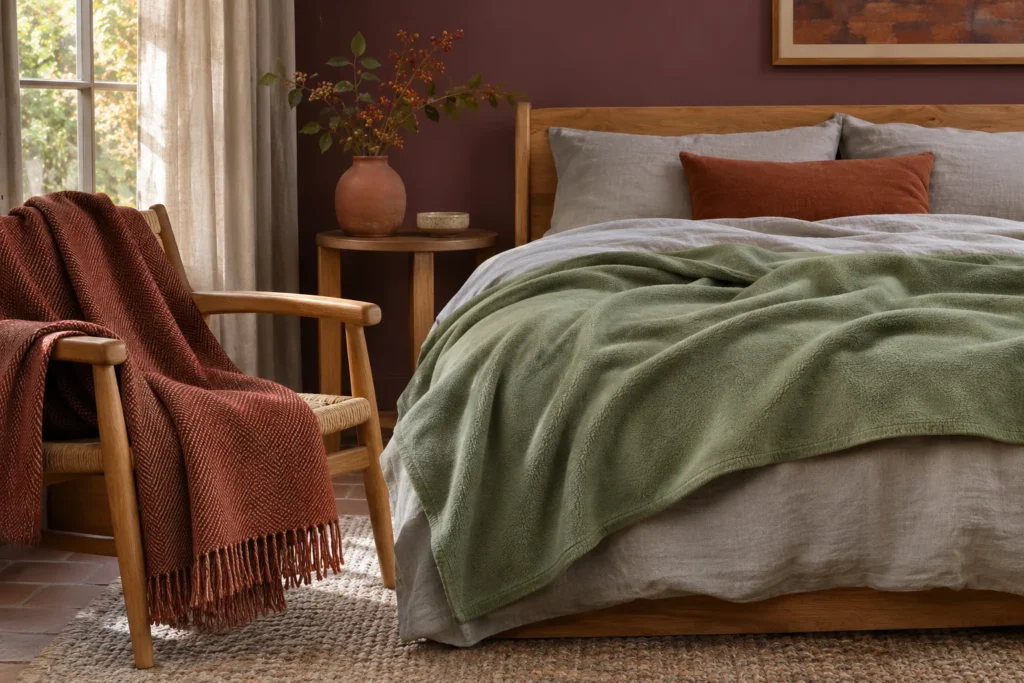
Choose wool if you want a sheep-fiber layer, like its woven texture, and can follow the particular care label. For a bed, check dimensions and drape; for direct skin contact, prioritize fineness and a useful return policy. If another natural fiber interests you, our alpaca vs wool blanket comparison addresses that separate choice.
Choose fleece if your priorities are a plush surface, convenient routine washing, and a potentially light everyday throw. Verify finished weight for travel and drying restrictions for frequent use. For a warm room, a thinner single-layer fleece may be a better starting point than a deep-pile, backed design.
Consider a different layer if neither texture suits you or you need less insulation. Our wool vs cotton blanket guide covers that alternative. For two sleepers with different preferences, separate throws can be more practical than expecting one fiber to satisfy both.
Frequently asked questions
Is a wool blanket warmer than a fleece blanket?
Not necessarily. Finished thickness, loft, weave or knit, coverage, and layering determine the comparison. A thick fleece can outperform a thin wool throw for insulation. Without comparable product-level thermal testing, fiber names alone cannot establish a warmth ranking.
Is fleece better if wool feels itchy?
It may suit your texture preferences better, especially if you like an even plush surface. Finer wool or using wool over a sheet may also help. Neither material name guarantees skin comfort, so sample the fabric when possible and check the return conditions.
Can wool and fleece blankets go in the dryer?
Only as the individual label permits. Some wool blankets need line or supported air drying, while fleece products may specify low heat or no heat. Machine washable does not mean safe for any dryer cycle.
Does fleece stay warm when wet?
Fleece can remain useful in damp conditions because polyester absorbs little water into the fiber and fleece can dry relatively quickly. A saturated blanket still holds water between fibers and can feel cold. Keep it dry; do not treat this property as a guarantee of adequate outdoor insulation.
The better blanket is the one that fits your routine
For a wool vs fleece blanket purchase, begin with size, construction, texture, and care. Wool is a strong candidate for a natural-fiber bed layer you are prepared to maintain. Fleece is a strong candidate for a soft, practical everyday throw. Choose the finished product that matches your room, skin preferences, laundry routine, and budget—not a universal winner based on its fiber label.