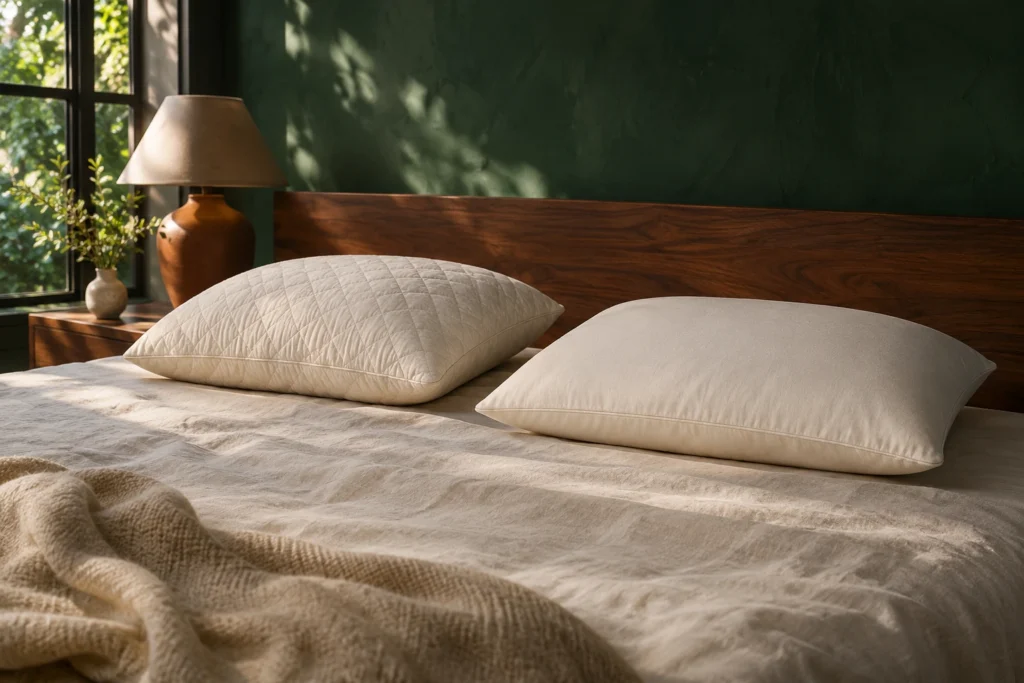
A wool vs latex pillow decision starts with the kind of support you enjoy. Wool-filled pillows offer a fibrous cushion that can settle with use; latex foam provides a more springy response. A solid latex core keeps a defined shape, while shredded latex can be repositioned and, in some designs, removed to change the height. Wool pillows may also be adjustable, but many use fixed layers of batting.
Neither filling is automatically better for side sleepers, cooler through the night or easier to wash. The useful comparison is between specific pillows: how high they remain under your head, how their filling moves, and which parts you can actually clean.
Research by the Editorial Team. Manufacturer specifications and care policies checked November 6, 2026. This is a research-based comparison, not a report of hands-on testing. Named products illustrate construction differences; they are not ranked recommendations.
Wool vs latex pillow: compare three constructions
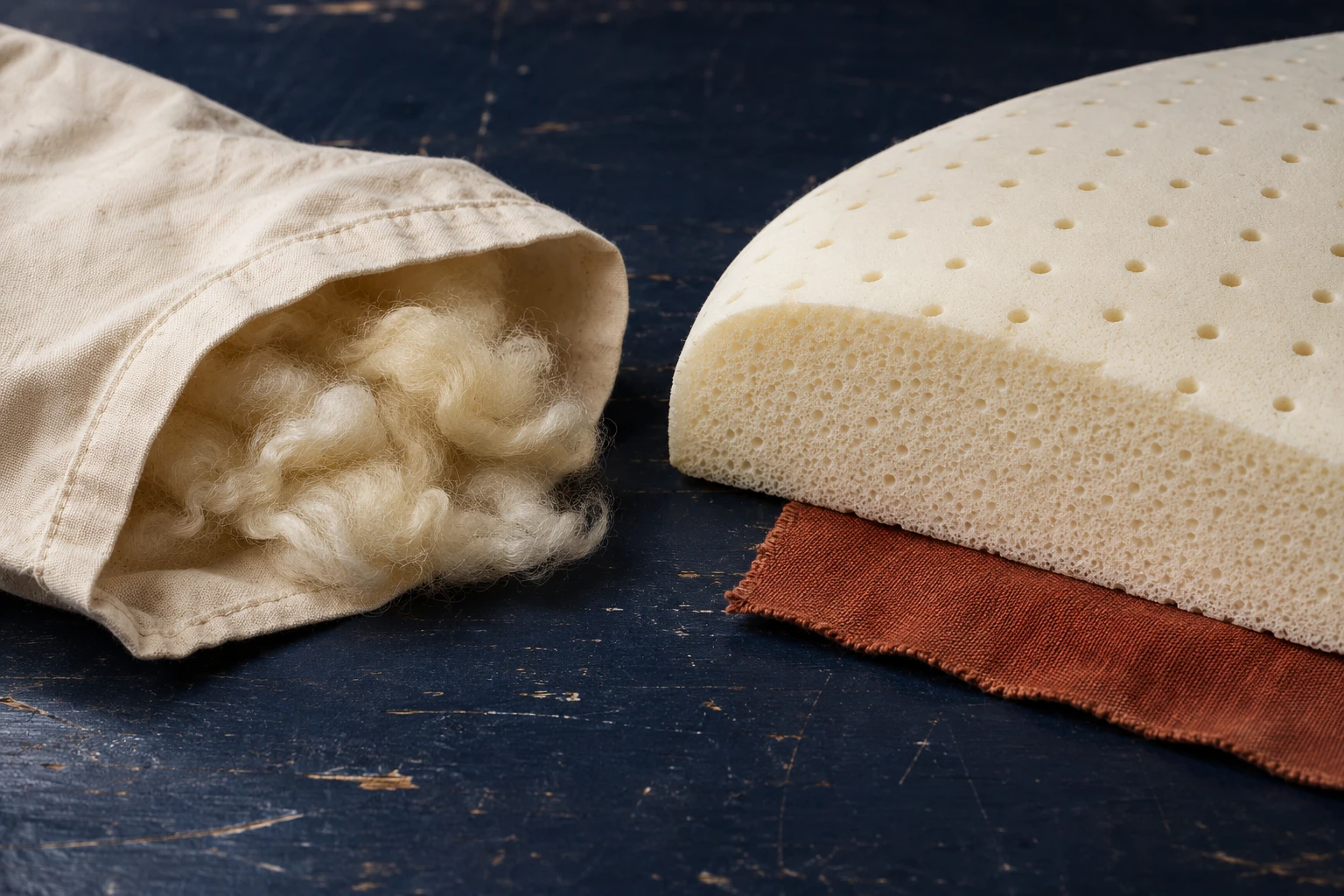
A pillow’s filling name leaves out much of its design. Start by separating wool batting, loose wool fill, a molded latex core and shredded latex. A cotton cover can conceal any of these.
| Buying question | Wool-filled pillow | Solid latex pillow | Shredded latex pillow |
|---|---|---|---|
| How does it respond? | Fibrous cushioning; density and settling affect feel. | A resilient foam core compresses and rebounds. | Foam pieces compress and move within the casing. |
| Can you change its height? | Only models designed with accessible, removable fill. | Usually fixed; choose the correct profile before buying. | Often adjustable, but confirm access to the filling. |
| Can you reshape it? | Loose fill can be redistributed; layered batting offers less freedom. | The molded shape limits reshaping. | Loose pieces allow redistribution; maintenance may be needed. |
| What must you check for washing? | The case, cover and wool filling may have different instructions. | Do not assume the foam core or complete pillow is washable. | A washable outer cover does not establish washable filling. |
| What matters over time? | Settling, uneven fill and whether replenishment is permitted. | Continued recovery, intact foam and suitable height. | Even distribution, foam condition and available replacement fill. |
| Best starting point | You prefer fiber cushioning and accept the model’s maintenance. | You want a defined profile with less fill rearranging. | You want latex resilience with more control over shape or fill. |
Wool: layered batting or loose fill
Batting consists of sheets of wool arranged inside a casing. Holy Lamb Organics says its Certified Organic Wool Bed Pillows use layered wool batting in an organic cotton sateen case, with different thickness choices. Selecting a thickness at checkout is different from being able to remove filling at home.
Loose-fill designs use wool clusters or balls instead. Woolroom’s Deluxe Washable Wool Pillow allows owners to add or remove wool balls. That makes height adjustable, although reducing the filling also changes how densely the pillow is packed.
Latex: a solid core or separate pieces
Solid latex means one continuous foam core, not a hard block. Its shape may be rectangular or contoured. Naturepedic’s Organic Solid Latex Pillow, for example, combines a molded latex core with cotton fabric and has a fixed profile.
Shredded latex consists of smaller foam pieces inside a casing. Naturepedic’s Adjustable Organic Latex Pillow allows fill adjustment and comes in Soft and Medium versions. Its specifications also list cotton batting alongside latex, a reminder that a latex pillow need not contain only latex.
Support, loft and firmness are different decisions
Loft is height; firmness is resistance to compression. Support describes how the finished pillow holds your head and neck in your sleeping position. A tall, easily compressed pillow can leave your head lower than a shorter, firmer one. Product photos and unloaded dimensions cannot tell you exactly where your head will rest.
Latex is often described as buoyant or responsive because the foam pushes back as it compresses. That does not make every latex pillow firm. Savvy Rest’s pillow range includes a Natural Talalay model described as very soft and a medium Dunlop contour model. Those are manufacturer descriptions, not a standardized comparison of their firmness against competing brands.
Wool can also feel dense rather than fluffy when tightly packed. If you dislike a springy sensation, a wool construction may be worth trying. If you dislike gathering loose filling beneath your neck, a suitable solid core may be more convenient.
Before buying, ask whether the quoted height is measured without weight, whether more than one profile is available, and whether the actual filling is adjustable. A zipper may simply remove the cover.
Which works for your sleeping position?
For side sleepers, consider the space between your head and mattress after your shoulder has sunk into the bed. A pillow that fills that space without pushing your head markedly upward or letting it drop is a more useful target than a particular material. A softer mattress can change the height you need.
For back sleeping, check that the pillow supports you without forcing your chin toward your chest. Stomach sleepers generally have less space to fill beneath the head; an overly lofty pillow may feel awkward. If you change positions, try the pillow in each position you actually use, rather than choosing solely from a side-sleeper label.
Pressure distribution is also about shape and compression. A surface that feels soft to your hand may still be uncomfortable beneath your ear, and a thick edge may not suit your neck. During an allowed home trial, use your usual mattress, pillowcase and protector. Note whether you keep folding the pillow or moving fill to get comfortable.
A review of pillow-height research examined alignment, body dimensions, contact pressure and muscle activity but found insufficient evidence for one optimal height for back or side sleeping. It does not establish a wool-versus-latex winner. Neither filling guarantees pain relief; persistent neck discomfort warrants individual professional advice.
Temperature comfort: moisture handling is not a cooling guarantee
Wool absorbs moisture vapor within its fibers and can release it as conditions change. Woolmark’s fiber research summary explains that mechanism. It is a reason to consider wool when a damp-feeling sleep surface bothers you, but the source is not a head-to-head test of these finished pillows.
Latex pillows may use perforations, and shredded designs have spaces between pieces. Those features describe construction; they do not establish how cool a particular pillow will feel all night. A dense filling, quilted cover, additional protector and pillowcase all contribute to the finished bedding system.
Separate three questions when reading cooling claims: does the surface initially feel cool, can air move through the construction, and how does the pillow handle moisture during use? These are related but different properties. Neither a ventilated foam photograph nor the word breathable supplies a measured answer.
If overheating drives your purchase, prioritize a usable return policy. Evaluate the pillow with the coverings you will keep using and your normal bedroom conditions.
Care can be the deciding difference
Read care instructions before committing to either material. Distinguish the everyday pillowcase, removable outer cover, inner casing and complete filled pillow. Permission to wash one layer does not extend to the others.
The verified examples show why blanket rules fail. Holy Lamb Organics specifies spot cleaning for its Certified Organic Wool Bed Pillows, while separate cases may be washed. Woolroom directs owners of its Deluxe model to remove the wool balls before washing the outer cover on a wool or delicate cycle with wool wash, then hang it to dry without tumble drying.
Naturepedic’s solid latex pillow is spot-clean-only. Its adjustable latex model permits machine washing and drying of the outer cover, while the inner pillow remains spot-clean-only and must dry fully before use. These instructions belong to those models, not every wool or latex pillow.
For practical buying purposes, check whether a removable washable protector is compatible, how long the permitted cleaning and drying process will take, and whether you have a spare pillow. If frequent whole-pillow washing is essential, neither a washable case nor an adjustable opening is enough: require explicit instructions allowing it.
Avoid improvising a soak, hot dryer cycle or wringing method for a foam core or wool-filled casing. Our guide to washing wool pillows explains the distinction between cleaning covers and handling different wool fillings.
Durability, compression and keeping a useful shape
Wool settling is worth planning for. Holy Lamb Organics warns that its layered pillows compress during early use. That is a manufacturer-specific expectation, not evidence that every wool pillow loses the same amount of height. Choose the initial thickness with the maker’s guidance, and check whether the design allows replenishment.
A solid latex core has no loose clusters to migrate across the case. Shredded latex can redistribute, so a model may need fluffing even though its material is resilient. Naturepedic explicitly recommends fluffing and adjusting the fill of its adjustable pillow.
There is no defensible universal replacement schedule from these specifications. Foam resilience is not proof that every latex pillow outlasts wool, and the ability to add wool does not make a pillow indefinitely serviceable.
Judge condition instead: has the pillow developed persistent low spots, clumping, damaged foam, torn seams or a height that no longer works for you? Follow model-specific maintenance first. If the permitted cleaning cannot address contamination, ask the manufacturer about replacement rather than assuming fresh fill fixes the entire pillow.
Composition and sensitivities: read beyond the front label
Natural latex originates from rubber-tree latex; synthetic latex is manufactured rubber, and blended formulations combine natural and synthetic components. These are not interchangeable composition claims. Talalay and Dunlop describe production methods, not an automatic guarantee of a particular natural-rubber percentage.
Talalay Global’s formulation information, for example, distinguishes its blended Classic material from a formulation using 100% natural rubber. Check the exact pillow’s declared composition instead of treating Talalay as synonymous with all-natural. The formulation, core design and finished construction still need evaluation; the natural label alone cannot predict firmness or longevity.
Also check whether wool is the main filling or only a quilted outer layer, and whether a supposedly single-material pillow contains other fibers or foam. Wool-and-latex hybrids exist. A certification attached to cotton fabric or latex does not necessarily describe every component or certify sleeping comfort.
Natural rubber latex proteins can cause allergy, as the American Academy of Allergy, Asthma & Immunology explains. If you have a known latex allergy, do not assume a cotton casing makes a latex pillow suitable; discuss material avoidance with your clinician. This is different from ordinary dislike of a pillow’s smell or texture.
Neither wool nor latex should be treated as universal allergy protection. Check the full composition, cleaning requirements and any known personal sensitivities instead of relying on a hypoallergenic sales claim.
Price and value: compare what you can actually use
Compare the same size and configuration, including the cover, extra fill, protector and shipping. A lower purchase price may be less useful if you cannot adjust an unsuitable height or return the pillow after trying it. Cleaning restrictions also have a cost in time and inconvenience.
Return terms differ meaningfully. At our verification date, Naturepedic’s direct-purchase policy allowed a 30-night pillow trial. The Savvy Rest Wool Pillow page stated that returns were not accepted. Retailer policies can differ, so confirm the terms at your actual checkout. A warranty covering defects is not the same as a comfort trial.
This comparison does not assign either filling a universal price advantage or estimate cost per year from an assumed lifespan. Pay for a construction, care routine and return arrangement that fit your needs. For model-level wool options after choosing a filling, see our best wool pillows guide.
How to choose without buying on the material name alone
Start with wool if you prefer fiber cushioning to a springy foam response. Choose loose adjustable fill when experimenting with height matters, or a fixed batting construction when you prefer a more settled shape and can select a suitable thickness.
Start with solid latex if you want a defined, resilient profile with less rearranging. Be particularly careful about height and returns, because a fixed core leaves less room to correct the fit afterward.
Start with shredded latex if you like foam resilience but want the ability to redistribute filling. Confirm that the model actually permits fill removal and that its texture and maintenance suit you.
If easy laundering or a known material sensitivity is your main constraint, resolve that first. Then compare the short list by supported height, feel and return terms. If your preferred alternative is a softer, moldable down construction, our wool vs down pillow comparison covers that separate decision.