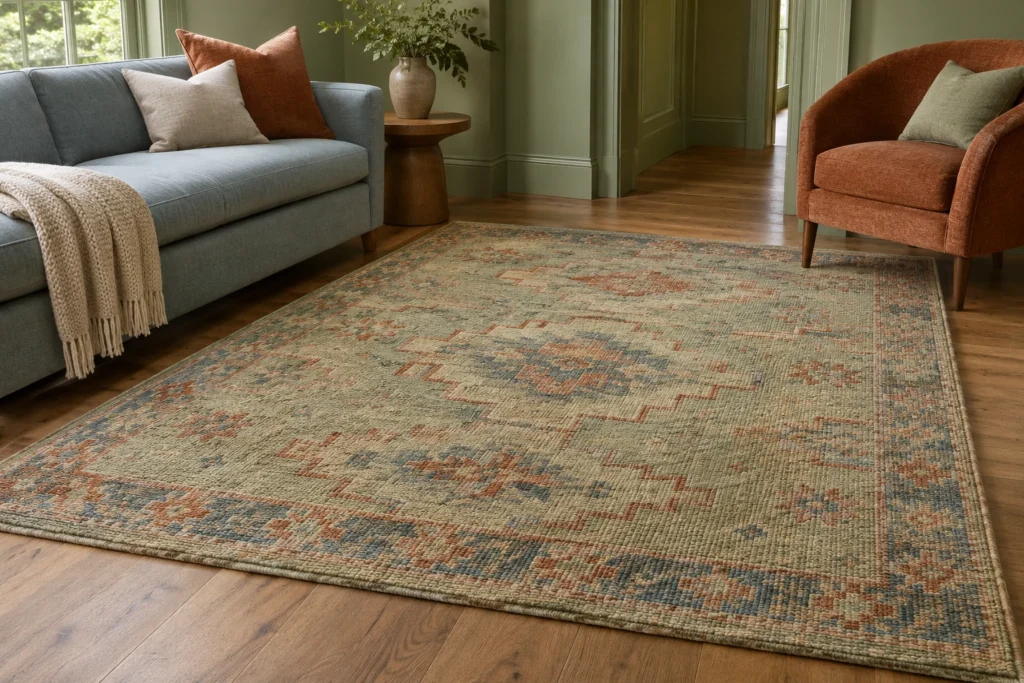
If your wool rug smells, check when the odor started and whether the rug, backing or pad is damp. A faint new-wool scent may be temporary; persistent mustiness, a strong backing odor or a smell after a spill needs a different response. Start with inspection and the maker’s care instructions, not a deodorizing treatment.
The description of a smell is a clue, not a diagnosis. “Wet dog,” “chemical” and “musty” can mean different things to different people. The useful questions are what changed, where the odor is concentrated and whether moisture or contamination remains below the surface.
This is a research-based troubleshooting guide, drawing on rug-care organizations, manufacturer guidance and indoor-moisture references. We have not tested odor-removal treatments on rugs.
Is a new wool rug smell normal?
WoolSafe explains that wool carpet can have a faint wool odor, which becomes more noticeable when damp, alongside a new-product smell associated with the backing. That makes a mild scent on a newly unpacked rug plausible. It does not establish that every strong or persistent odor is harmless.
Construction matters even before a rug gets dirty. For its own tufted wool rugs, manufacturer Tekstiil Ruumis attributes a temporary new-rug smell to its latex backing adhesive and recommends ventilation while avoiding strong sunlight. That is product-specific guidance, not a promise for every rug.
Unroll a dry new rug in a suitable, ventilated room and keep the packaging and order information. Ask the seller what is expected for the exact model and what the return window allows. Report an intense, worsening or unacceptable odor promptly rather than spending that window experimenting with cleaners.
There is no dependable number of days after which all wool rugs should stop smelling. Nor does smell alone prove how much lanolin remains, what finishing chemicals were used or whether a rug is high quality.
Wool rug smells: a troubleshooting table
Use this table to choose a next step. The possible explanations are not confirmed diagnoses, and several can occur together.
| Observed odor or situation | Possible explanations | Safe next step | When to seek professional help |
|---|---|---|---|
| Mild scent just after unpacking; rug is dry | Wool odor or materials used in manufacture and backing | Ventilate as the maker permits; record whether it eases | Contact the seller if strong, worsening or not improving |
| “Wet dog” smell after damp weather or wetting | More noticeable damp-wool odor; other wet layers or residues may contribute | Check the reverse, pad and floor; address moisture promptly | Seek help if wet through, slow to dry or persistently unpleasant |
| Rubbery odor strongest near the back | Backing adhesive may be involved | Check construction and contact the supplier before washing | Ask about inspection, repair or return if persistent |
| Musty smell after storage, a leak or cleaning | Damp materials; possible microbial growth in the rug or surroundings | Find the water source; avoid routine vacuuming if mold is suspected | Prompt assessment for visible growth, substantial wetting or recurrence |
| Localized sour or urine-like smell | A spill or pet residue may extend below the pile | Blot a fresh accident; inspect what lies beneath | Specialist help for old residue, wet padding or returning odor |
| Stale smell following smoke or cooking exposure | Environmental odor or deposited contamination; other room textiles may contribute | Stop the source and check nearby furnishings too | Professional advice if ordinary permitted dry care is insufficient |
Inspect the whole rug, not just the pile
Establish what happened
Note whether the smell was present on delivery or began after cleaning, a spill, humid weather or storage. Check the rug label and order details for face fiber, blends, construction and care restrictions. A wool face can sit above a different foundation or adhesive-backed assembly; the label “wool” is not a complete cleaning specification.
Our guide to wool rug construction explains the buying terminology. Here, the practical question is which layers could be holding moisture or producing odor.
Look underneath only when it is safe
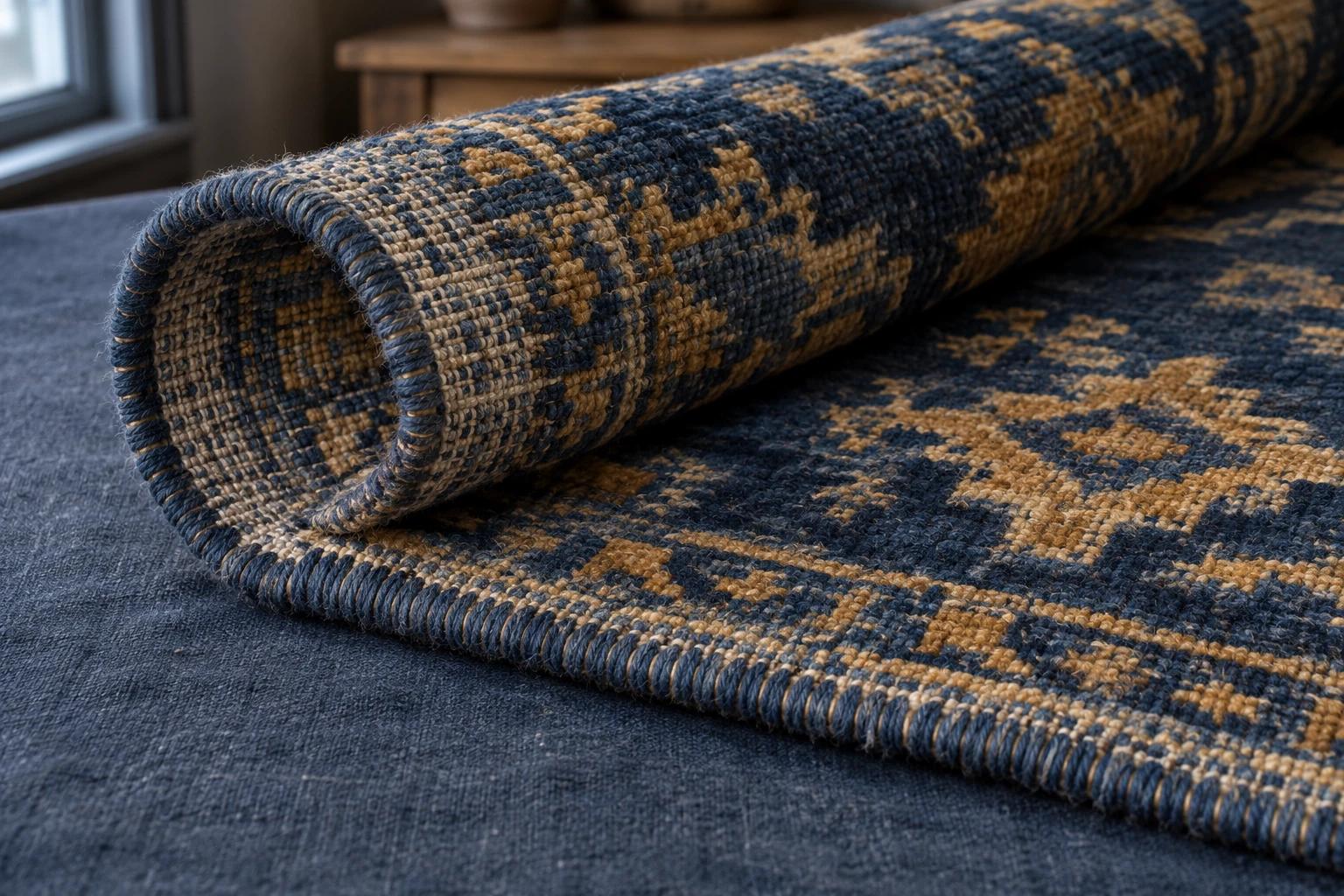
For a sound, manageable rug with no suspected mold, move light furniture out of the way and gently lift an accessible edge. Look for dampness, discoloration, a damaged backing, changes in the pad and moisture on the floor. Do not peel apart glued layers or drag heavy furniture across the rug. Leave heavy, fragile or valuable rugs to someone equipped to handle them.
A dry-feeling surface does not establish that the whole assembly is dry. Touch and appearance cannot rule out hidden moisture or contamination. If the underside cannot be checked safely, that is a reason to request an inspection, not to add more cleaning liquid.
Check the surrounding room
Look for a leaking planter, condensation, a plumbing problem or a recently washed floor beneath the rug. Also consider the pad, upholstery and other nearby textiles. Locating the smell near a rug does not prove that its wool fibers are the source.
Why wet wool may smell—and why drying matters
A damp-wool scent can be temporary. But if the rug smells like wet dog after cleaning or getting wet, do not assume every odor is simply the natural fiber. The amount of water, the materials underneath and the drying conditions all change what needs attention.
EPA guidance for clean-water damage calls for drying carpet and backing within 24–48 hours to reduce mold risk, including attention to the floor underneath. This is an urgency guideline, not a guaranteed safe waiting period or a drying specification for every wool rug. EPA also notes that mold can develop within that window, while growth does not always occur after it.
Do not wait for a deadline if the rug is soaked or drying is uncertain. A rug or water-damage professional can assess hidden layers and arrange suitable extraction and controlled drying. An expensive handmade rug may also need textile-conservation expertise.
If the smell began after cleaning
Contact the cleaner promptly and describe the timeline, the cleaning method if known, and any changes in color, texture or backing. Ask how the rug was dried and whether the pad and floor were checked. A second wet cleaning is not automatically the answer.
The IICRC’s area-rug guidance explains that construction can affect shrinkage and that excess moisture or unsuitable chemicals can contribute to dye migration. It favors controlled professional conditions for rugs that need them. Our guide to wool rugs and steam cleaning distinguishes household vapor steamers from professional hot-water extraction; neither the marketing name nor the fiber alone determines suitability.
A backing odor may not be a cleaning problem
The Association of Rug Care Specialists describes tufted rugs as yarn inserted through a primary backing, commonly held with latex adhesive and covered with a secondary backing. It identifies adhesive odor and deterioration as possible problems. Powder underneath, separation or rippling can warrant investigation, but none should be diagnosed from smell alone.
This distinction can save an unnecessary cleaning bill. ARCS warns that odor originating in latex backing may remain or worsen with cleaning. The IICRC likewise identifies a burnt-rubber-type odor associated with certain tufted-rug manufacturing problems and advises contacting the retailer about a new affected rug.
Ask the supplier to confirm the actual backing materials and recommend a next step in writing. Do not try to speed the process with a heater or dismantle the backing. A rug specialist can discuss whether repair is feasible; a new-product problem may be better handled through the seller.
Take persistent mustiness seriously
EPA identifies a moldy odor as a reason to investigate possible growth in a building. A musty wool rug therefore deserves a moisture check, especially after damp storage, a leak or slow drying. The smell does not tell you the organism, the extent of contamination or whether the source is the rug rather than the floor or nearby wall.
If you see suspected growth, do not shake, brush or routinely vacuum the rug. Stop ordinary home care and seek assessment. Avoid aiming a fan across suspected mold or contaminated water; air movement is not appropriate for every contamination situation.
EPA’s residential mold guidance emphasizes fixing the moisture problem as well as dealing with affected materials. Porous items such as carpet may be difficult to clean completely and sometimes require disposal. That decision needs context, particularly for a valuable rug; airing or masking the smell does not establish that contamination has been removed.
For sewage, floodwater of uncertain cleanliness or extensive water damage, contact an experienced restoration professional promptly. If you have health concerns, seek medical advice rather than using the smell to judge exposure.
Pet accidents and household odors need different responses
The Carpet and Rug Institute’s pet-urine bulletin explains that urine can affect dyes and backing bonds, that stains may be permanent, and that odor can return in humid conditions when residue remains. A fresh spill and an old contaminated foundation are not equivalent problems.
Blot a fresh accident with clean white absorbent towels without rubbing. Follow the exact rug’s instructions before adding water or a product. Persistent or returning odor may require attention to the pad or floor as well as the rug. Our dog-urine guide for wool rugs covers that situation in detail, including why not every enzyme cleaner is compatible with wool.
Smoke, cooking and other room odors require a different history: remove or reduce the continuing source and assess neighboring furnishings before treating the rug alone. A professional can distinguish surface soil from contamination requiring more extensive work.
A textile study on wool carpets and odor sorption found that uptake depended on the experimental setting and the proximity of odor sources. Meanwhile, Woolmark’s odor-resistance guidance largely concerns apparel and body odor. Neither is a guarantee that an installed rug will stay odor-free or that ventilation will remove everything it has encountered.
What you can do without adding cleaning chemicals
For a dry, sound rug with a mild odor and no suspected mold or contamination, begin with the maker’s permitted routine care. Improve room ventilation when outside conditions are suitable. In a humid room, opening windows may not help drying; moisture control may require dehumidification and attention to the source.
The Canadian Conservation Institute’s rug-care guidance recommends cautious vacuuming with low suction, avoiding a power head and watching for loose threads and fringe. Use the exact rug’s instructions to choose equipment and technique. Our wool-rug vacuum guide explains the controls that matter.
If safely accessible and permitted, include the dry reverse, pad and floor in routine care. Do not vacuum a wet rug with an ordinary dry vacuum. Valuable or fragile textiles need tailored advice.
Do not soak an unidentified rug or treat outdoor sun exposure as a universal deodorizer. Strong light can fade textiles, and a rug placed on damp ground can acquire another moisture problem.
Skip unverified vinegar, baking soda, bleach, perfume, essential oils and homemade mixtures. A deodorizing powder is not necessarily a suitable cleaning compound, and fragrance does not show that the source is gone.
WoolSafe’s consumer guidance offers independently evaluated products and trained service providers. Product compatibility is useful evidence, but it does not replace the rug maker’s restrictions, dye checks or a suitable drying plan. A cleaner safe for wool fibers cannot make every backing washable.
Who to contact—and what to tell them
Start with the seller or manufacturer when a new rug has a strong or persistent odor, especially near its backing. Send the model or order number, label photographs, delivery date and a short account of how it has been stored and cared for. Ask about inspection and return options before authorizing treatment.
Contact a wool-rug specialist for recurring odors, old spills, uncertain dyes, backing changes or a rug that remains damp. Explain every product already applied; a treatment history is more useful than a confident guess about the smell.
Use a restoration professional or textile conservator when appropriate for contaminated water, suspected mold, substantial wetting, antiques or fragile valuable rugs. Ask whether the proposed work includes the pad and floor, how suitability will be assessed, how drying will be verified and what outcome cannot be promised.
Keep a brief record of when the odor appears and whether it changes with humidity or recent cleaning. That gives the person inspecting the rug a better starting point than another round of deodorizer.