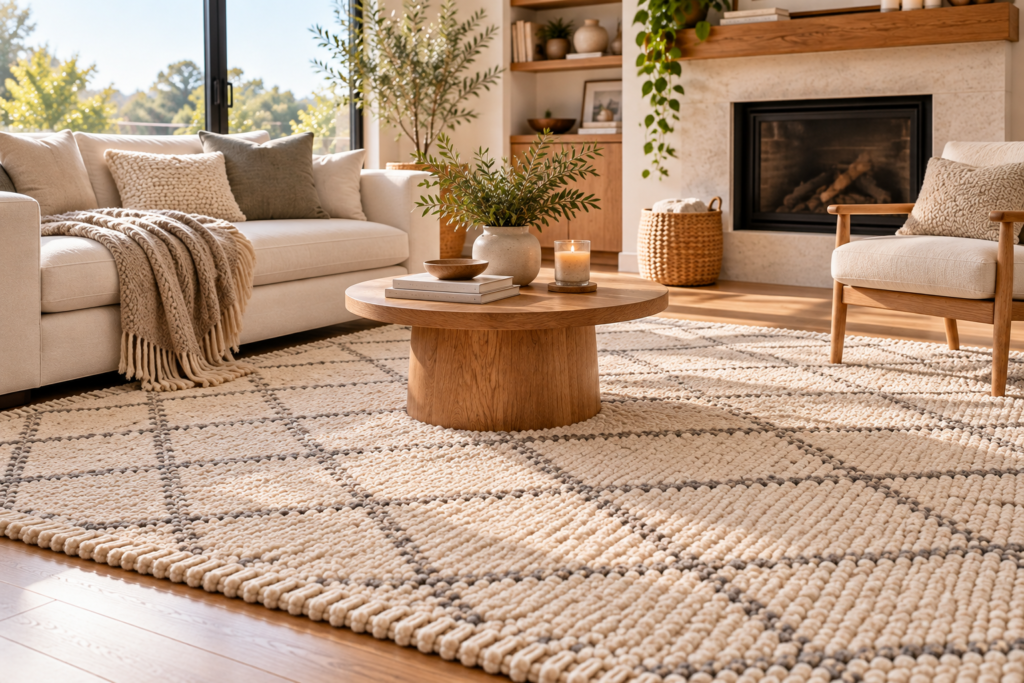
Wool rugs can completely change the way a room feels. They can add warmth to a large living room, soften a bedroom, or help bring together furniture that otherwise looks slightly disconnected.
Part of their appeal comes from the combination of comfort, texture, and the natural resilience of wool. But choosing a wool rug isn’t simply a matter of finding a design you like—or assuming that anything made from wool will automatically be a good purchase.
Construction matters. So does pile height, wool content, size, and where you plan to use the rug.
If you’re considering a wool rug for your home, this guide walks through the details that are actually worth looking at before you buy.
What Is a Wool Rug?
A wool rug is a rug made entirely or partly from wool fibers. Sheep’s wool is the most common, although the exact characteristics of the fiber can vary depending on its source and how it has been processed.
You’ll also come across both 100% wool rugs and wool blends.
A 100% wool rug uses wool for the primary pile or woven surface, while a blended rug combines wool with another fiber. The second fiber may be natural or synthetic.
That distinction is worth checking rather than relying on the word “wool” in a product title. A rug marketed as a wool rug isn’t necessarily made exclusively from wool.
Natural Wool vs. Wool-Blend Rugs
Neither option is automatically right for every home.
A 100% wool rug gives you the characteristics people generally associate with wool: a substantial feel, natural texture, resilience, and insulation.
Blends can behave differently depending on what has been mixed with the wool and in what proportion. They may also be used to change the price, texture, durability, or construction of a rug.
When comparing products, check the actual fiber composition on the manufacturer’s label or specifications.
Common Types of Wool Used in Rugs
Not all wool feels identical.
Some rugs use fine, relatively soft wool, while others use stronger or coarser fibers that are well suited to floor coverings. You may also see manufacturers highlighting New Zealand wool or wool from particular regions.
Rather than treating a geographic label as a guarantee of quality, look at the bigger picture: fiber quality, density, construction, finishing, and the reputation of the manufacturer all matter.
Why Choose Wool Rugs?
There isn’t one single reason people choose wool. Its appeal comes from several characteristics working together.
Comfort and Softness
Wool has a naturally textured, cushioned feel that works particularly well in spaces where comfort matters.
That can make it attractive in bedrooms and living rooms, especially if you often walk around barefoot or want to soften a room dominated by hard flooring.
The exact feel underfoot still depends heavily on the rug’s construction. A thick hand-tufted rug and a thin flatweave may both contain wool but feel completely different.
Durability and Resilience
One of wool’s useful characteristics is its natural elasticity.
Wool fibers can flex and recover rather than remaining permanently flattened immediately after pressure. That resilience is one reason wool has traditionally been used for carpets and rugs.
Construction quality matters just as much, though. A poorly made wool rug shouldn’t be expected to outperform a well-constructed rug simply because of its fiber content.
Natural Insulation
Wool can help add a layer of thermal insulation between your feet and the floor.
You notice this most on hard surfaces such as tile or wood, where a rug can make the space feel noticeably less stark and more comfortable.
It can also help soften sound in rooms with lots of hard surfaces.
Appearance and Texture
This is harder to measure, but it’s a big part of wool’s appeal.
Wool can be dyed in a wide range of colors, which is one reason wool rugs are available in everything from subtle neutrals to richly patterned designs.
Its natural texture also gives a room depth without requiring an elaborate pattern.
Types of Wool Rugs
Two rugs made from similar wool can perform very differently because of how they’re constructed.
Before choosing one, it helps to understand the main categories you’re likely to encounter.
Hand-Knotted Wool Rugs
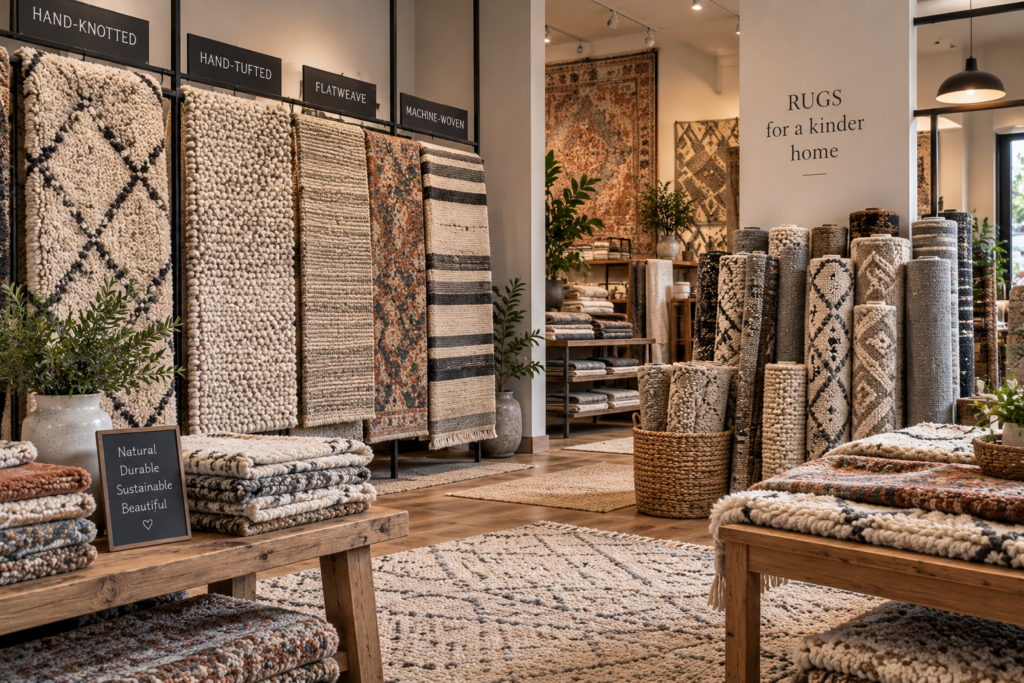
Hand-knotting is a labor-intensive technique in which individual knots are tied onto the rug’s foundation.
Well-made hand-knotted rugs can be exceptionally detailed and durable, but they also tend to sit toward the expensive end of the market because of the amount of skilled labor involved.
If you’re considering one, look beyond the phrase “hand-knotted.” Materials, knotting quality, finishing, and overall craftsmanship still matter.
Hand-Tufted Wool Rugs
Hand-tufted rugs are produced differently.
Instead of individually tying knots, yarn is inserted through a backing material with a tufting tool. A secondary backing is commonly applied afterward.
This makes production considerably faster than hand-knotting and can make tufted wool rugs more accessible.
They’re capable of looking plush and substantial, but they shouldn’t automatically be treated as equivalent to hand-knotted rugs simply because both are handmade.
Flatweave Wool Rugs
Flatweaves don’t have the deep pile you might picture when thinking about a traditional wool rug.
Their flatter construction can make them practical in areas where you don’t want a thick rug interfering with furniture or doors.
They can also be easier to move than very heavy, high-pile rugs.
If you’re after a deeply cushioned feel, however, a flatweave probably won’t give you the experience you’re looking for.
Machine-Made Wool Rugs
Machine production makes it possible to create wool rugs at scale and at a wide range of prices.
“Machine-made” doesn’t automatically mean poor quality, just as “handmade” doesn’t automatically guarantee excellent quality.
Look at the rug as a complete product: wool content, density, backing, finishing, manufacturer information, and care requirements are all more useful than judging it from a single label.
How to Choose the Right Wool Rug
This is where buying a rug becomes less about finding the prettiest photograph and more about finding something that works in your actual room.
Start With the Room
Think about what happens in the space.
A bedroom rug doesn’t face the same demands as one sitting underneath the main seating area of a busy living room.
For frequently used spaces, construction and practicality deserve more weight. In quieter rooms, you may be able to prioritize softness or a more delicate design.
Choose the Right Size
An undersized rug can make even beautiful furniture look disconnected.
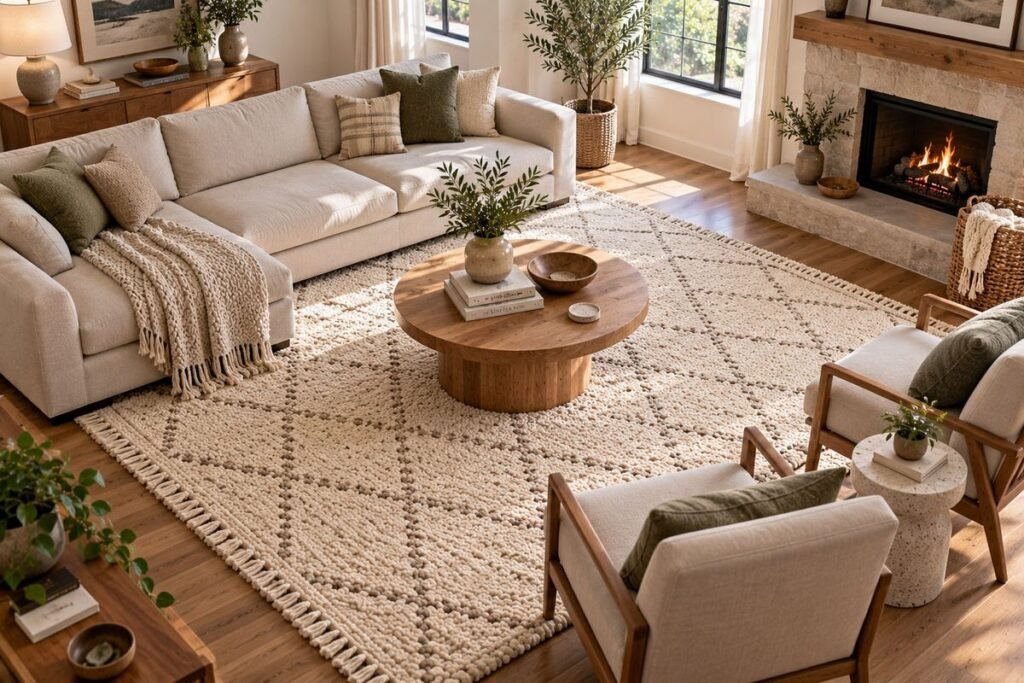
In a living room, a common approach is to choose a rug large enough for at least the front legs of the main seating pieces to rest on it. Larger rooms may look more cohesive with the furniture sitting more fully within the rug area.
For a dining room, remember that chairs move backward when people sit down or stand up. The rug needs enough space around the table for the chairs to remain comfortably on it.
Measure the room and furniture arrangement before ordering rather than estimating from photographs.
Think About Pile Height
High pile can feel plush and cozy, but more pile isn’t always better.
Lower-pile rugs can make sense underneath dining furniture or in busy areas because there’s less material for chair legs and foot traffic to work against.
Bedrooms and relaxed seating areas give you more freedom to choose something thicker if softness is the priority.
Look at Construction, Not Just Fiber
Seeing “100% wool” on a product page tells you something important, but not everything.
Two 100% wool rugs can differ dramatically in density, construction, finishing, and longevity.
Check how the rug was made and, when available, look for detailed specifications rather than relying solely on marketing descriptions.
Consider Color and Pattern in the Actual Room
A rug occupies a large visual area. Even a relatively subtle color can have a strong effect once it’s covering several square feet of floor.
If the furniture already has strong patterns, a quieter rug can help balance the room. If the furniture and walls are simple, the rug can become the element that introduces pattern or color.
Also remember that very pale rugs and intricate patterns create different maintenance realities. Choose for the home you actually have, not only for the styled room in the product photograph.
Check the Fiber Content
Before buying, find the material specification.
If you’re specifically looking for a natural wool rug, determine whether the pile is 100% wool or a blend and what other fibers are present.
This is particularly important when comparing prices because two visually similar rugs may have very different compositions.
Choosing a Wool Rug by Room
The “best” wool rug changes depending on where you’re putting it.
Living Room
Living rooms usually benefit from a rug that visually connects the main seating area.
Size is especially important here. A beautiful wool rug that’s too small can make the furniture arrangement feel fragmented.
For an actively used living room, also consider a construction that can cope with regular foot traffic.
Bedroom
Comfort can take priority in the bedroom.
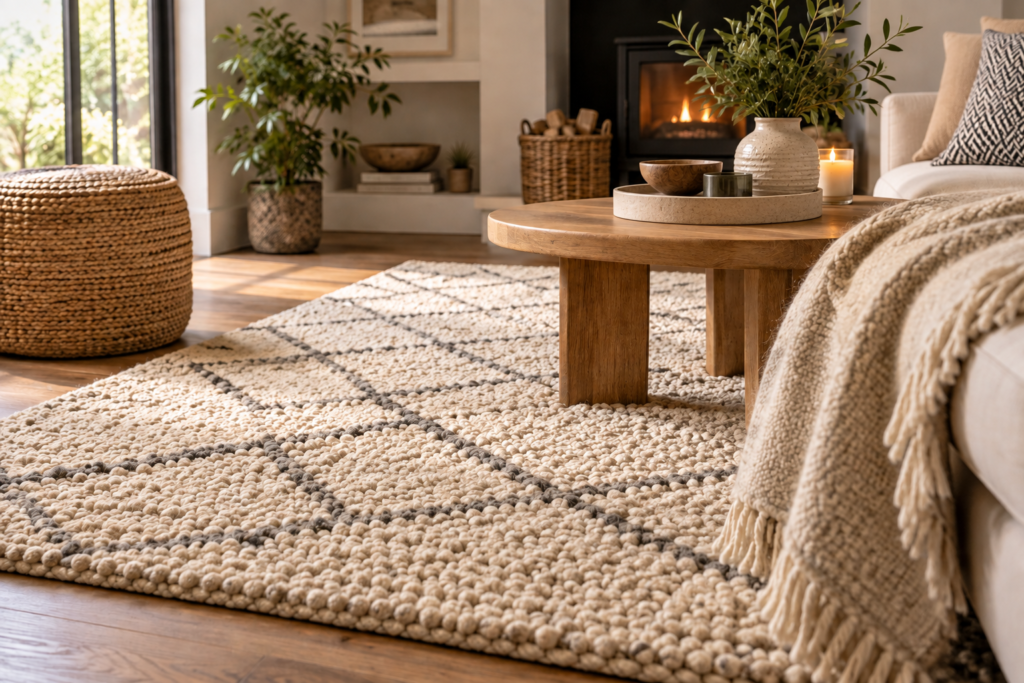
A soft wool rug can add warmth around the bed, particularly over wood, tile, or other hard flooring.
You don’t necessarily need a wall-to-wall effect. Depending on the room layout, a large rug under the bed or smaller rugs beside it can both work.
Dining Room
Dining rooms require a little more practicality.
The rug needs to accommodate moving chairs, and a very thick pile may not be the easiest surface underneath dining furniture.
Spills are also more likely here, so consider care requirements before choosing purely on appearance.
Hallways and High-Traffic Areas
These spaces ask more from a rug.
A lower-profile, well-constructed wool rug may make more sense than something extremely plush. You’ll also want to think carefully about rug pads and slip resistance, especially on smooth flooring.
Do Wool Rugs Shed?
They can.
Some shedding is common with many new wool rugs, particularly certain cut-pile and tufted constructions. Loose fibers can work their way to the surface, especially during the early period of use.
How much shedding occurs and how long it continues depends on the rug’s fiber quality and construction.
Persistent or excessive fiber loss shouldn’t simply be dismissed because a rug contains wool.
We’ll cover the subject in more detail in our dedicated wool rug shedding guide.
Are Wool Rugs Easy to Care For?
Wool isn’t maintenance-free, but everyday care doesn’t need to be complicated.
Regular vacuuming helps remove dust and loose material before it becomes embedded. Follow the rug manufacturer’s instructions regarding vacuum settings, particularly for delicate constructions or fringed edges.
For spills, acting quickly is usually preferable to aggressive scrubbing. Blotting is generally safer than rubbing, which can spread a spill and disturb the fibers.
Avoid assuming that a cleaning method is safe simply because it’s described as “natural.” Wool can react poorly to inappropriate chemicals, excessive moisture, heat, and rough treatment.
If you also have wool blankets at home, our guide to washing a wool blanket explains how to clean them while reducing the risk of shrinking or felting.
Are Wool Rugs Worth It?
For the right household, they certainly can be.
Wool offers an appealing combination of comfort, resilience, insulation, and natural texture. A well-made wool rug can also be something you keep for a long time rather than replace whenever a decorating trend changes.
The trade-off is that good wool rugs can cost more upfront than many synthetic alternatives.
They also aren’t necessarily the easiest choice for every situation. Budget, pets, children, traffic levels, cleaning expectations, and the specific construction of the rug all deserve consideration.
So rather than asking whether wool rugs are universally “worth it,” a better question is whether the qualities you’re paying for match the way you’ll actually use the rug.
Wool Rug FAQs
How Long Can a Wool Rug Last?
There isn’t a reliable universal lifespan for a wool rug.
Longevity depends on construction, fiber quality, foot traffic, maintenance, placement, and many other factors. A high-quality rug that’s appropriately used and cared for may last many years, while fiber content alone can’t guarantee longevity.
Are Wool Rugs Good for High-Traffic Areas?
They can be.
Wool’s natural resilience makes it a useful rug fiber, but construction is important. For a busy area, look for a well-made rug designed for regular use rather than choosing based solely on softness.
Are Wool Rugs Suitable for Bedrooms?
Yes. Wool’s comfortable feel and insulating properties make it particularly appealing over hard bedroom flooring.
The best size and pile height will depend on the bed placement and the feel you want underfoot.
Can You Vacuum a Wool Rug?
Many wool rugs can be vacuumed as part of routine care, but the appropriate vacuum settings vary.
Always check the manufacturer’s care instructions. Aggressive beater bars or settings designed for other types of carpet may not be appropriate for every wool rug.
Is 100% Wool Better Than a Wool Blend?
Not automatically.
If natural fiber content is your priority, a 100% wool pile may be preferable. But overall rug quality also depends on construction, materials, density, finishing, and intended use.
A well-made blend that suits a particular room can be a better purchase than a poorly constructed rug that happens to contain 100% wool.
Final Thoughts: Is a Wool Rug Right for Your Home?
Wool rugs have stayed relevant for good reason. They bring together qualities that are difficult to judge from a product photograph alone: texture, resilience, warmth, and the ability to make a room feel more comfortable.
But the word “wool” shouldn’t make the decision for you.
Start with the room. Measure carefully. Look at how the rug is constructed, check the actual fiber composition, think realistically about maintenance, and then choose the design.
That’s a much better way to find a wool rug you’ll be happy to live with than simply picking whichever one looks best on the screen.