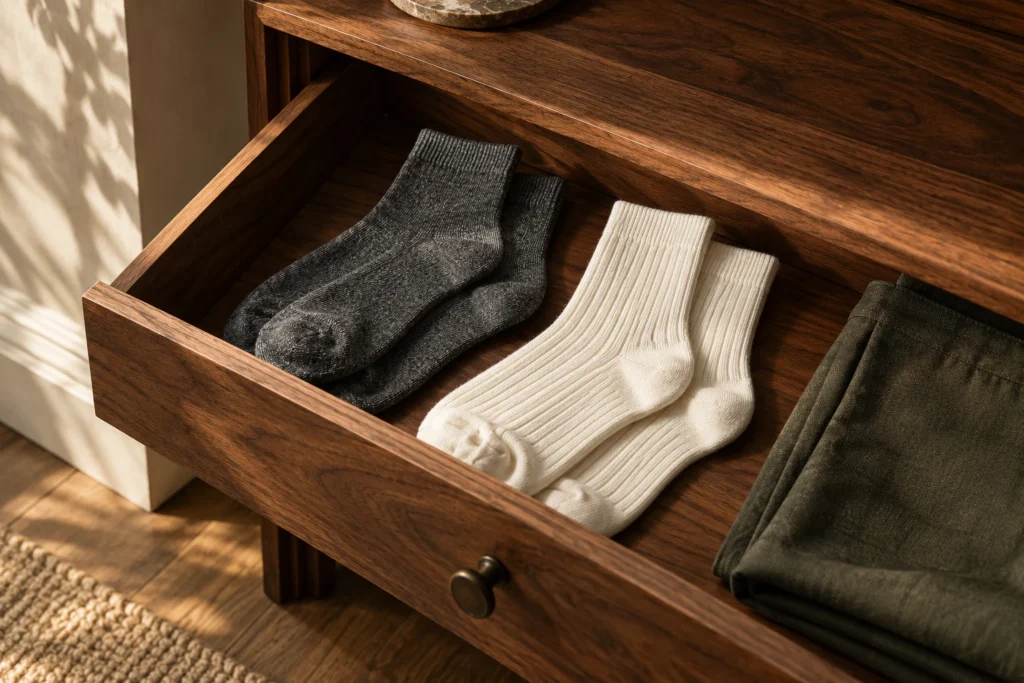
For everyday wear in comfortable, mostly dry conditions, cotton-blend socks can be a sensible, economical choice. For hiking, changing weather or a long day in boots, a well-fitting Merino wool blend deserves a closer look. Neither material guarantees dry feet, extra warmth or better durability: the sock’s thickness, knit, cushioning and fit matter too.
The useful question in the wool vs cotton socks debate is what you need the pair to do. A thin office sock and a padded hiking sock solve different problems, even when both contain wool. Equally, a cotton sock blended with nylon and polyester is different from a basic all-cotton tube sock.
This is a research-based comparison, not a wear test. Product specifications below come from manufacturer listings checked on October 13, 2026. Research findings are identified in context; buying recommendations are editorial judgments based on those findings and specifications.
Wool vs cotton socks at a glance
Use this comparison to narrow your choice, then check the actual pair.
| Buying factor | Wool and Merino wool socks | Cotton socks |
|---|---|---|
| Material | Animal fiber; Merino is wool from Merino sheep. Many socks include synthetic fibers. | Plant fiber; many socks also contain polyester, nylon or stretch fibers. |
| Moisture | Wool can absorb moisture vapor within the fiber. Liquid movement and drying depend on the whole sock. | Cotton absorbs moisture. Knit, blend and finishing affect how a cotton sock handles it. |
| Warmth | Wool is a useful starting point for insulating socks; cushioning, thickness and footwear remain important. | Can suit mild conditions or provide substantial padding; cotton content alone does not establish warmth. |
| Comfort and fit | Fine Merino may suit next-to-skin wear; check seams, cuff pressure and stretch. | A practical option if you prefer cotton’s feel; check the same fit details. |
| Care | Some are machine washable and allow low-heat drying; others need different treatment. | Often machine washable, but cotton content does not authorize hot washing or high-heat drying. |
| Value | Consider paying more for a particular construction or use, rather than the wool name alone. | Multipacks can lower the purchase price per pair; compare composition and cushioning before stocking up. |
These are material-level distinctions and buying guidance, not measured ratings of competing socks.
Read the blend before choosing the material
Wool is a protein fiber from sheep. Merino identifies a sheep breed and its wool, rather than a separate synthetic material or a sock construction. Our guide to where Merino wool comes from explains that distinction. Cotton is the plant fiber used as the main ingredient in many everyday socks.
The rest of the label matters. Nylon can contribute reinforcement, while elastane, also called spandex, provides stretch. Polyester is another common component. REI’s sock-selection guidance explains these roles. Blending fibers is an intentional design choice; 100% natural fiber is not automatically the most practical specification for a close-fitting sock.
Look at the exact color as well as the product name. Wigwam’s At Work Crew, discussed below, lists different cotton percentages for white, gray and black. A shopper choosing only by the collection name could miss that difference.
Treat the blend percentage as information about ingredients, not a performance score. A higher Merino percentage does not tell you whether the sock has a smooth toe, enough stretch, or cushioning in the place your shoe rubs.
Moisture management is more than absorbing sweat
Absorption, wicking and drying describe different processes. Absorption means taking in moisture. Wicking is liquid moving through the textile. Drying requires that water leave it. A fiber can absorb moisture without the finished sock necessarily drying quickly.
Woolmark’s moisture guidance documents wool’s ability to absorb water vapor. That helps explain its use in next-to-skin clothing. It does not prove that every wool sock keeps every foot dry, or that a thick Merino sock dries faster than a thin cotton blend.
Cotton’s absorbency can become uncomfortable when a pair stays damp inside a shoe. However, dismissing every cotton sock as incapable of releasing moisture is too broad. In a 2025 walking study, an experimental cotton-blend mesh sock showed faster humidity recovery after shoes were removed than the commercial wool- and polyester-based comparison socks. The designs differed, so this is evidence that construction matters, not that cotton always dries faster.
For buying, ask about your previous pair: did it become damp during a short commute, a whole workday or a strenuous walk? If dampness is the problem, consider a different knit and blend, the shoe’s ventilation, and a spare pair. Changing the fiber alone may not solve it.
Warmth and breathability depend on construction
Wool’s crimp can help create insulating air spaces. But the finished textile determines how much material and air sit around your foot. Breathability also involves several questions, including airflow and the movement of moisture vapor; it is not a single property you can read from the fiber name.
In research on wool and acrylic sock fabrics, fabric structure had the largest influence on several thermal and moisture measures. That study did not compare cotton socks, but it shows why construction deserves attention alongside fiber.
Human comfort research is similarly worth reading carefully. A 2021 study involving ten women compared cotton, wool, polyester and Coolmax socks during a controlled rest, running and recovery session. It found no significant differences between the sock conditions in the reported physiological and perceptual responses. This was one small study under defined conditions, not proof that all socks perform alike.
Our recommendation is to choose insulation for the day and footwear. A padded Merino hiking sock is a reasonable candidate for cold outdoor use. A thinner pair may be more suitable for warm weather or close-fitting shoes. Do not assume that adding a bulky sock to an already snug boot improves comfort.
Odor resistance has limits
Wool has evidence behind its interaction with odor molecules, but odor control is not the same as preventing sweating or killing bacteria. It also does not establish a universal number of wears before washing.
Research on polyester and wool blends found that adding wool reduced odor intensity compared with polyester in the tested conditions. That is not a direct wool-versus-cotton sock result. In separate research comparing cotton, wool and polyester fabrics, certain odor-related compounds increased above polyester after storage, but not above wool or cotton. The work concerned underarm odor, so it should not become a precise claim about feet.
Merino is worth considering if odor retention is a purchasing concern. Still, judge the actual pair, keep a clean rotation, and wash socks when needed. Neither material makes prolonged wear automatically hygienic or guarantees that shoes will remain odor-free.
Check softness cushioning and fit together
Fine Merino fibers can bend readily against the skin, which helps explain their use in clothing, as Woolmark’s Merino overview describes. Individual sensitivity, yarn construction and finishing still affect comfort. Cotton may simply be the feel you prefer.
The same distinction appears in our Merino wool vs cashmere comparison: a material name does not settle softness or suitability for a particular garment.
Cushioning is a separate specification. Terry loops create padding; a smooth knit can take up less room. Look for whether padding covers the sole, heel and toe, or additional areas. Terms such as “targeted” and “midweight” are manufacturer descriptions, not standardized scores that let you rank different brands precisely.
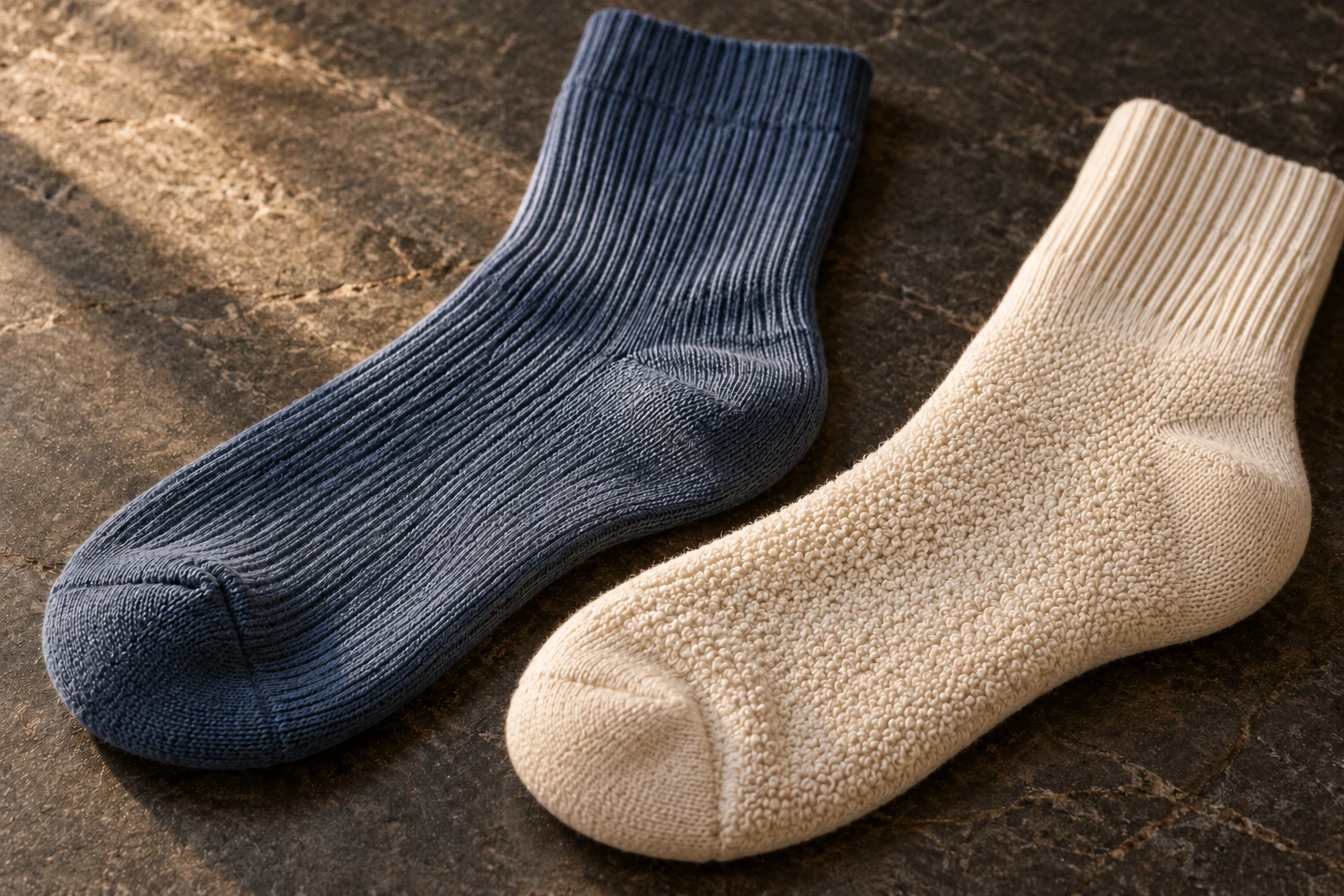
Try the sock with its intended footwear. Check that the heel sits correctly, the toe does not bunch and the cuff feels comfortable. For loafers and low-cut shoes, coverage matters as much as material. For boots, choose a height that covers the contact area around the collar.
Which socks suit your day
Everyday and office wear
For a mostly seated day, start with the feel, color and thickness you want. Cotton blends make sense when they are comfortable in your shoes and fit your laundry routine. Merino blends are another option for someone who prefers their feel or wants to try them across indoor and outdoor temperatures.
With dress shoes, avoid buying substantial cushioning without checking available room. A sock marketed for hiking may be unnecessarily bulky for that job, regardless of how appealing its fiber content sounds.
Walking and hiking
For short neighborhood walks, a comfortable cotton blend may be entirely adequate. For longer walks, wet conditions or routes where changing socks is inconvenient, our recommendation is to start with a purpose-designed Merino or synthetic hiking blend and appropriate cushioning.
Inspect the toe construction, heel fit and cuff height. Carry a spare pair when wet socks would disrupt the day. Neither wool nor cotton automatically prevents blisters; the sock and shoe need to work together.
Travel and prolonged wear
Decide how you will wash and dry your socks before choosing a travel wardrobe. Merino may appeal for odor management, while a cotton multipack can make a clean rotation affordable when laundry is readily available.
Do not plan a trip around an unverified “dries overnight” promise. A thick pair in a humid bathroom may still be damp the next morning. Buy one pair first, follow its care instructions and check whether it suits your routine before replacing the whole drawer.
Cold and warm weather
For cold weather, consider a wool blend with suitable coverage and cushioning, plus footwear that accommodates it. For warm weather, start with a lighter construction and less bulk if your shoes fit closely. Cotton socks vs Merino wool is not simply a summer-versus-winter decision.
If your day moves from an air-conditioned office to a hot sidewalk, you may prefer a lighter pair over substantial padding. If you spend hours standing outside in winter, prioritize the whole sock-and-boot combination. Neither “cotton for summer” nor “wool for winter” gives enough detail to make that purchase.
Three current US product examples
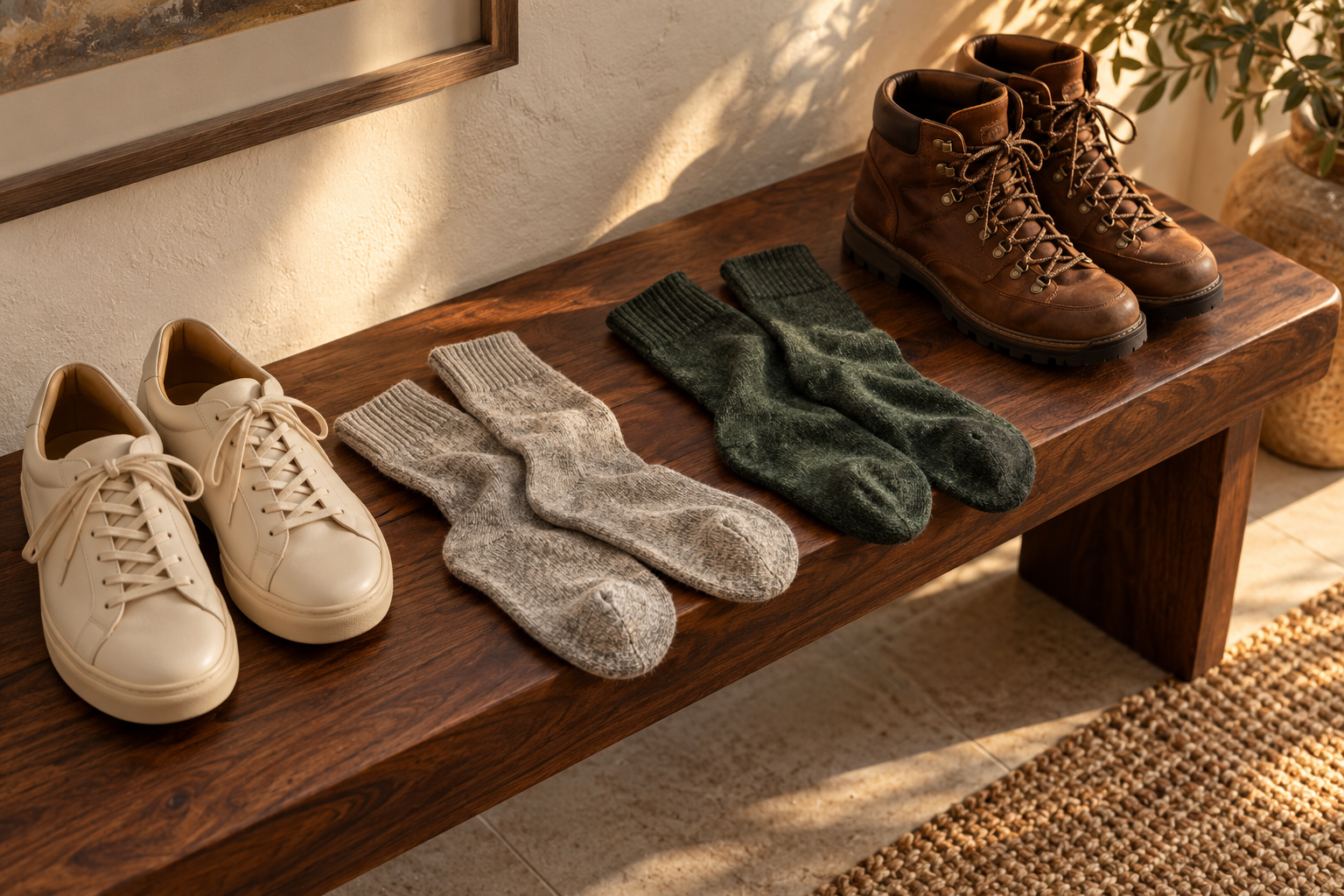
These examples illustrate different buying choices, not a tested ranking. Prices are the displayed US prices checked on October 13, 2026, before shipping or tax. Each product had purchasable variants; stock and specifications can change.
| Product | Documented blend | Height and cushioning | Displayed price |
|---|---|---|---|
| Darn Tough Men’s Hiker Micro Crew Midweight Hiking Socks, style 1466 | 61% Merino wool, 36% nylon, 3% Lycra spandex | Micro crew; Cushion option with terry padding underfoot and around ankle/Achilles | $26 per pair |
| Smartwool Everyday Solid Rib Crew Socks, SW003150 | 53% Merino wool, 45% recycled nylon, 2% elastane | Crew; Targeted Cushion | $24 per pair |
| Wigwam At Work Crew 3-Pack Midweight Socks, S1221, white variant | 73% cotton, 19% stretch nylon, 7% polyester, 1% spandex | Crew; Zone Cushion | $22 for three pairs |
The Darn Tough 1466 is the trail-oriented example. Sizes span XS–XXL across selected colors. Consider it when a micro crew and underfoot cushioning suit your hiking footwear; it may be more sock than you want in close-fitting office shoes. Darn Tough notes that fiber percentages may vary slightly.
The Smartwool Everyday Solid Rib Crew provides an everyday alternative in M, L and XL. Its targeted cushioning and ribbed crew design make it worth considering for casual shoes or boots when you want Merino without choosing a dedicated hiking model.
The Wigwam At Work Crew is the cotton-blend value example, offered in Medium, Large and Extra Large. White contains 73% cotton; gray contains 63% and black 45%, with different synthetic proportions. Check your chosen color. Consider it when a cushioned crew multipack suits your routine, rather than as a like-for-like substitute for every hiking sock.
Compare care requirements and real purchase value
Darn Tough specifies a cold gentle wash, inside out, followed by low-heat tumble drying or hanging. Smartwool permits a gentle warm or cool wash and low tumble drying. Both prohibit bleach and dry cleaning; Smartwool also prohibits ironing.
Wigwam’s care guidance calls for washing inside out, warm water no hotter than 120°F/50°C, no bleach or fabric softener, and the lowest dryer heat or flat air drying. Follow the instructions supplied with the actual pair if they differ.
For washable wool, Woolmark recommends a mild, neutral detergent. Our best wool detergent guide compares options without assuming one wash suits every textile. A cotton-rich blend also deserves its own label check.
Durability cannot be calculated from wool or cotton percentage. Look for documented reinforcement, appropriate sizing and a care routine you can maintain. A warranty is useful purchase protection, not evidence that the original pair will never wear out.
The Wigwam pack works out to about $7.33 per pair, compared with the two single-pair Merino examples at $24 and $26. Those are different products, not proof of a universal price gap. Paying more makes sense when the specific fit and construction solve a need. Without comparable wear testing, there is no honest cost-per-wear winner.
Frequently asked questions
Are wool socks better than cotton socks?
Neither is better for every use. A cotton blend may suit routine indoor wear and a lower purchase budget. For demanding outdoor use, consider a purpose-designed Merino blend. Check thickness, cushioning, fit and care before choosing.
Is Merino wool different from regular wool in socks?
Merino is wool from Merino sheep, commonly selected for fine fibers. “Wool” alone does not identify a breed or softness grade. Merino wool vs cotton socks comparisons should still examine the whole blend and construction.
Can you wear wool socks in summer?
Yes, if the pair’s thickness and fit suit the conditions and your footwear. A lightweight Merino blend is a different proposition from a heavily cushioned winter sock. Cotton blends can also work; neither fiber guarantees cool feet.
Do wool socks prevent blisters or foot odor?
No sock material guarantees either outcome. Odor-related textile findings do not establish a health benefit or a fixed washing interval. Consider fit, footwear, moisture and a clean sock rotation rather than relying on the fiber label.
Are 100 percent cotton or wool socks better than blends?
Not automatically. Added fibers can provide stretch or reinforcement, while knit construction affects cushioning and fit. If avoiding synthetic fibers matters to you, inspect the full composition and accept that your priorities may differ from those of a hiking-sock buyer.
Can wool and cotton socks go in the dryer?
Some can, at the temperature their care instructions allow. The three examples here permit drying at low or lowest heat, but that does not apply to every wool or cotton sock. Check each pair before combining laundry loads.