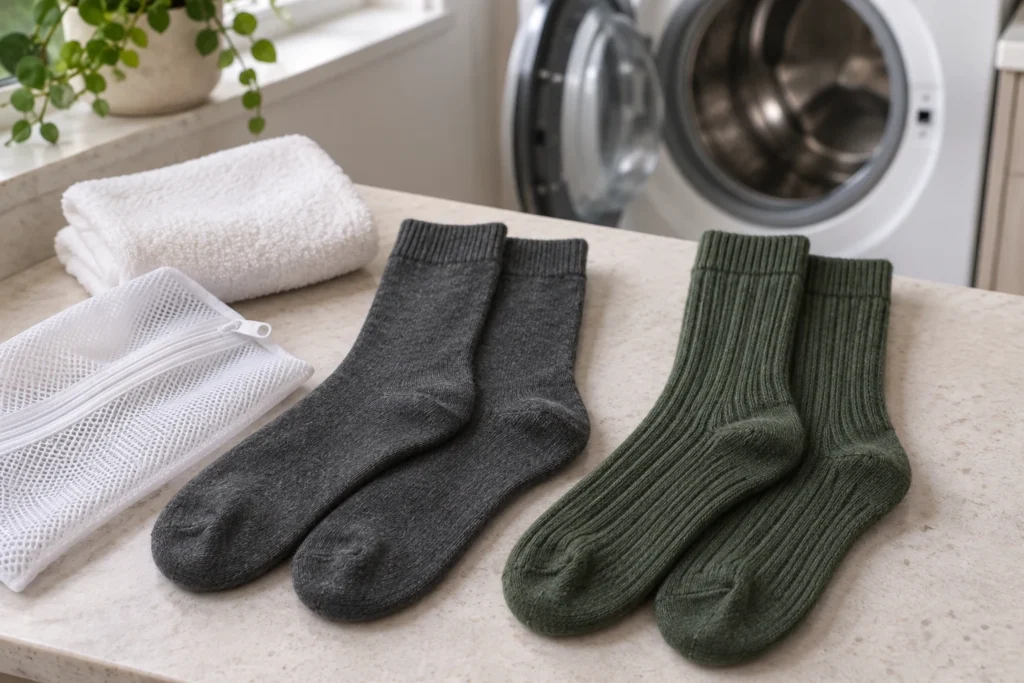
To wash wool socks, start with the care label: machine wash only when permitted, hand wash when required, and check the drying instructions separately. Use a suitable mild detergent, turn socks inside out, and handle wet fabric gently. Some wool socks allow low tumble drying; others need to dry flat.
The details matter more than the word “wool.” A cushioned hiking sock, a fine dress sock and a hand-knitted pair can have different fibers, finishes and care requirements. This guide explains how to wash wool socks with attention to soles, cuffs, blends and drying—not a single setting for every pair.
Our guidance is research-based, using Woolmark and sock and yarn manufacturers. We have not personally tested these washing methods. For sweaters and other garments, use our broader Merino wool washing guide.
Choose the washing and drying method first
Read the packaging, sewn-in label or instructions for the exact sock model. Keep a photo of the care directions before discarding a cardboard sock band. For handmade socks, keep the yarn label and ask the knitter whether more than one yarn was used.
Woolmark’s care-symbol guide distinguishes machine washing, hand washing, no washing and drying restrictions. A hand-wash instruction does not automatically permit a machine’s “hand wash” program, and machine washable does not mean dryer safe.
| Care instruction or sock type | Washing approach | Drying decision |
|---|---|---|
| Machine-washable wool socks | Use the permitted cycle and temperature; choose compatible detergent. | Read the drying instruction separately. |
| Hand-wash-only socks | Wash gently in a basin at the specified temperature. | Dry flat when directed; do not assume low tumble heat is allowed. |
| Hand-knitted socks | Follow the yarn labels and maker’s directions, including contrasting heels and toes. | Support the wet knit and follow the most restrictive applicable instructions. |
| Wool blends or superwash socks | Follow the finished sock’s label; the fiber name alone does not choose the cycle. | Superwash is not blanket permission to tumble dry. |
| Missing label or “do not wash” | Identify the pair and ask its maker before wet cleaning. | Obtain the matching drying directions too. |
If the socks are unidentifiable gifts, photograph the whole pair and any remaining markings. Neither softness nor a wool percentage reliably tells you whether they were made for machine washing.
Prepare socks, detergent and the load
Unball each sock and check the toe, heel and cuff. Remove loose grit carefully and look for holes or pulled threads that need attention. Separate pairs by compatible care instructions and color rather than putting the entire sock drawer into one load.
Turn socks inside out. Woolmark’s sock-washing guidance recommends this for machine-washable pairs. It is particularly useful for cushioned socks: the inner loops can hold debris that is easy to miss from the outside. Do not pull those loops to remove something caught in them.
Choose a detergent that explicitly suits wool
Woolmark recommends a mild, neutral detergent and advises against heavy-duty detergents, enzyme-containing “bio” products, and chlorine or oxygen bleach. Check the exact formula, not just the brand. “Natural,” “gentle” or “for sensitive skin” does not by itself establish wool suitability.
Use the bottle’s dose for your load and washing method, including any HE-machine directions. A basin dose and a machine dose are not interchangeable. Our wool detergent guide compares conventional rinse-required washes with no-rinse options.
Skip fabric softener for technical socks when their maker prohibits it; both Darn Tough and Smartwool advise against it. Woolmark’s general guidance is less restrictive about small amounts of conditioner, so the sock maker’s instructions settle that question for a particular pair.
How to wash wool socks in the washing machine
Use these steps for socks whose label permits machine washing. Woolmark recommends a wool program for suitable items, with a cold or delicate wash as an alternative in its general sock guidance. Check the washer manual too: program names do not guarantee identical agitation or spin settings.
- Prepare the pairs. Check for damage, treat any suitable stains and turn the socks inside out.
- Group compatible laundry. Wash with items that allow the same detergent and settings. Keep snagging fasteners and abrasive items away from the socks.
- Use a mesh bag if helpful. It can keep pairs together and reduce contact with other items. Do not pack it tightly; it cannot compensate for an unsuitable cycle.
- Add the measured detergent. Follow its dispenser directions and avoid unapproved boosters or softener.
- Select the permitted program. Match temperature, movement and spin to the sock instructions and the machine’s guidance. Stay within that program’s load limit.
- Remove and sort for drying. When washing finishes, separate dryer-approved pairs from those requiring air drying before transferring anything to the dryer.
What Darn Tough and Smartwool actually say
Darn Tough’s care FAQ specifies an inside-out, cold, gentle machine wash, followed by low tumble drying or hanging to dry. It prohibits bleach and dry cleaning. These are brand-specific directions, not instructions for an unidentified wool sock.
Smartwool’s US care page describes gentle washing in warm or cool water, mild soap, and no bleach or softener. It mentions low tumble drying but also recommends air drying and notes product exceptions. Follow the label on your pair if general website advice seems inconsistent.
The practical lesson is simple: do not borrow another brand’s temperature or drying permission. If two pairs have different instructions, separate them or ask their makers about a compatible routine.
How to hand wash wool socks
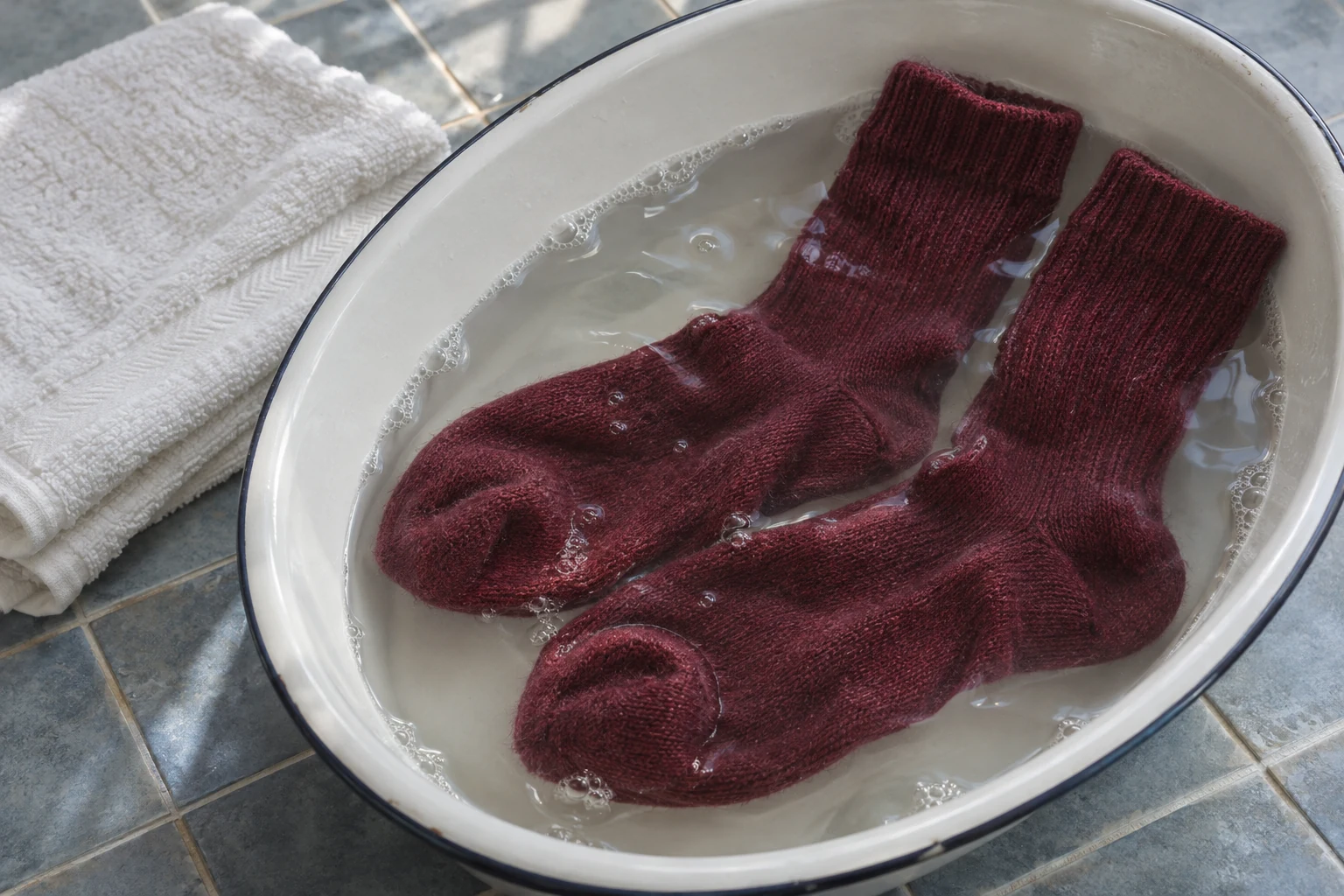
Set out a clean basin, suitable detergent and a clean towel before starting. Hand washing should involve gentle movement, not scrubbing the soles together as though they were cleaning cloths.
- Fill the basin. Use the water temperature allowed by the sock or yarn instructions. Mix in the correct hand-washing dose before adding the socks.
- Submerge gently. Let the solution reach the inside-out socks, easing them through the water without rubbing or stretching.
- Follow the stated soak guidance. Some instructions include a short soak; others discourage soaking. Do not turn a brief wash into an overnight treatment.
- Rinse as directed. For a rinse-required detergent, drain the dirty water and use clean water to remove the wash solution. Handle the socks gently throughout.
- Press out excess water. Support each sock when lifting it. Press gently, then use a clean towel to absorb moisture without twisting or wringing.
- Move straight to drying. Arrange the socks as their label directs rather than leaving them in a wet pile.
Woolmark’s hand-washing guidance provides a general gentle-wash sequence. Product-specific instructions still take priority. A no-rinse formula is an option only when compatible with the textile’s care requirements; ordinary detergent does not become no-rinse because the socks look clean.
Dry wool socks without losing their shape
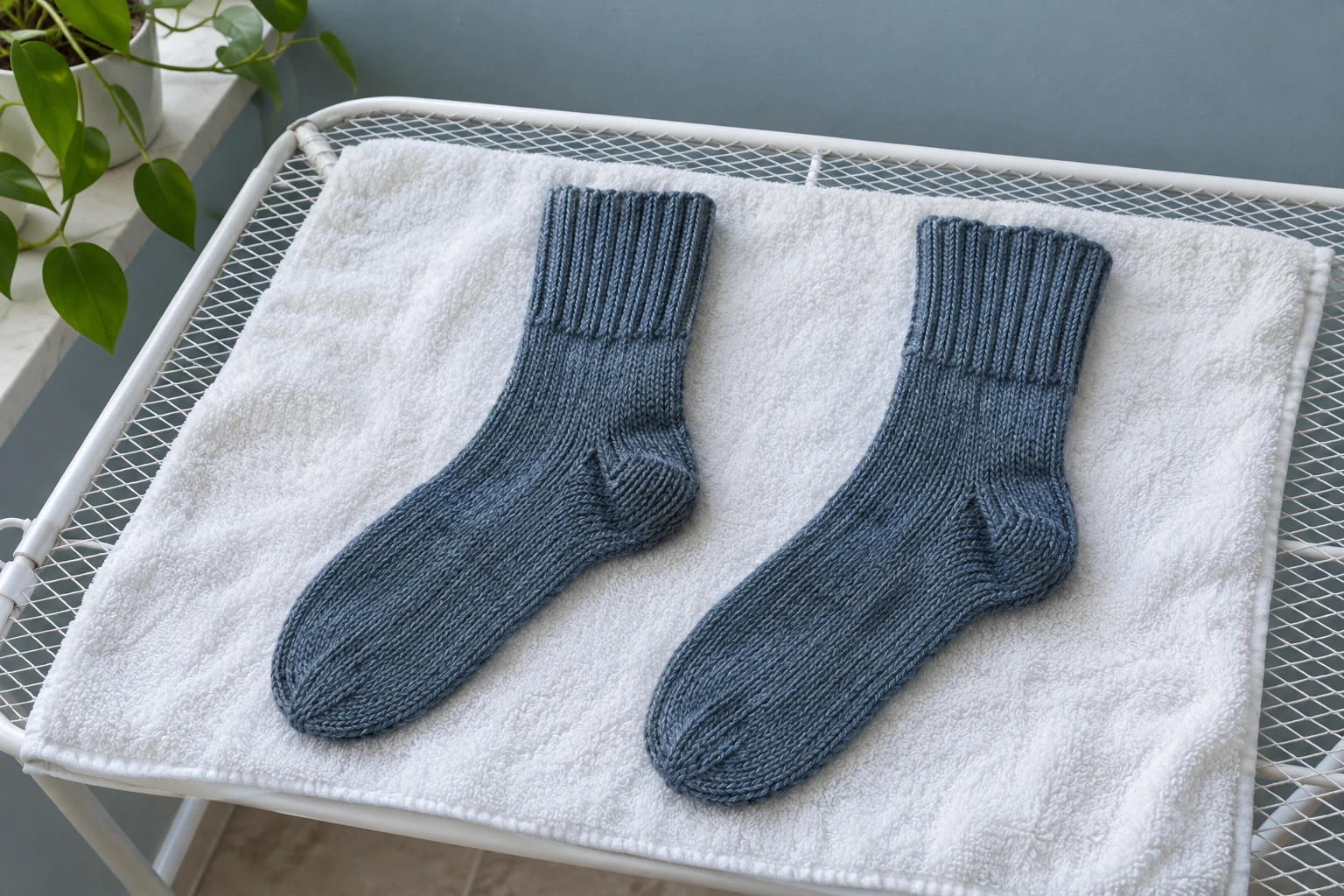
For flat-dry pairs, place each sock on a clean, pale towel or suitable flat drying surface. Ease the heel, toe and cuff back into their usual shape without pulling them larger. Separate the socks rather than stacking them.
Woolmark’s drying guide recommends supporting knitwear flat and avoiding radiators, direct heat and strong sunlight. If a towel becomes saturated, replace it so the underside can dry. Check thick cushioned soles and folded cuffs before putting the pair away.
Some manufactured socks allow line drying or low tumble drying. Use those options only when the pair’s instructions permit them. A low setting does not override “do not tumble dry,” and a quick blast of high heat is not a safe substitute.
There is no dependable universal drying time. Thickness, retained water, humidity and airflow all matter. For travel, keep a spare dry pair instead of planning around an overnight-drying promise.
Wool blends, superwash and hand-knitted socks
Nylon, polyester or elastane in a sock does not erase the wool’s care requirements. Equally, 100% wool does not automatically mean hand-wash-only. The finished item’s construction and treatment matter. Our wool vs cotton socks comparison covers the buying and fit decisions behind those blends.
For hand-knits, check every yarn used. A contrasting heel, toe, cuff or repair may have different care needs from the main sock. Wash a leftover swatch using the proposed routine when available; it is more useful than experimenting on the finished pair, although it cannot guarantee the sock’s result.
The Knit Picks sock-yarn guide illustrates why “sock yarn” is not one care category: it lists Stroll for gentle cold machine washing and low tumble drying, but Gloss Fingering for hand washing and flat drying. Read the label on the actual yarn rather than transferring those examples to another product.
If the yarn is called superwash, keep following its wash and dry restrictions. If its identity is unknown, ask the maker before using a machine. Preserve the sock’s intended dimensions during drying; routine cleaning does not require stretching it tightly over an oversized blocker.
Dirty soles, stains, odor and shrinkage
For dirty hiking socks, inspect both sides before choosing a treatment. Loose trail grit, oily marks and a colored spill are different problems. Remove loose debris gently and use only a stain treatment compatible with wool, the dyes and the sock label. Test as the product directs; do not scrub the knit with a stiff brush.
Our stain-by-stain wool guide helps identify the next step. If a mark remains, reassess it before applying dryer heat or repeating stronger treatments. White wool socks are not an exception to bleach restrictions.
For lingering odor, review the whole routine: were the socks unballed and inside out, was the machine overloaded, was detergent dosed and rinsed correctly, and were the thick areas fully dry before storage? Avoid masking the problem with softener or repeatedly increasing the detergent dose.
If a pair becomes smaller, compare the method used with its label. Darn Tough describes some post-wash snugness in its own socks as fabric recovery; that does not explain every shrunken pair. Dense, matted fabric can indicate felting, which should not be treated as reliably reversible. Read our wool shrinkage guide before attempting a rescue.
Frequently asked questions
How often should you wash wool socks?
There is no universal number of wears. Consider sweat, visible soil, odor, activity and the maker’s advice. Darn Tough’s hiking-sock guide highlights dirt, debris and sweat buildup as reasons to wash. Airing a lightly worn pair does not remove accumulated dirt.
Can you wash wool socks with other clothes?
Yes, if the items have compatible colors, detergent requirements and wash settings. Avoid a mixed load that requires hotter water, bleach or aggressive agitation. A mesh bag helps separate socks but does not change their care permissions.
Should you wash wool socks inside out?
Woolmark, Darn Tough and Smartwool recommend it. Check the outside for stains first, then turn the sock inside out so the inner fabric is exposed during washing. Pay attention to cushioned soles without pulling their loops.
Can wool socks go in the dryer?
Some can, at the setting their label permits. Darn Tough allows low tumble drying for its socks; other pairs require air drying. Check drying separately from washing and never use high heat to hurry a flat-dry pair.
Is cold water enough to prevent shrinking?
No single temperature guarantees the result. The permitted cycle, handling and drying method also matter. A cold but aggressive wash can still be unsuitable for a delicate pair. Follow the complete routine on the label.
Do hand-knitted socks need a different routine?
They may. Use the yarn labels and knitter’s instructions, especially if several yarns or repairs are present. Some sock yarns permit machines and dryers; others require hand washing and flat drying. “Handmade” alone cannot settle the choice.