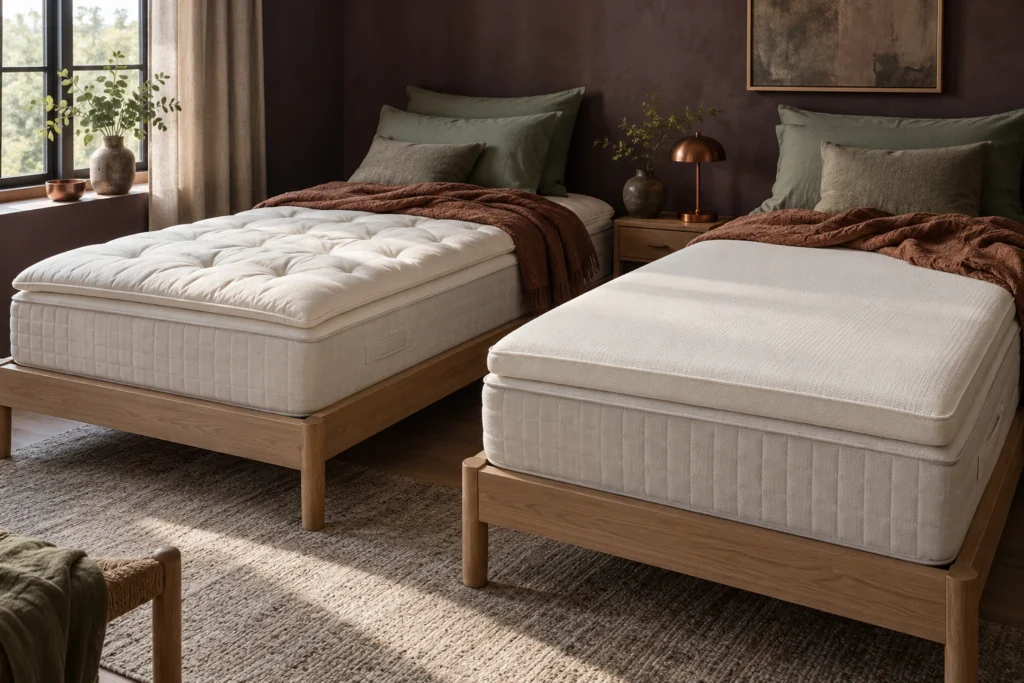
Choose a wool-filled topper if your mattress already supports you well and you want a cushioned textile surface. Choose latex if you want elastic cushioning and a choice of foam firmnesses. The useful distinction in a wool vs latex mattress topper comparison is how the finished layer responds beneath you—not which material has the better reputation.
Wool can settle and become less lofty. Latex springs back, but its thickness and firmness can still make a bed feel wrong for you. Neither material repairs a failed mattress, and neither guarantees a cooler night.
Research note: Editorial Team compared manufacturer specifications, care guidance and direct-order return policies on October 30, 2026. We have not slept on or physically tested these toppers. Buying suggestions below are editorial interpretations of that evidence.
Start with the mattress you already have
A topper is most promising when the mattress is level and adequately supportive but its surface feels uncomfortable. First remove the bedding and check the mattress and its base for visible dips, damaged slats or other problems. Follow the mattress manufacturer’s support requirements; adding another layer cannot repair broken components.
If the surface feels hard but you otherwise like the bed, consider whether you want a little padding or more room to sink into a resilient comfort layer. Those are different changes. A thick, soft topper may feel less stable than you expect, while firm latex may add very little of the softness you wanted.
Keep mattress pads separate from toppers when comparing listings. A thin protective pad and a substantial comfort layer can share a wool label while doing different jobs. Check fill, depth and intended use rather than trusting the product name. Once you decide on wool, our organic and natural wool topper buying guide compares a broader shortlist.
Wool vs latex mattress topper: the practical differences
These are construction-based buying distinctions, not results from a head-to-head sleep test.
| Buying question | Wool-filled topper | Latex topper |
|---|---|---|
| What creates the cushioning? | Loft and compression of a fiber filling held inside a cover. | An elastic foam layer that compresses and rebounds. |
| Which specifications matter? | Fill weight, initial depth, quilting or tufting, and expected settling. | Thickness, firmness, foam formulation and cover stretch. |
| How can temperature differ? | Wool absorbs moisture vapor and also provides insulation. | Foam structure, perforations, thickness and surrounding fabrics affect airflow and heat transfer. |
| What changes with use? | The filling can compact; maintenance depends on the construction. | Elastic recovery does not make foam immune to wear or damage. |
| What can be washed? | Check the exact model; the two wool examples below are not machine washable. | A washable removable cover does not mean the foam core is washable. |
| What is the buying risk? | Soft-looking loft may settle, and some sellers accept only unused returns. | The wrong firmness or thickness can be disappointing despite detailed specifications. |
Read the filling and firmness specifications
Wool: look beyond the advertised loft
Wool toppers may contain layered batting or a looser fiber filling. Quilting and tufting hold the filling in place, while the cover and stitching influence how freely it compresses. A densely packed topper can feel quite different from an airy one with the same advertised thickness.
Ask whether the listed depth describes the new, unloaded product. Wool batting can settle under use, so initial loft is not a promise of permanent height. Where fill weight is disclosed, compare the same mattress size; total pounds and grams per square meter describe different things.
Also check whether “wool topper” means wool filling throughout. Some products combine wool with latex or coils. That is a different construction, not evidence that all wool toppers have the same feel.
Latex: separate the recipe, process and firmness
Latex foam may use natural rubber, synthetic rubber or a blend. Dunlop and Talalay describe manufacturing processes, not organic status or a guaranteed firmness. Talalay Global describes both natural and blended formulations; its process explanation includes vacuuming and freezing stages. Neither process name replaces a finished-product specification.
For firmness, you may see ILD or IFD values: measurements of the force needed to indent foam under stated conditions. Sleep On Latex’s explanation of IFD testing shows why units, sample thickness and indentation depth matter. Two bare numbers from different brands may not be comparable.
Soft latex can contour as well as rebound; “latex” does not automatically mean firm. A thicker layer gives the foam more influence over the bed’s feel, but more depth is not automatically better. Your body, preferred position, existing mattress and cover all affect the result. Pressure distribution is a physical property of that combination, not a guarantee of pain relief.
Responsiveness and motion isolation are separate questions, too. Quick recovery when you turn does not establish how much movement a partner will feel through the whole bed. We found no comparable measurements that justify scoring these three products against one another.
Will wool or latex sleep cooler?
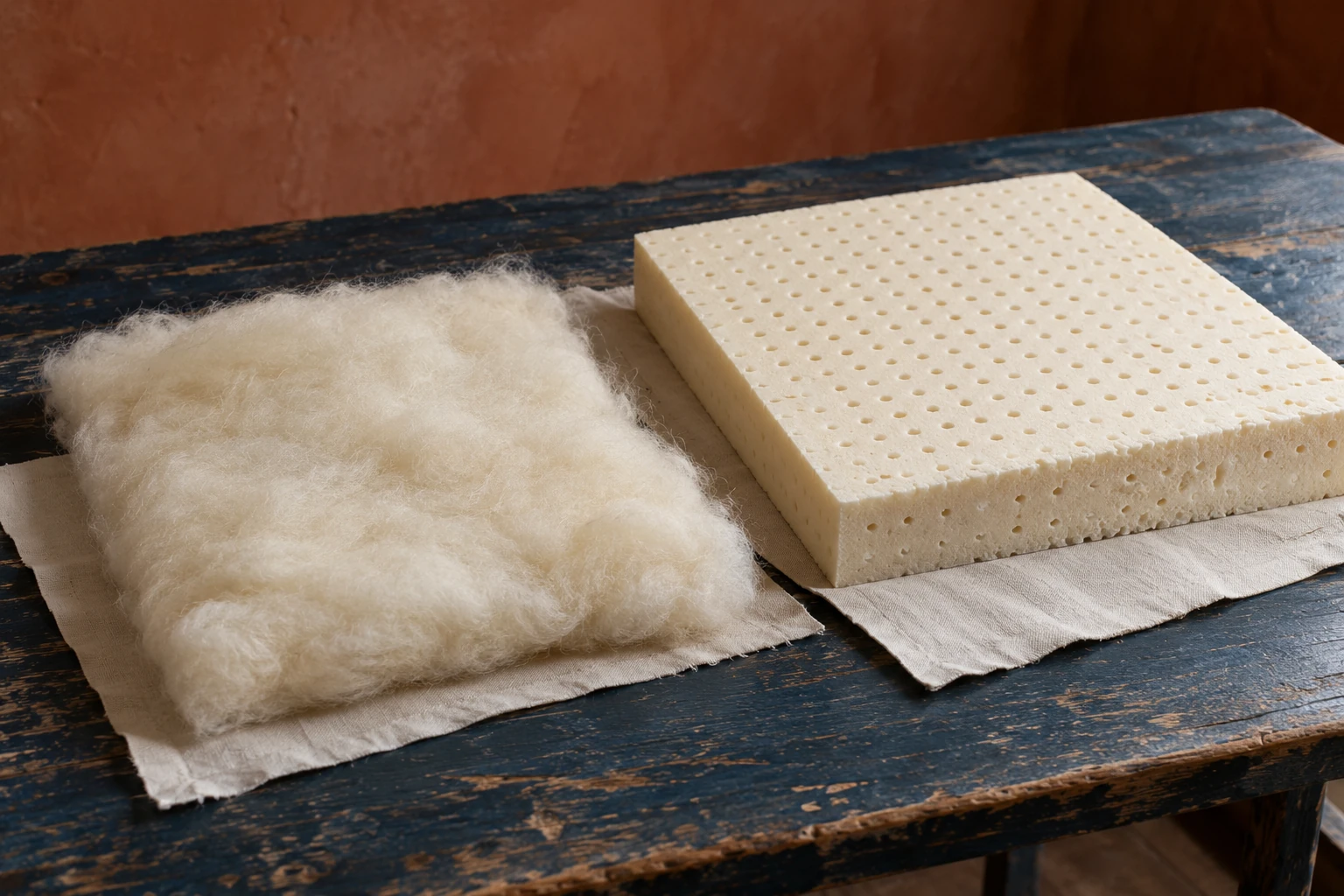
There is no reliable universal winner. Woolmark explains that wool absorbs moisture vapor and releases it as conditions change. Its crimp also traps insulating air. Moisture buffering and insulation can coexist; absorbing vapor is not the same as actively cooling a bed or removing liquid perspiration.
Latex foam has a cellular structure, and many toppers have molded ventilation holes. Those features may allow airflow, but the holes alone cannot tell you the temperature beneath a sleeping person. A dense cover, protector, fitted sheet, topper thickness and room conditions remain part of the system.
If overheating is your main complaint, review your upper bedding before buying another layer. A heavy duvet can matter even when the topper is breathable. Our wool comforter comparison separates fill weight and care requirements. For a topper purchase, favor a usable comfort trial over an unsupported “always cool” claim.
Three US product examples, without a ranking
These examples show why material names are insufficient. All offer a nominal 60-by-80-inch Queen, but their depths and constructions differ. We could not verify a consistent selected-variant Queen price for all three, so we have not presented a misleading price league table. Confirm the configuration and availability before ordering.
Sleep & Beyond myMerino Topper: a shallower wool layer
The myMerino Topper lists 1.5 inches of loft, 1,500 GSM Merino wool filling and a 270-thread-count cotton percale cover. The manufacturer identifies both the wool and cotton as GOTS-certified organic. Queen measures 60 by 80 inches; the range also includes Twin, Twin XL, Full, King and California King.
Care calls for spot cleaning the cover and drying it fully. For major stains, the company recommends professional dry cleaning with limited moisture; it does not give permission to machine wash this model.
The important purchasing limitation is its direct-order return policy: 30 days from receipt, but only for new, unused products with tags and packaging intact. Shipping costs can reduce the refund. That is not a sleep trial. Consider it when you already want a relatively low-profile wool layer and accept that return restriction.
Naturepedic Wooly Organic Wool Mattress Topper: deeper wool with a trial
Naturepedic’s Wooly Organic Wool Mattress Topper lists a 3-inch profile, organic wool batting and an organic cotton encasement, with GOTS certification identified in its specifications. Queen is 60 by 80 by 3 inches; Twin through California King are offered. A comparable wool fill weight was not disclosed in the material we could verify.
It is spot-clean-only: no machine washing, ironing or bleaching. Naturepedic directs owners to dry it fully and rotate and fluff it to maintain loft. Its topper return policy allows up to 30 nights of use before a return for a full refund on eligible direct purchases; retailer terms may differ.
The practical attraction is a chance to evaluate a deeper wool construction at home. Three inches of initial loft should not be interpreted as the equivalent of three inches of latex.
Sleep On Latex Pure Green Natural Latex Mattress Topper: selectable foam firmness
The Pure Green Natural Latex Mattress Topper offers 1-, 2- and 3-inch depths and Soft, Medium and Firm options. Queen is 60 by 80 inches; Twin through California King are listed. It uses Dunlop-process natural latex foam, with optional 100% organic cotton covers.
The manufacturer reports Soft foam at 90 N (20 lbf) at 25% indentation, tested on a 4-inch sample. This describes a test condition, not how far your body will sink into a 2-inch topper. Its certification page states that GOLS covers its finished toppers and mattresses.
The return policy permits topper returns within 30 days of receipt, with a prepaid label and a larger return box if needed. Only one item per product group may be returned or exchanged per customer within 12 months. This makes the return route useful, but not an unlimited series of firmness trials.
Plan for cleaning, settling and handling
Check care instructions for the filling and cover separately. On Pure Green’s current product page, the Luxury Knit cover permits a cold machine wash and low-heat tumble drying. The Jersey cover instead calls for gentle cold washing and air drying, with a warning about shrinkage and reassembly. Those instructions apply to the covers, not the foam.
Do not transfer wool-airing routines to latex. Sleep On Latex’s topper FAQ warns that heat and sunlight can damage the foam. For core cleaning, obtain the exact maker’s directions. Latex For Less, for example, specifies limited spot cleaning rather than soaking; that is not permission to improvise a wash for another model.
Wool maintenance also varies. Holy Lamb Organics’ care FAQ recommends rotating and flipping its toppers to reduce uneven compression. Follow the instructions for the one you buy; do not assume fluffing will restore every topper to its original height.
Neither a warranty nor a material name establishes usable lifespan. Look for coverage of specific defects, exclusions for normal settling, and practical cleaning options. We have not assigned years of life to either material.
Ask for the finished weight in your chosen size, especially if you must move the topper alone. A flexible foam sheet can be awkward to handle; a generously filled wool topper can also be bulky. Consider whether you have space to air it, rotate it, remove its cover or package it for a return.
A buying checklist that prevents expensive mistakes
- Describe the change you want. For modest textile padding on an otherwise comfortable bed, investigate wool. For elastic cushioning with a selectable firmness, investigate latex. If the mattress has failed, address that first.
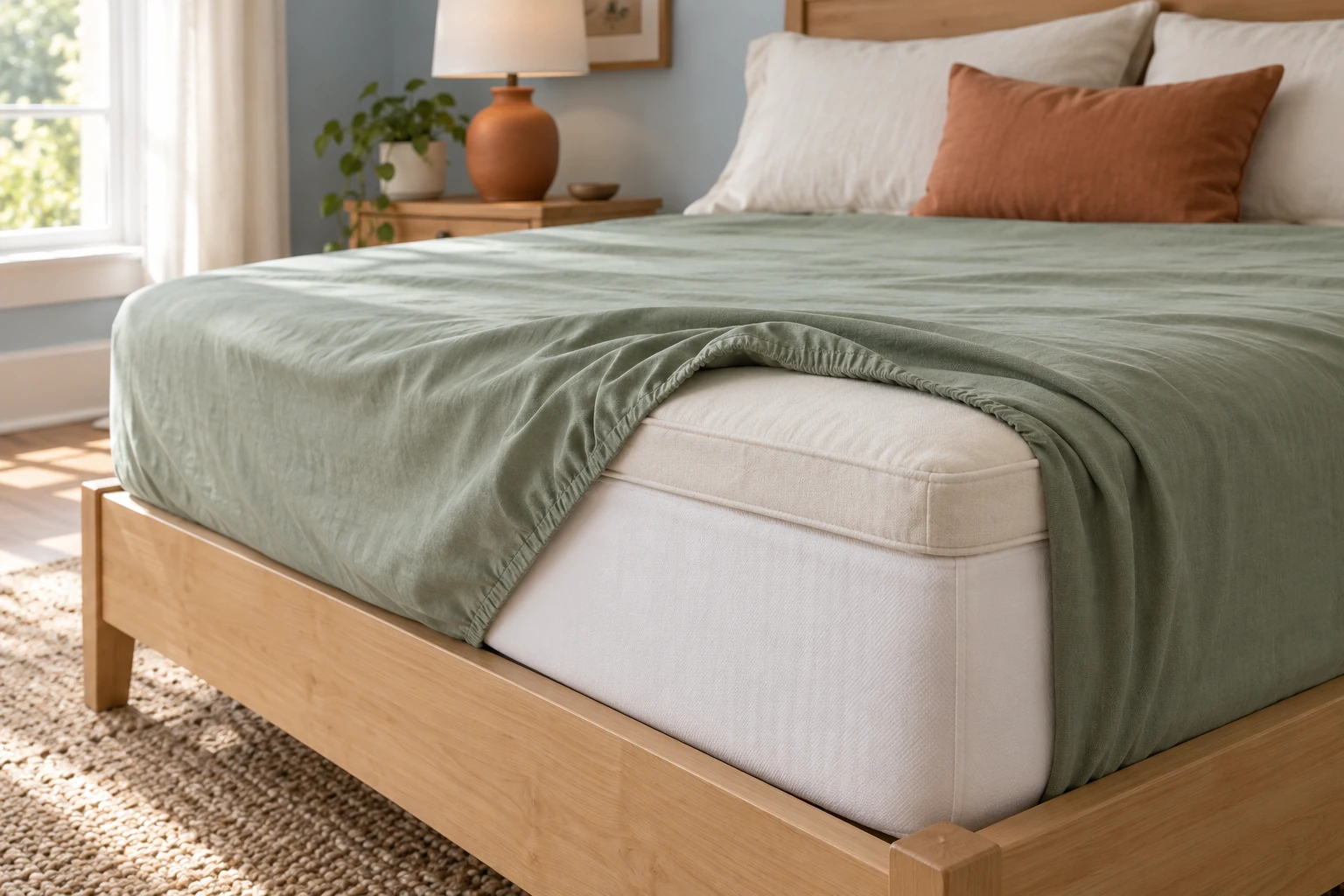
- Measure the complete bed height. Add the proposed topper to the mattress depth, then check the fitted sheet and protector’s stated capacity. Do not stretch an undersized sheet tightly over a new comfort layer. Reassess pillow height if the change alters how deeply you settle; our wool pillow guide explains adjustable versus fixed filling.
- Price the version you will actually use. Compare the same bed size, including the chosen cover, shipping, any new protector and potential return costs. A cheaper bare foam sheet and an encased wool topper are not complete like-for-like offers.
- Verify the exact certification claim. Natural latex is not automatically organic. A cotton-fabric claim does not, by itself, establish certification of the finished topper. Ask for documentation naming the relevant product and materials; certification does not predict personal comfort.
- Read the return terms before opening. Check whether sleeping on it is permitted, when the clock starts, who pays shipping and whether an exchange consumes your return allowance. If you cannot accept the cleaning routine, handling demands or financial risk, neither of these particular toppers is the right purchase.
Choose the construction that addresses your actual comfort problem, then use its specifications and return conditions to narrow the purchase. There is little value in the “right” material if you cannot live with the finished product.