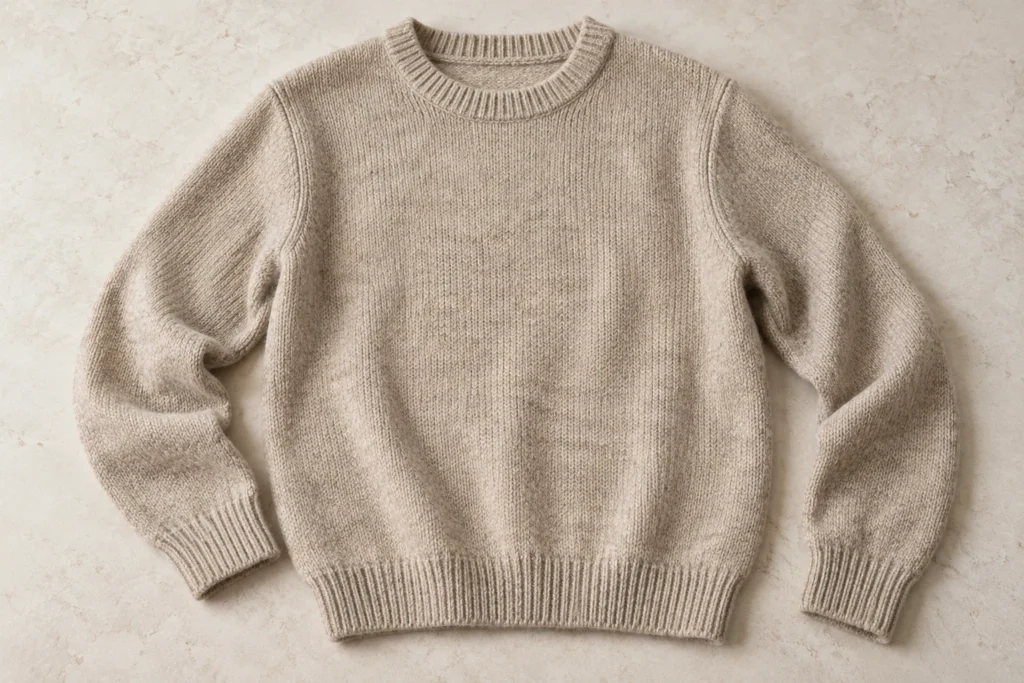
If you are wondering how to unshrink a wool sweater, start by checking its texture, not by adding conditioner. A slightly smaller, still-flexible knit may respond to careful wet reshaping if its care label permits washing. A severely felted sweater generally cannot be restored to its original size and structure. No home method guarantees recovery.
The useful goal is to improve a salvageable garment’s shape without turning modest shrinkage into stretched cuffs, thin patches or damaged seams. This guide explains how to assess the sweater, try a restrained approach where appropriate, and recognize when to stop. The advice is based on textile-care sources, not personal before-and-after testing.
Quick method (only for washable, still-flexible knitwear): Wet the sweater gently according to its care label, press excess moisture into a towel without wringing, smooth it into a balanced shape, and let it dry flat. Stop if the fabric resists or seams distort. This may improve the fit, but cannot reliably reverse severe felting.
Why wool sweaters shrink
Wool shrinkage is not one single process. A garment can change dimensions as tensions introduced during manufacture relax when it gets wet. It can also shrink through felting, when fibers become entangled and the fabric becomes denser. These changes may look similar at first, but their prospects for recovery differ.
Woolmark explains the felting mechanism: wool fibers have surface scales, and mechanical action in wet conditions can promote interlocking. The resulting entanglement is not simply a tight knit waiting for a household ingredient to loosen it. Heat and an unsuitable washing or drying routine can compound the problem; cold water alone does not make vigorous agitation safe.
Some wool is treated to reduce felting, while garment construction and fiber blends also affect care. Neither “100% wool” nor “machine washable” tells you everything about recovery. A sweater with a wool blend, delicate trim or a bonded detail still needs instructions for the finished garment.
Can a shrunken wool sweater actually be restored?
Sometimes its fit or shape can improve, but “unshrink” is an imprecise promise. Gentle blocking means arranging a damp knit toward its intended dimensions as it dries. It may help distortion or limited dimensional change; it does not rebuild the original structure of heavily felted wool.
Woolmark’s drying guidance supports gentle reshaping of knitwear and states that severely felted sweaters cannot be recovered. That distinction matters more than how persuasive an online rescue photograph looks. An item that stretches while wet may still dry smaller, feel different or have an uneven fit.
There is no reliable at-home percentage test that tells you how much size you will recover. Slight shrinkage is encouraging only when the fabric remains flexible and responds without force. For an expensive, sentimental or structurally complicated sweater, ask its manufacturer or a professional textile cleaner before trying a rescue.
Assess the sweater before getting it wet
First read the care label and fiber composition. A “do not wash” instruction or dry-clean-only label is a reason to seek garment-specific help, not permission for a supposedly gentle soak. If the label is missing, identify the item or ask the maker rather than assuming that cold water is harmless.
Next examine the sweater dry, in good light. Compare the body, sleeves and neckline with an older photograph or measurements if available. A manufacturer’s size chart may describe body measurements rather than the garment itself, so it is not automatically a stretching template.
Look for these clues without pulling hard:
- The knit still feels supple, with recognizable stitches and a familiar drape: a cautious reshaping attempt may be reasonable if washing is permitted.
- The fabric feels substantially thicker, denser or matted, with less distinct stitches: these are warning signs consistent with felting, not a definitive home diagnosis.
- Only one area is distorted, such as a shoulder bump or uneven hem: localized reshaping may be more appropriate than stretching the whole sweater.
- Seams are strained, yarn is fragile, or embellishments restrict movement: stop and seek advice before adding water or tension.
Use this decision table to choose a next step, not to predict a guaranteed result.
| What you notice | Reasonable next step |
|---|---|
| Slight size loss; soft, flexible knit; washing allowed | Consider one gentle wet-reshaping attempt. Expect limited or uncertain improvement. |
| Small misshapen area; rest of sweater fits | Ask the maker about localized damp reshaping rather than enlarging everything. |
| Dense, matted fabric with substantial shrinkage | Avoid forceful stretching. Severe felting is generally irreversible. |
| Dry-clean-only, unreadable label or vulnerable details | Seek garment-specific professional advice before soaking. |
How to unshrink a wool sweater with gentle reshaping
Treat the following as a limited salvage attempt for washable, still-flexible knitwear. It combines established washing and blocking principles; it is not a scientifically validated cure for every type of shrinkage. If the sweater resists light adjustment, stop rather than increasing the force.
1. Prepare a supported drying space
Set out a clean basin, pale lint-free towels and a flat surface where the entire sweater can rest. Remove jewelry that could catch the knit. If you know the original garment dimensions, keep them nearby as a guide rather than a target to reach at any cost.
Take a few current measurements without stretching, such as body width and shoulder-to-hem length. This lets you assess the dry result realistically. Do not use a much larger sweater as a template simply because that is the size you want.
2. Wet the sweater according to its label
Use the permitted water temperature and a gentle hand-washing process only if allowed. If cleaning is needed, choose a compatible wool detergent at its stated dose. Do not mix in several household products in the hope that one will reverse the damage.
Woolmark’s ordinary hand-washing instructions describe a short soak with wool detergent followed by rinsing. This is washing advice, not evidence that a particular soaking time reverses shrinkage. Follow your garment and detergent directions; an overnight soak is not a stronger rescue treatment.
3. Remove water without twisting
Rinse as the product and garment require. Support the whole sweater when lifting it from the basin, and gently press out excess water. Do not wring it, hold it up by the shoulders or let heavy sleeves dangle.
Lay it on a towel, roll the towel around it and press gently to absorb moisture. Unroll and transfer it to a dry towel. The American Cleaning Institute’s sweater-care guidance recommends towel-pressing and blocking soft handwash-only knits to shape. The sweater should be damp and supported, not dripping and suspended.
4. Ease the knit into a balanced shape
Arrange the body and both sleeves flat. Smooth the fabric gently with your palms, working across broad areas rather than tugging on the neckline, cuffs or hem. Make small, even adjustments toward its familiar proportions only where the knit yields readily.
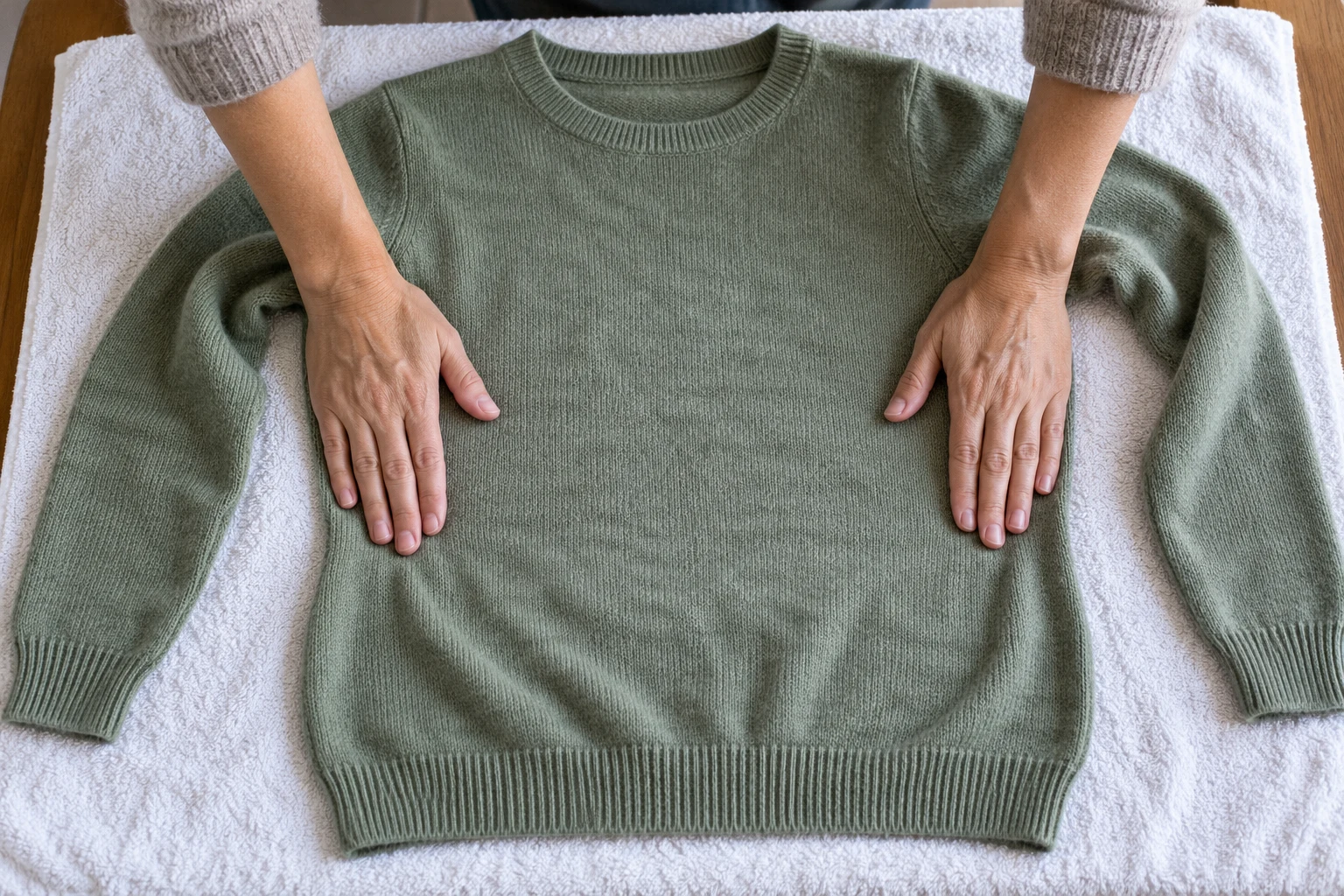
Keep seams aligned and compare the two sleeves. Trying to gain length in one small spot can leave a narrow, stretched patch while the rest remains shrunken. Do not pin the garment under tension, attach weights or force it over a rigid frame. Stop if stitches open unevenly, seams pull or the fabric feels resistant.
5. Let it dry flat, then judge the result
Leave the whole sweater supported and gently arranged, with normal indoor airflow and no direct heat. Check the underside and thicker ribbing before deciding it is dry. Only then compare the fit and measurements with your starting point.
If the result is still too small, that is not a cue to repeat the process with hotter water, longer soaking or harder stretching. Repeated attempts can trade shrinkage for permanent distortion. Accept limited improvement or seek professional advice instead of chasing the original size at any cost.
What conditioner and baby shampoo can and cannot do
Hair conditioner and baby shampoo appear in many popular unshrinking recipes. Their presence in a tutorial is not evidence that they reverse felting. We did not find authoritative textile-care evidence establishing a reliable household recipe, success rate or guaranteed amount of size recovery for either product.
A sweater may feel different after a product is applied, but a softer feel does not establish that interlocked fibers have returned to their original arrangement. Any apparent improvement could also reflect wetting and reshaping. Without controlled evidence, those effects should not be presented as proof of a conditioner cure.
The products are not interchangeable with approved wool detergent. Formulas, residues and garment finishes vary. “Gentle enough for a baby” describes a different intended use, not compatibility with every wool sweater. Avoid making an exact spoonful-and-soak-time recipe sound authoritative when its outcome is uncertain.
Woolmark recommends a mild, neutral detergent for wool. Its discussion of limited rinse-conditioner use is not an endorsement of hair conditioner as an unshrinking treatment. If you already used a household product, ask the garment maker about removing it safely rather than layering on another remedy. Our wool detergent guide explains routine product-selection distinctions, not rescue guarantees.
Drying and reshaping without creating new damage
Flat drying is part of the attempt, not an optional finishing step. A wet knit can distort under its own weight, so keep its body and sleeves on the towel rather than hanging over an edge. Replace a saturated towel carefully while supporting the fabric.
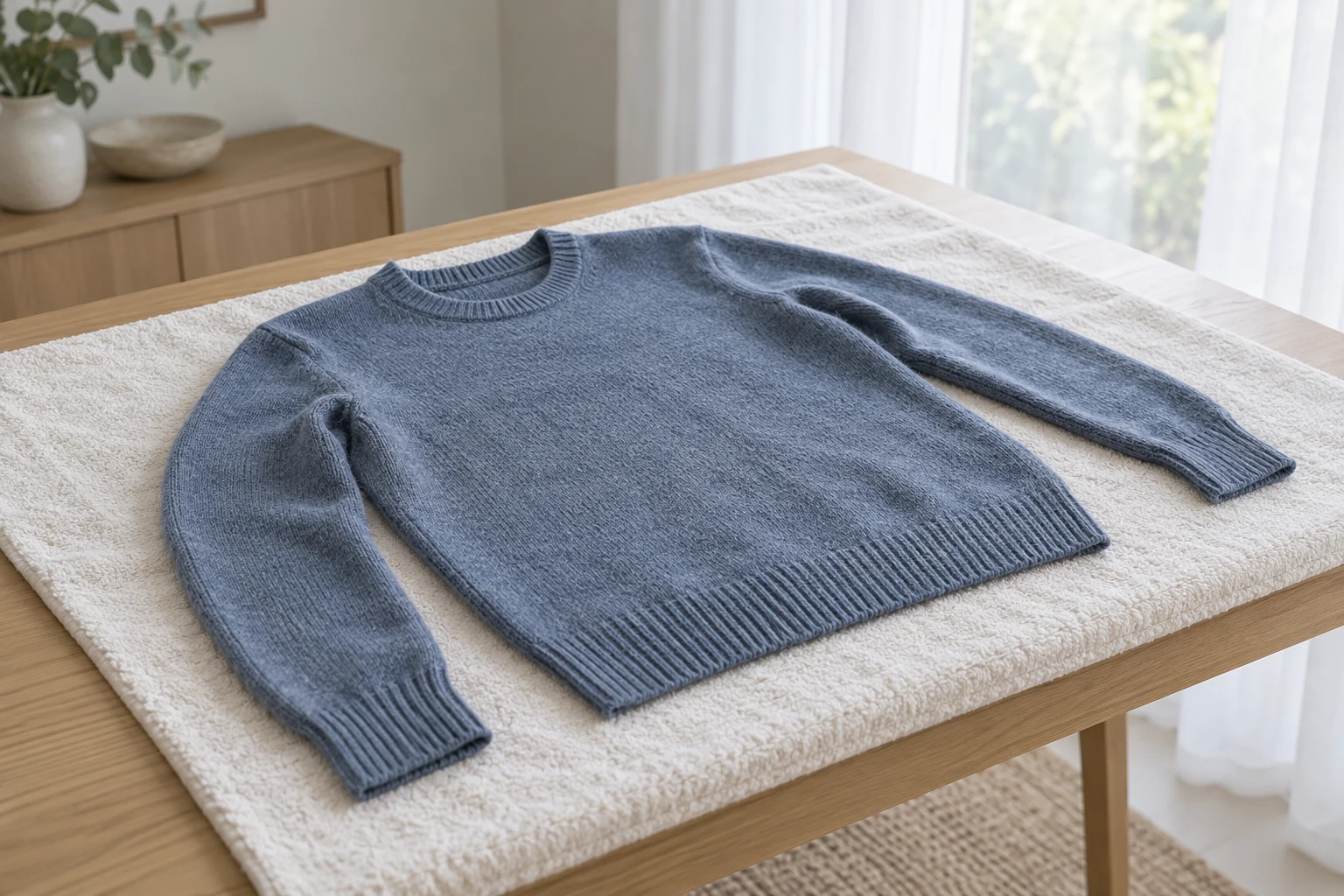
Avoid radiators, hair dryers and strong direct sunlight. Do not put the sweater in a dryer to “set” the new size. Some garments permit tumble drying in ordinary care, but that permission is not evidence that a dryer will improve a failed reshaping attempt.
There is no universal drying time. Knit thickness, retained moisture and airflow all matter. Once fully dry, try it on gently and check the shoulders, sleeve length and body together. A wider body with strained armholes is not a successful restoration. Store it only when dry; our guide to storing wool sweaters covers the next step.
Mistakes to avoid and when to stop
The biggest mistake is assuming that enough tension can undo any shrinkage. Avoid scrubbing, wringing, pulling from small edges, wearing the sweater wet to stretch it, or hanging weights from the hem. Do not combine heat with force because the first gentle attempt made little difference.
If the sweater is densely matted, significantly smaller and no longer behaves like a flexible knit, restoration may not be realistic. A professional may help assess options, but professional cleaning is not a guarantee of unfelting either. Consider alteration or another use only if the remaining fabric is suitable; do not spend repeated effort on a promise no one can substantiate.
Prevent another shrinking incident
Review what happened before changing your routine. Compare the actual wash cycle, temperature, detergent and drying method with the care label. A wool setting on one machine may differ from another, and machine-wash permission does not automatically allow tumble drying.
For ordinary cleaning, see our guide to washing Merino wool safely. Keeping prevention separate from recovery helps: a correct future wash can protect a garment, but it cannot be promised to reverse damage already done.
Frequently asked questions
Can you unshrink a wool sweater after the dryer?
Possibly improve its shape if it remains flexible and the care label allows a cautious wet-reshaping attempt. If drying has left it severely felted, full recovery is not realistic. Judge the fabric as well as the size; the fact that the dryer caused the problem does not identify a reliable reversal method.
Does hair conditioner really unshrink wool?
It is a popular home remedy, not a guaranteed textile treatment. We found no authoritative evidence establishing a dependable conditioner recipe or success rate. Wet reshaping may help some limited dimensional change, but conditioner should not be said to unlock or reverse severe felting.
Can you unshrink 100% wool or Merino wool?
The fiber label alone cannot answer that. Check the finished garment’s care instructions, construction and current condition. A soft, slightly changed knit has different prospects from a dense, felted one, whether it contains Merino or another wool. Blends also require garment-specific care.
How can you tell whether a sweater is felted?
Substantial shrinkage together with a denser, matted feel and less distinct stitches can suggest felting. These are warning signs, not a definitive diagnosis. Compare with its original texture if possible, and ask a suitable professional when the sweater is valuable or the condition is unclear.
How much can you stretch a shrunken wool sweater?
There is no safe universal number of inches or percentage. Make only light, even adjustments that the damp knit accepts without resistance. If reaching the desired size requires force or distorts seams and stitches, stop. A wet measurement does not guarantee the same dimensions after drying.
Can a dry cleaner restore a shrunken wool sweater?
A professional may assess the fabric and advise whether controlled reshaping is worth attempting. They cannot be assumed to reverse severe felting. Explain the washing or drying incident and any products already used, and ask about realistic outcomes before authorizing a treatment.