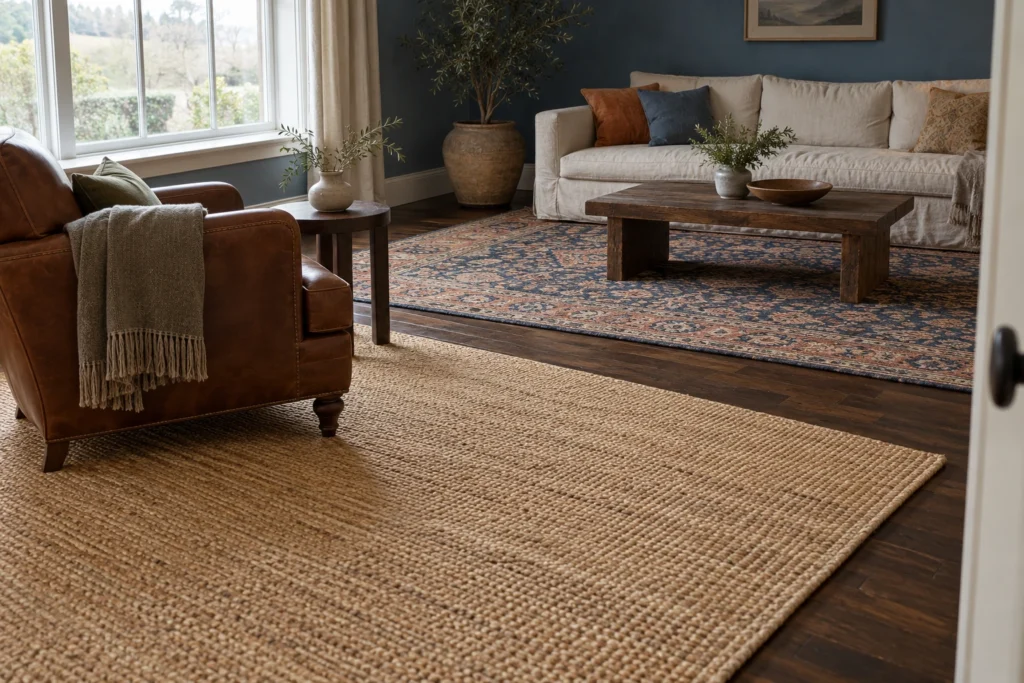
For a jute vs wool rug decision, start with how the room gets used. Choose jute when you want a textured, often less expensive rug for a dry space and can accept limited spill-cleaning options. Start with wool when barefoot comfort and access to appropriate professional cleaning matter more. Neither fiber guarantees durability: the weave, pile, backing and care instructions can change the choice.
A quiet bedroom and a family room beside the dog’s water bowl present different problems. Even “high traffic” needs unpacking: frequent dry footsteps are different from muddy shoes, chair legs and spilled drinks.
This comparison is based on textile-industry guidance, rug-care organizations, manufacturer information and environmental research. We have not physically tested the rugs. Recommendations below are editorial judgments based on those sources, not performance rankings.
Jute vs wool rugs at a glance
| Priority | Jute rug | Wool rug |
|---|---|---|
| Barefoot feel | Textured; weave can feel smooth or nubby | Often a softer starting point; pile and yarn matter |
| Spills | Moisture-sensitive; restricted cleaning options | Not stain-proof; treatment depends on the whole rug |
| Busy rooms | Check the exact weave and traffic recommendation | Look for construction approved for the intended use |
| Shedding | Loose plant fibers and debris can occur | Loose wool fibers can occur; construction matters |
| Appearance | Often earthy tones and visible woven texture | Broad choice of colors, patterns and pile styles |
| Purchase cost | Often lower, but custom and blended rugs vary | Often higher; price alone does not establish quality |
These are buying tendencies, not ratings for every rug. Compare samples and specifications before treating either column as a promise.
Fiber and construction: read beyond the material name
Jute is a plant fiber obtained from stems. Processing includes retting, which loosens the material holding the usable fibers within the plant. FAO’s report on jute extraction describes this process. Wool is an animal fiber grown by sheep; Woolmark explains its protein structure and natural crimp. They are both natural fibers, but their origins do not tell you how a finished rug will wear.
Separate the fiber from the construction. A flatweave has no raised pile; a hand-knotted wool rug and a hand-tufted wool rug are different assemblies. “Handwoven” is not a synonym for “hand-knotted.” Nor does “machine-made” identify one uniform quality level. Ask how the surface yarn is held in place and what supports it underneath.
The Association of Rug Care Specialists describes tufted construction as face yarn inserted through a primary backing, commonly secured with latex and a secondary backing. Adhesive deterioration can therefore become a problem even when the wool surface still looks serviceable.
Check whether the stated percentage describes the face fiber or the entire rug. A wool rug can have jute in its backing. Also check pad requirements: Sisal Rugs Direct’s backing guide warns that some backing materials can react with certain floor finishes. Confirm compatibility with both the flooring maker and rug supplier.
For the wider construction and sizing questions, our wool rug buying guide provides the background. Here, the key is comparing two specific rugs rather than two labels.
Texture, comfort and appearance
For sitting on the floor or stepping out of bed, wool is usually the more promising place to start shopping. That is a recommendation to sample wool, not a claim that every wool rug is plush. A thin wool flatweave and a dense pile rug can feel quite different. Woolmark also identifies fiber diameter as one influence on softness; “wool” does not mean fine Merino apparel wool.
Jute’s appeal is its visible weave. A tightly woven surface and a chunky braided one offer different sensations underfoot. Natural-fiber supplier Curran’s jute guide describes that range and the importance of weave choice. Do not confuse jute with sisal simply because both appear in natural-fiber collections.
Put samples on the floor you will actually use, with the proposed pad. Walk barefoot, sit down if that is part of your routine, and check the texture in daylight. A pad may add cushioning, but it cannot turn a coarse surface into a fine one. Choose the sensation you enjoy, not the softness promised by a styled photograph.
Durability, shedding and foot traffic
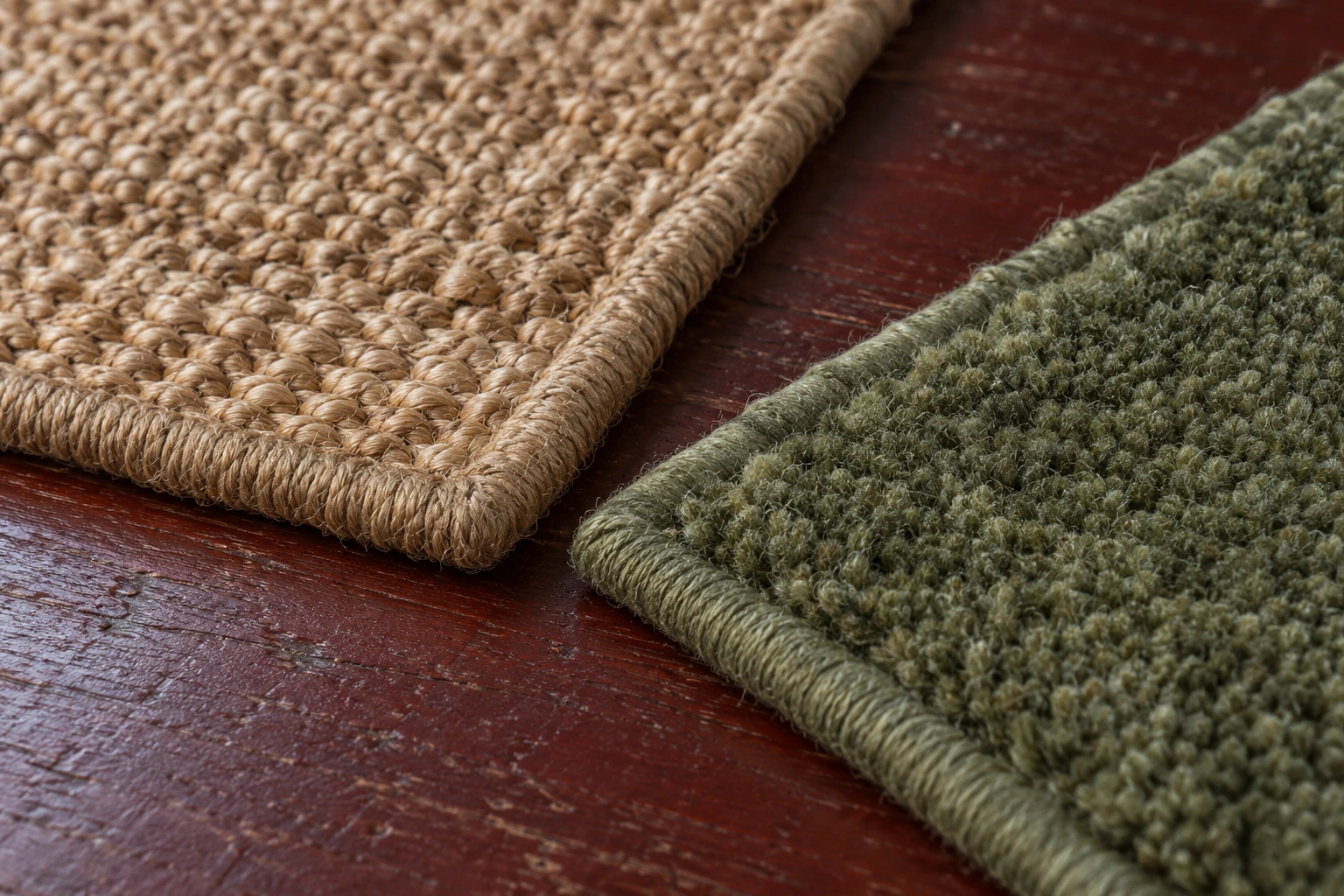
Wool’s natural crimp contributes to its resilience. Manufacturer Cormar explains this recovery from compression in its carpet guidance. Resilience is not the same as immunity to abrasion, snagging or backing failure, and a carpet claim is not a wear rating for an unrelated area rug.
For a busy walkway, request a traffic recommendation for the exact rug. Examine how firmly the yarn is held, whether the edge is secure and whether the surface suits shoes or rolling chairs. A hand-knotted label does not establish a universal lifespan; neither does a high price.
Both materials can release loose fibers. Curran notes shedding in jute and differences between tighter and chunkier weaves. Wool can also shed, especially as loose manufacturing fibers work free. Visible thinning, unraveling or pulled yarn deserves a seller’s assessment rather than an assumption that all shedding is harmless. Our wool rug shedding guide separates those situations.
Spills and cleaning: the most consequential difference
Jute’s dry, textured appearance can disguise its sensitivity to water. Sisal Rugs Direct’s jute-care instructions warn that excess moisture can cause swelling, discoloration or a weakened weave. The supplier advises against soaking, steam cleaning and shampooing its jute rugs. This is a meaningful purchase constraint if spills are routine.
Wool offers more scope for appropriate professional cleaning, but it is not stain-proof or automatically washable. The IWTO and WoolSafe wool-carpet care guide makes cleaning dependent on construction, soiling and the cleaner’s experience. It also warns about over-wetting, excessive agitation and unsuitable chemicals.
For either rug, blot a fresh liquid spill with a clean absorbent cloth rather than scrubbing. Then follow the exact rug’s instructions. Do not turn general fiber advice into a home-cleaning recipe. Valuable rugs, uncertain dyes, persistent odors or contamination underneath need professional assessment.
Routine vacuuming must suit the weave. WoolSafe’s fine-fiber guidance generally recommends suction-only cleaning for loop pile. Consult the manufacturer before choosing a powered brush; our guide to vacuum floorheads and controls explains the practical differences.
If deep cleaning is part of your buying decision, read whether a wool rug can be steam-cleaned. A household vapor steamer and professional hot-water extraction are different processes, and neither should be assumed suitable for every rug.
Which is better for pets and children?
Choose around the behavior you expect. For a child who plays on the floor, sample for comfort. For a pet that scratches or catches claws, inspect the loops and weave. For frequent accidents, make an achievable cleaning plan the deciding factor.
Jute is not automatically ruled out by the presence of a pet. A dry, quiet room used by a house-trained animal presents a different situation from a puppy’s play area. Curran nevertheless flags absorbed accidents and claw-related fraying as concerns. Those are reasons to evaluate the household honestly, not a guarantee that every pet will damage jute.
Wool is not accident-proof either. Urine reaching the foundation or pad may require more than surface treatment. If frequent wet cleaning is nonnegotiable, consider expanding the shortlist to a rug with explicit washable-care instructions. Our wool versus synthetic rug comparison explains that separate buying decision. “Natural” alone does not establish allergy suitability for either material.
Choosing jute or wool by room
Living rooms and bedrooms
For a living room where people sit on the rug, start with wool samples. For a dry sitting room where visible woven texture matters more than cushioning, jute can make sense. A dark sofa and pale jute rug may look attractive together, but inspect samples against the floor so you can judge how noticeable loose fibers would be.
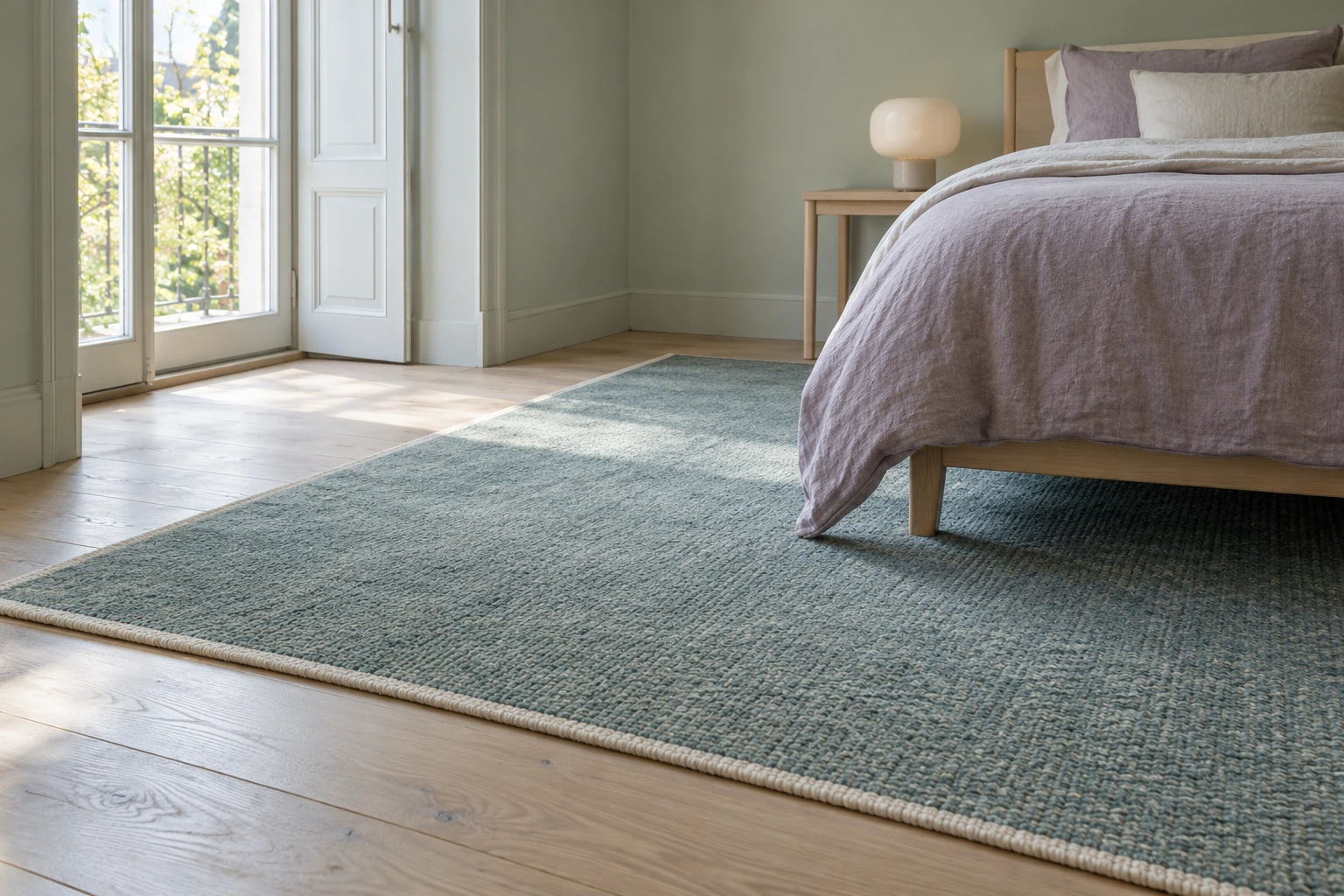
In a bedroom, decide what you want to feel at the bedside. Wool pile is a sensible shortlist for a softer landing. Jute remains an option if you enjoy its texture and can keep it away from damp areas. There is no need to pay for deep pile if you prefer a thinner, firmer rug.
Dining rooms, hallways and entries
Under a dining table, food and drink may matter more than footsteps. Our preference is a low-profile wool rug whose care instructions and chair-clearance requirements suit the room, or another explicitly easy-care rug. Jute is more defensible in an infrequently used dining space where the owner accepts possible spill marks.
For a hallway, check edge stability, door clearance, pad grip and the actual traffic rating. A dry internal corridor and a wet front entry should not share the same recommendation. Neither ordinary jute nor wool is a substitute for an absorbent entry mat. In kitchens, bathrooms or damp rooms, prioritize a product expressly designed for those conditions.
Price, long-term value and environmental trade-offs
Sisal Rugs Direct’s material comparison positions jute as the generally more affordable option. Treat that as a market tendency. Compare the same dimensions, construction, finishing, delivery and return terms; a custom wool-and-jute rug may cost more than a simpler wool option.
Add the pad and realistic cleaning costs to your budget. If a lower-priced rug cannot tolerate the spills you expect, the initial saving may disappoint. Conversely, paying more for wool makes little sense if you dislike its texture or the rug lacks clear care information. There is no reliable material-only lifespan to divide into the price.
Neither fiber earns an automatic environmental win. FAO’s jute report discusses processing that can involve substantial water use and polluted retting water. Sheep farming also has impacts: a peer-reviewed study of US sheep and wool production found methane to be a major emissions source and evaluated differences among farming systems. It did not compare finished jute and wool rugs.
Backings and finishes belong in the comparison too. A product-specific environmental declaration for wool carpet with jute backing illustrates why the whole assembly and lifecycle matter. Renewable face fiber does not prove that an assembled rug is compostable or locally recyclable. Ask for sourcing, backing and disposal information, and favor a rug you can maintain and keep using.
A practical way to make the choice
Start with the hardest requirement. If the room is regularly wet, select for documented moisture and cleaning compatibility before appearance. If it stays dry, decide whether your priority is tactile woven texture or softness for floor-level use.
Then compare the exact constructions. Get the face composition, backing, pile or weave description, traffic guidance and care sheet. For a wool and jute runner or blended area rug, ask about both fibers. WoolSafe advises treating a blend according to its most sensitive component; adding wool does not cancel jute’s care limitations.
Finally, buy from a sample and a complete price. Check feel, edges, flooring compatibility and the cost of the pad and care. If a seller cannot answer basic construction or maintenance questions, keep looking. The right rug should suit the way you live without requiring a routine you will not follow.
Frequently asked questions
Is a wool rug better than a jute rug?
Wool is often the stronger shortlist for softness and professional cleaning flexibility. Jute can be a good choice for woven texture in a dry room at a lower initial cost. Compare the specific rugs: material alone does not establish quality or suitability.
Are jute rugs scratchy under bare feet?
Some feel textured or nubby; others feel relatively smooth. Yarn and weave change the sensation. Order a sample and try it on the intended floor and pad rather than relying on the word “soft” in a listing.
Which sheds more, jute or wool?
There is no reliable ranking covering every rug. Both can shed, and construction, finishing, use and care affect what you notice. Ask about the exact product and investigate thinning or unraveling rather than accepting all fiber loss as normal.
Is jute or wool easier to clean?
Wool often allows more professional cleaning options, subject to dyes, backing and construction. Jute’s moisture sensitivity restricts treatment. Neither comparison justifies soaking a rug or using a household carpet machine without explicit manufacturer approval.
Are wool-and-jute blends a good compromise?
They can combine an appealing texture with a different feel, but they are not automatically easier to maintain. Check the proportions, weave and complete care instructions. Cleaning must accommodate the more sensitive components.
Can you layer a wool rug over a jute rug?
You can consider layering for appearance, provided the rugs lie securely and edges do not obstruct walking or doors. Check the supplier’s pad and layering advice. The arrangement does not protect the jute underneath from spills or make either rug washable.