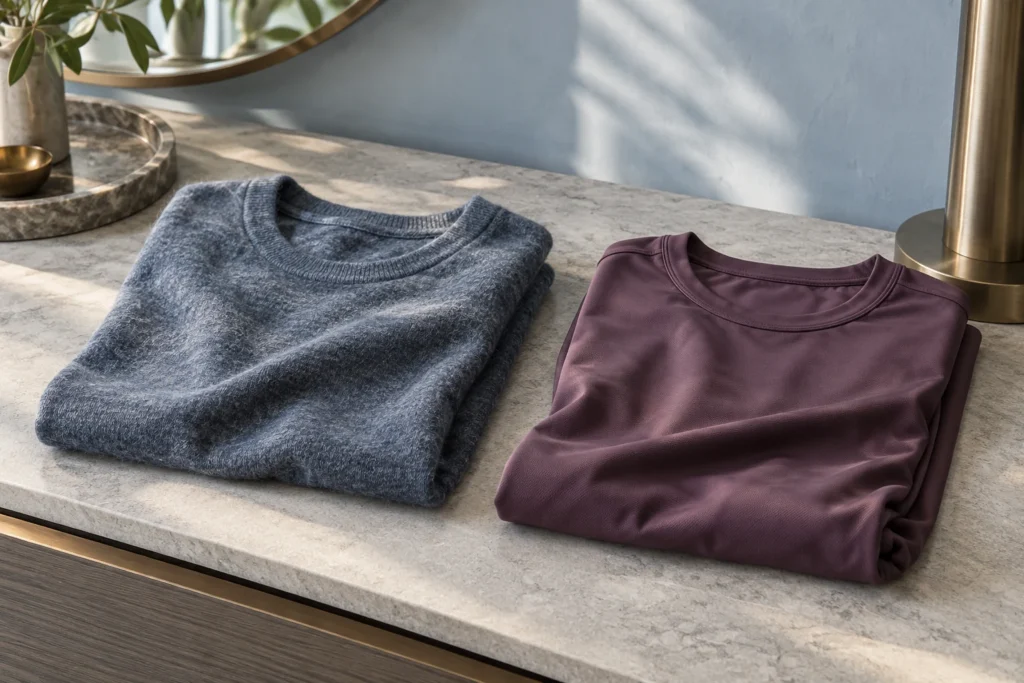
Merino wool vs polyester comes down to the job you need your clothing to do. Merino is often a good choice for repeated wear when odor and next-to-skin comfort matter. Polyester performance fabrics are often a practical choice for heavy sweating, quick turnaround between washes and a lower purchase price. Fabric weight, knit structure, fit and finishing can change those tradeoffs substantially.
A thin running shirt and a thick sweater are not a fair material comparison, even when their labels say polyester and Merino. Start with two garments intended for the same activity and similar conditions. Then decide which tradeoffs matter in your routine.
This is a research-based comparison of textile properties and garment-care guidance. We have not physically tested the clothing described. Recommendations are editorial interpretations of the evidence; the generated photographs illustrate clothing and construction, not tested samples.
Merino wool vs polyester at a glance
Merino is wool from Merino sheep, a protein fiber used in everything from fine jersey to substantial knitwear. Polyester is a manufactured synthetic fiber, commonly PET, made into smooth jerseys, mesh, fleece and many other fabrics. Neither name specifies how warm, airy or durable a finished shirt will be.
| Priority | Merino wool | Polyester |
|---|---|---|
| Moisture | Absorbs water vapor within the fiber; liquid transport depends on the fabric. | Absorbs little water within the fiber; engineered fabrics can wick liquid effectively. |
| Drying | May take longer after substantial wetting. | Often useful when rapid drying is a priority; thickness still matters. |
| Odor | Often develops less noticeable odor during repeated wear. | Can retain more odor; finishes and laundering affect the result. |
| Warmth and airflow | Can provide insulation or a light next-to-skin layer. | Ranges from open running mesh to warm fleece. |
| Skin feel | Fine fibers can feel soft; some wearers still notice prickle. | Can feel smooth or brushed; seams and texture vary. |
| Wear and care | Fine knits need protection from abrasion and label-led washing. | Often tolerates frequent use well; snagging, pilling and heat damage remain possible. |
| Environmental tradeoffs | Renewable fiber; farming, processing and animal welfare matter. | Plastic microfiber shedding; recycled content can reduce virgin feedstock demand. |
| Value | Worth considering when comfort and repeated wear justify the premium. | Often suits a limited budget or a large workout rotation. |
Breathability, sweat and drying are different questions
Separate absorption from wicking
Absorption means moisture entering a fiber. Wicking is liquid moving through the small spaces in a textile. Drying is moisture leaving the garment through evaporation. A fabric can perform well at one without leading at all three.
Wool is hygroscopic: it takes up water vapor from its surroundings. Woolmark explains this moisture-buffering behavior, which helps explain why a Merino layer can feel comfortable as conditions change. It does not mean that wool cannot become saturated or that it instantly removes liquid sweat.
Polyester’s low absorption within the fiber does not stop liquid from traveling through a polyester fabric. Yarn arrangement, surface treatment and knit geometry matter. For example, Polartec describes Power Dry’s two-component knit as using different yarn surface areas to move moisture toward the outside. That is a construction-specific explanation, not proof that every polyester T-shirt performs the same way.
Check airflow and drying separately
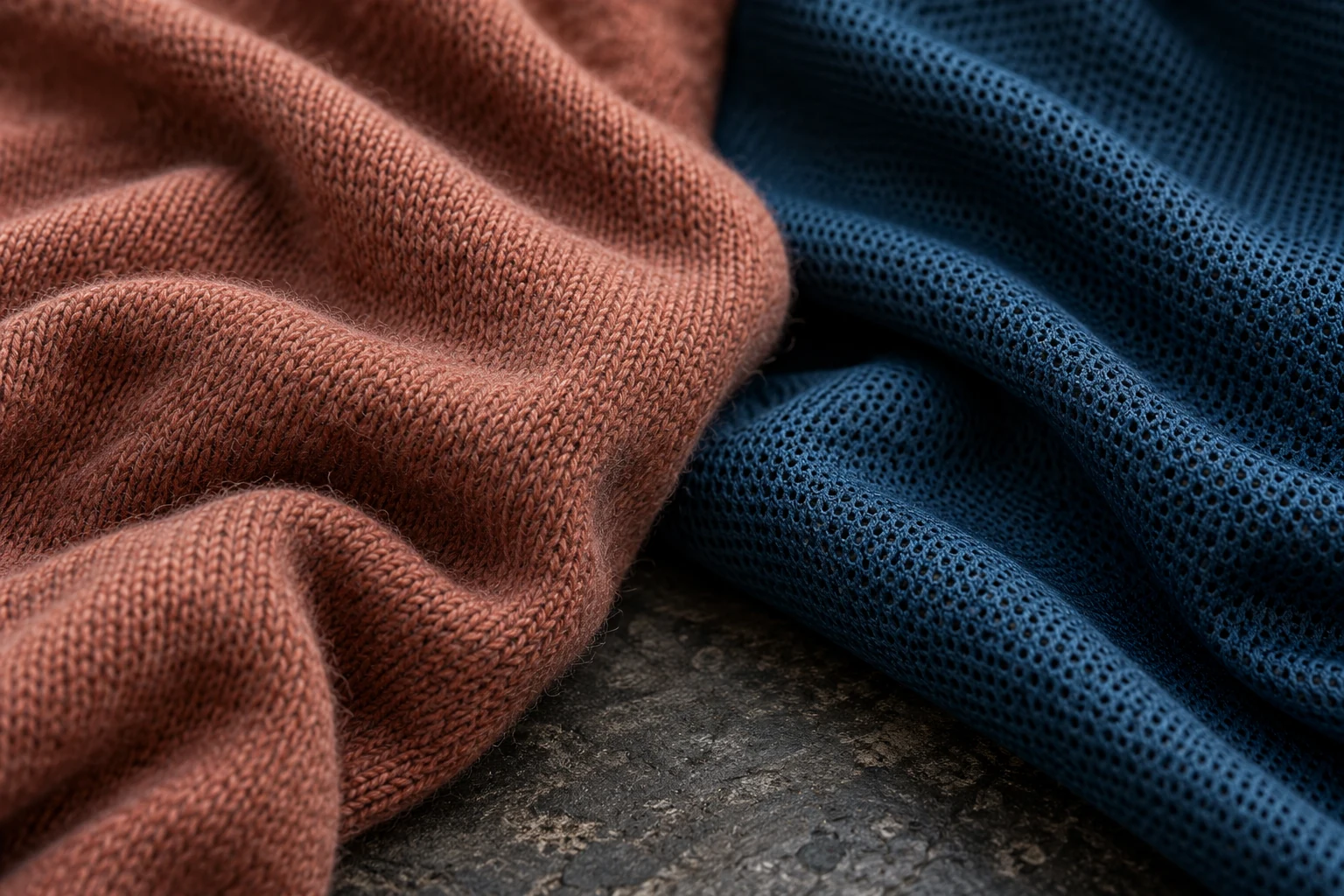
“Breathable” may refer to airflow, water-vapor transfer or simply how comfortable a garment feels. Those are related but different. An open polyester mesh can allow more airflow than a dense wool knit. A wind-blocking outer layer can also change how either base layer feels.
For drying, compare similar weights and constructions. Lightweight polyester is often convenient after a sweaty run or a sink wash, while wet Merino may need more time. But a thick polyester fleece and a thin Merino tee are a poor basis for a universal ranking.
When a listing gives fabric weight in grams per square meter, or GSM, it describes mass per area. It is useful for comparing similar fabrics, but it is not a warmth or breathability score. Microns describe fiber diameter instead. Check which measurement a seller is actually providing.
Humidity, air movement, how much water remains after washing and whether fabric is bunched together all influence drying. Treat an overnight-drying promise cautiously unless it describes the particular garment and conditions. Feeling dry at the surface is not the same as containing no moisture.
Odor and thermal comfort: where the evidence needs context
Merino often has an odor advantage
In research published in Textile Research Journal, wool-containing fabrics produced lower odor intensity than the tested all-polyester fabric. A wear trial also supported the odor benefit of the particular 20% wool/80% polyester blend studied.
That result supports considering wool for repeated wear. It does not establish a minimum wool percentage that guarantees a fresh-smelling shirt, nor does it mean wool kills all odor-causing microbes. Odor absorption, odor release and microbial growth are different processes.
For travel, Merino may make packing fewer tops more comfortable. Still wash when clothing is dirty or needs cleaning; airing is not a substitute for removing soil. With polyester, check whether odor control comes from a finish and whether the manufacturer supplies care or durability guidance for it.
Neither fiber guarantees the right temperature
Warmth depends on the air a garment holds, its thickness, coverage and the layers around it. Wool’s crimp can help create insulating space, but polyester fleece also traps air. A heavy Merino layer can be too warm for hard exercise; a thin polyester top can be inadequate for a cold rest stop.
A controlled study of 21 adults exercising and recovering in cold conditions illustrates the limits of fiber-only predictions. The tested Merino fabric had greater thermal resistance and water absorption but lower air and water-vapor permeability than the polyester fabric. Thermal-sensation ratings did not differ significantly between clothing conditions.
This was one protocol with specific garments, not a verdict on every base layer. The useful buying lesson is to choose insulation and ventilation for your activity rather than relying on “temperature regulating” as a complete specification.
Softness, durability and pilling
Merino’s appeal often starts with its fine fibers. Woolmark’s softness guidance explains how finer, more flexible fibers can reduce prickle. A micron measurement describes fiber diameter; it does not describe fabric thickness or guarantee comfort for every person.
Polyester can feel silky, dry, textured or fleecy depending on its construction and finish. Try the actual garment where it will touch your neck and underarms, and check seams, labels and cuffs. A fabric you dislike against your skin is unlikely to become a good purchase because its comparison chart looks impressive.
Fine Merino can be vulnerable to repeated rubbing under pack straps or against rough fasteners. Polyester is often selected for hard use, but lightweight open mesh can snag, and brushed synthetic fabrics can pill. Fiber strength alone does not determine a garment’s useful life.
Pilling is surface fibers tangling into attached balls. Woolmark identifies fiber length, yarn twist, fabric density and abrasion among the relevant factors. Neither a pure-fiber label nor a high price makes a garment pill-proof. For existing bobbles and removal precautions, use our Merino wool pilling guide.
For everyday sweaters, texture and drape may matter more than running performance. Our Merino wool versus cashmere comparison addresses that different buying decision.
Choose for your day, not just the fiber label
Everyday clothing and travel
Consider Merino when you want a comfortable top that can move between walking, work and travel, especially if opportunities to wash are limited. Choose a weight suited to the climate and check whether the care routine fits your accommodation.
Consider polyester when you prefer its feel, need several affordable changes or expect frequent washing. For a trip, the decisive question may be whether you can dry and wear the garment again before leaving, rather than which fiber has the stronger reputation.
Hiking and changing conditions
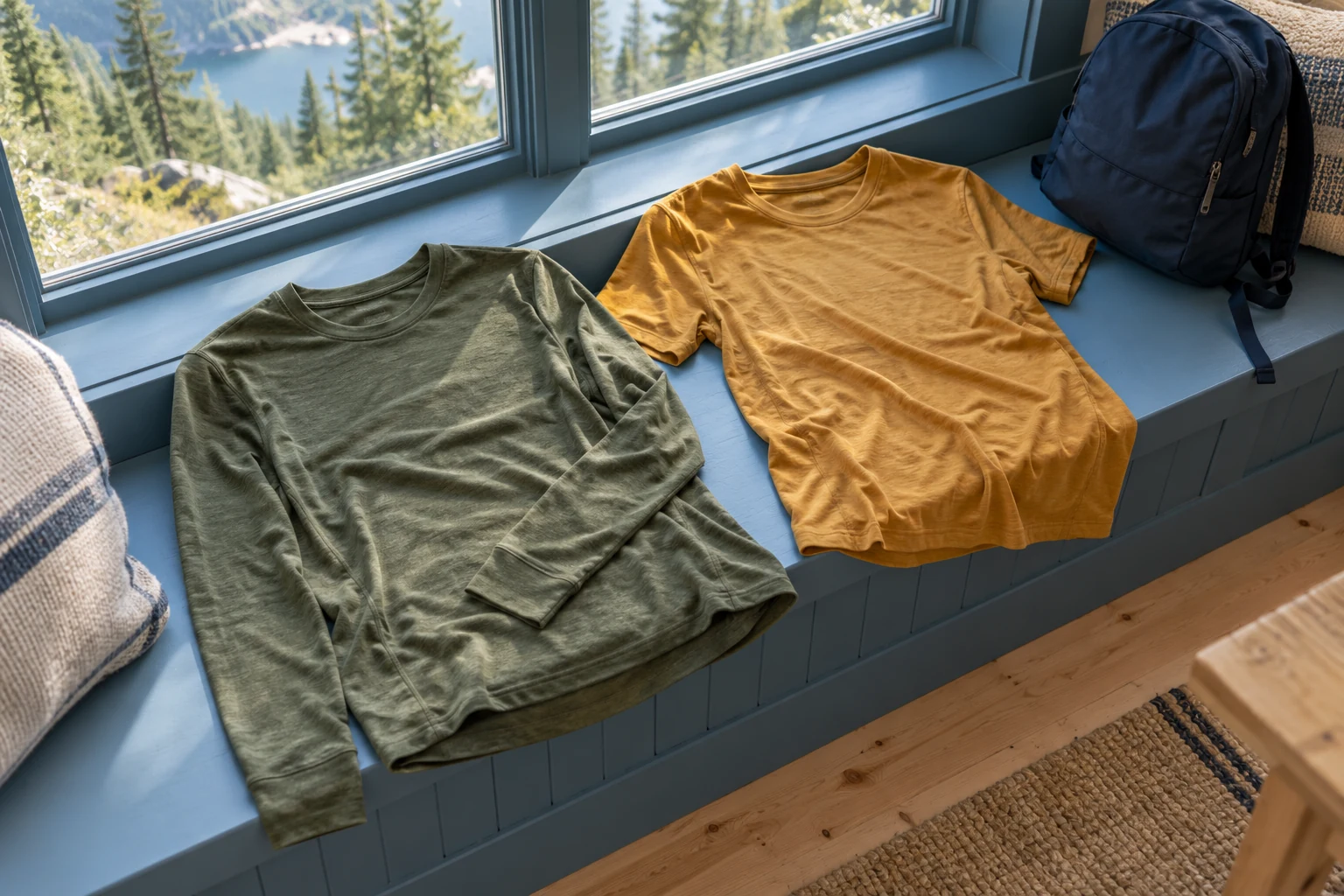
For a multiday hike, an odor-resistant Merino or wool-blend layer is worth considering. For strenuous day hikes with easy laundry access, a lightweight polyester layer may be more convenient. Look at shoulder seams, pack contact areas and ventilation before choosing.
REI’s base-layer guidance treats material, weight and fit as separate decisions. A next-to-skin layer should contact the skin comfortably when its job is moving liquid sweat, without restricting movement. Carry the insulation and weather protection the trip requires; neither fiber makes a wet clothing system automatically safe or comfortable.
Running and other high-output exercise
Start with a light, well-ventilated garment. Polyester performance fabrics are a sensible option when heavy sweating and frequent laundry dominate the routine. Merino or a blend may suit runners who prefer its feel or want less odor between uses.
Try arm movement, check the hem and examine seams under a running vest. A poorly placed seam or a shirt that rides up can matter more than a small difference in fiber performance. Do not assume either material prevents chafing.
Cold-weather base layers
Match fabric weight to effort and the rest of your clothing. Someone walking briskly uphill may need a lighter layer than someone standing still in the same weather. Both Merino and polyester offer suitable options; neither provides a universal temperature rating.
Socks introduce additional variables, including cushioning and shoe volume. Keep that decision separate: our wool versus cotton socks guide explains why fit and construction belong alongside fiber content.
Blends, care and long-term value
A blend can be a deliberate design choice
A wool/polyester blend is not necessarily a compromise in quality. In a study of knitted base-layer fabrics, blending wool with polyester improved measured liquid-moisture-management properties compared with the tested all-wool fabric. The finding applies to the studied constructions, not every blend with a similar label.
Read the full composition. Nylon may be included for reinforcement and elastane for stretch; they are not polyester. Ask what the blend is designed to improve, and look for garment-level evidence rather than assuming that more Merino always means better performance.
Buy a care routine you can follow
Start with the sewn-in label. Woolmark’s care-symbol guidance distinguishes machine-washable wool from hand-wash-only and non-washable garments. Some wool clothing permits tumble drying; other pieces must dry flat. Do not transfer one sweater’s instructions to another.
For polyester performance clothing, follow the manufacturer’s wash and heat limits, especially when elastane, prints or finishes are present. Polartec advises avoiding fabric softener for Power Dry. Easy care does not mean that every hot wash or dryer setting is appropriate.
For Merino-specific steps, follow our Merino wool washing guide. Budget for drying space as well as detergent. A garment that needs careful flat drying may be inconvenient in a busy shared laundry even if its other qualities suit you.
Judge value by useful wear
Merino commonly carries a price premium, but retail ranges overlap. Compare equivalent garments at the prices actually offered, including construction, repair support and return terms. We are not assigning either fiber a guaranteed lifespan or cost-per-wear figure.
Paying more may make sense if you enjoy the fabric and repeatedly choose it. A less expensive polyester top may be better value for daily workouts. Consider buying one suitable garment before replacing a whole wardrobe with an unfamiliar material.
Sustainability and microfiber shedding
There is no responsible single-score answer based only on the fiber name. Polyester’s fossil feedstock, wool farming, processing, garment lifespan and laundering affect different environmental measures.
The European Environment Agency identifies wearing and washing synthetic textiles as sources of plastic microfibers. Shedding varies with construction, production and care. Recycled polyester remains polyester: it can reduce demand for virgin feedstock without eliminating plastic-fiber shedding.
Wool fibers are renewable and can biodegrade under suitable conditions, as Woolmark explains. That is not a reason to discard clothing outdoors or assume that a finished blend, coating, thread and trim will all break down together.
Textile Exchange identifies methane emissions and animal welfare as wool-sourcing concerns. Look for traceable sourcing and specific certification claims. Its Responsible Wool Standard covers animal welfare, land management and supply-chain requirements; it is not a guarantee of zero environmental impact.
For a practical purchase, prioritize something you will use, maintain and repair. Start by checking whether clothing you already own can do the job. A “natural” label alone is not a reason to replace a serviceable polyester garment.
Frequently asked questions
Is Merino wool better than polyester?
It depends on your priorities. Merino often suits repeated wear and odor concerns. Polyester can suit frequent washing, fast drying and a tighter budget. Compare garments with similar purposes and weights before deciding.
Which dries faster, Merino wool or polyester?
Lightweight polyester performance fabrics often dry faster than comparable wet Merino garments. There is no universal drying time: thickness, construction, retained water, humidity and airflow can change the result.
Is Merino wool warmer than polyester?
Not automatically. A thick polyester fleece can provide more insulation than a thin Merino shirt. Warmth depends on the garment’s thickness, trapped air, fit and layering, as well as weather and activity.
Why can polyester smell more than Merino?
The fibers handle odor compounds differently, and research has found lower odor intensity in certain wool-containing fabrics than in polyester. Finishes, body soil and cleaning also matter. Merino can still smell and still needs washing.
Is a Merino-polyester blend better than 100% Merino?
Sometimes it better matches the intended use. A blend can change moisture handling, feel and wear behavior, but the percentage alone cannot predict the outcome. Check fabric construction, garment design and the maker’s evidence.
Which is better for running in hot weather?
A lightweight, ventilated polyester shirt is a practical starting point for heavy sweating. Light Merino or a blend may suit your skin feel and odor preferences. Avoid choosing a heavy garment merely because the fiber is advertised as cooling.