
Here is how to store wool sweaters safely: put them away clean, completely dry, and gently folded, with enough room to keep their shape. For sweaters you wear regularly, an accessible drawer or shelf works well. For seasonal storage, choose a well-closing container or suitable storage bag based on the room’s conditions and the need to exclude insects.
No bag, scent, or folding trick solves every storage problem. A sealed box cannot dry a damp sweater, and a breathable bag is not automatically moth-proof. This guide separates everyday care from summer packing and explains what to do if you find signs of an existing infestation.
Choose a routine for everyday or seasonal storage
Start with how soon you expect to wear the sweater again. A cardigan you reach for every week needs a convenient home; a winter sweater packed away until November needs more preparation and a planned check.
- Everyday storage: check for marks after wearing, let the garment air before putting it away, and keep it easy to see and retrieve.
- Seasonal storage: clean as the care label allows, inspect the whole garment, dry thoroughly, and pack without squeezing.
- Suspected insect activity: separate the affected item and investigate before returning anything to shared storage.
Set aside a small “needs attention” space so a sweater with a loose button, stain, or suspicious hole does not disappear into the clean pile. This simple sorting step also prevents autumn surprises: finding the one cardigan you wanted still waiting for a repair.
For a small wardrobe, one drawer and one seasonal box may be enough. There is no need to buy a separate accessory for every garment. Spend effort first on preparation, a suitable location, and a setup you can inspect easily.
Fold wool sweaters rather than hanging them
Fold knitted sweaters for storage. Long periods on a hanger can stretch knitwear and change its shape, as Fjällräven’s wool-care guidance explains. A sweater’s shoulders should not have to support the whole garment through months in a closet.
A gentle folding method
- Place the sweater on a clean, flat surface and smooth it lightly without pulling.
- Bring the sleeves inward so they sit within the width of the body.
- Fold the body loosely to fit the available space, using as few folds as practical.
- Check that the collar, cuffs, and hem are resting naturally rather than twisted underneath.
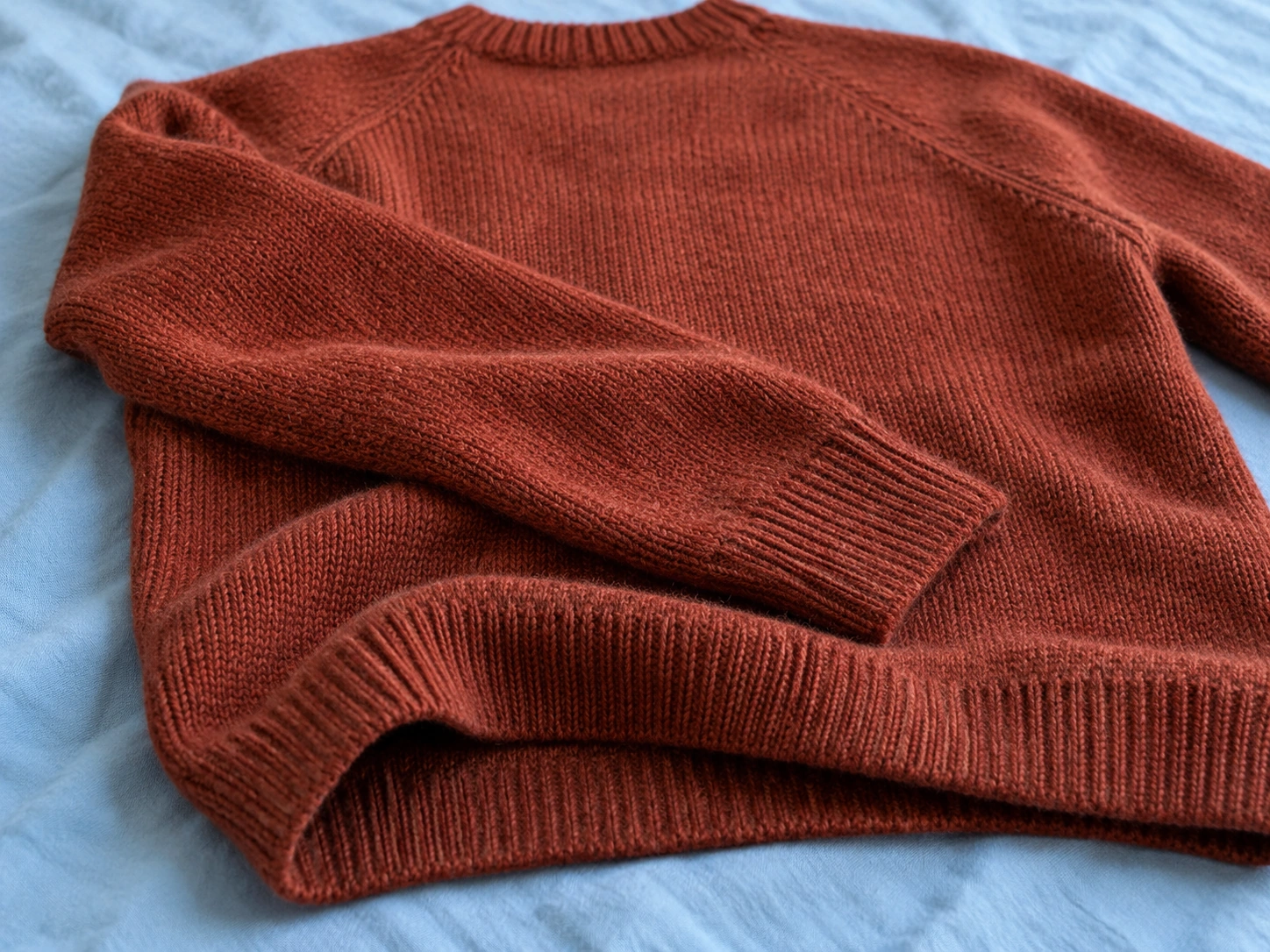
Adjust the fold to the garment. A bulky cable-knit may need a wider shelf than a thin crewneck. Forcing both into identical little rectangles makes organization look tidy at the expense of the knitwear. A cardigan with prominent buttons can sit separately so its hardware does not press into another sweater.
Keep stacks manageable. The Museum Textile Services storage guidelines recommend supporting folds, placing delicate textiles above heavier ones, and avoiding overpacking. For an ordinary wardrobe, that translates into shallow piles and enough room to lift out the sweater you want without dragging it through the others.
For a fragile heirloom, padded folds deserve extra attention. Smithsonian guidance on tissue for textile storage favors acid-free, unbuffered tissue for animal fibers such as wool. This is conservation advice for more protective storage, not a requirement to wrap every everyday jumper in specialist materials.
Clean before long-term storage, then dry completely
A sweater that looks presentable after a final wear is not necessarily ready for several months in a box. Check the neckline, underarms, cuffs, and front for residue or marks. Follow its care label when deciding between hand washing, a permitted machine cycle, and professional cleaning.
Wool does not need washing after every outing. Woolmark’s care guidance notes its odor resistance and reduced need for washing. End-of-season packing is a different decision from returning a lightly worn sweater to its usual drawer: Woolmark’s seasonal storage advice recommends clean garments in closed bags or containers.
Use a product appropriate for the label rather than assuming your usual laundry liquid suits every knit. Our guide to choosing a wool detergent covers that decision in more detail.
Do not pack by the clock alone
A fixed drying time is unreliable because a fine sweater and a thick shawl-collar cardigan hold different amounts of water. Inspect thicker areas and the underside before packing. If there is any doubt about remaining dampness, leave the garment out longer in an appropriate drying space.
Woolmark recommends drying knitwear flat, unless the care label permits tumble drying, and avoiding direct heat and strong sunlight. Support the sweater on a suitable flat drying surface and arrange it gently into shape. Do not use a radiator as a shortcut.
Make cleaning a separate task from packing. For example, wash the sweaters first, then use another session to inspect, fold, and box them. That removes the temptation to seal a nearly dry garment just to finish the job.
Which storage container should you use?
Choose according to the conditions, closure, and amount of room inside. “Plastic” and “breathable” describe materials; neither word tells you whether the entire storage setup is suitable.
| Option | Useful for | What to check |
|---|---|---|
| Drawer or shelf | Sweaters in regular rotation | Clean surfaces, easy inspection, and room to retrieve items; an open shelf provides no sealed insect barrier. |
| Lidded plastic bin | Seasonal storage of dry garments | A sound, close-fitting lid, dry contents, and no pressure needed to close it. |
| Fabric storage bag | Dust protection in a suitable indoor cupboard | Fabric, seams, and closure; a loose drawstring opening is not an insect-proof seal. |
| Archival box with tissue | Heirlooms needing careful support | Appropriate materials, padded folds, and separate pest prevention; a box alone is not a treatment. |
| Vacuum-compression bag | Generally a poor default for wool knitwear | Compression can distort the garment and create difficult creases; choose uncompressed storage instead. |
Plastic bins and breathable bags
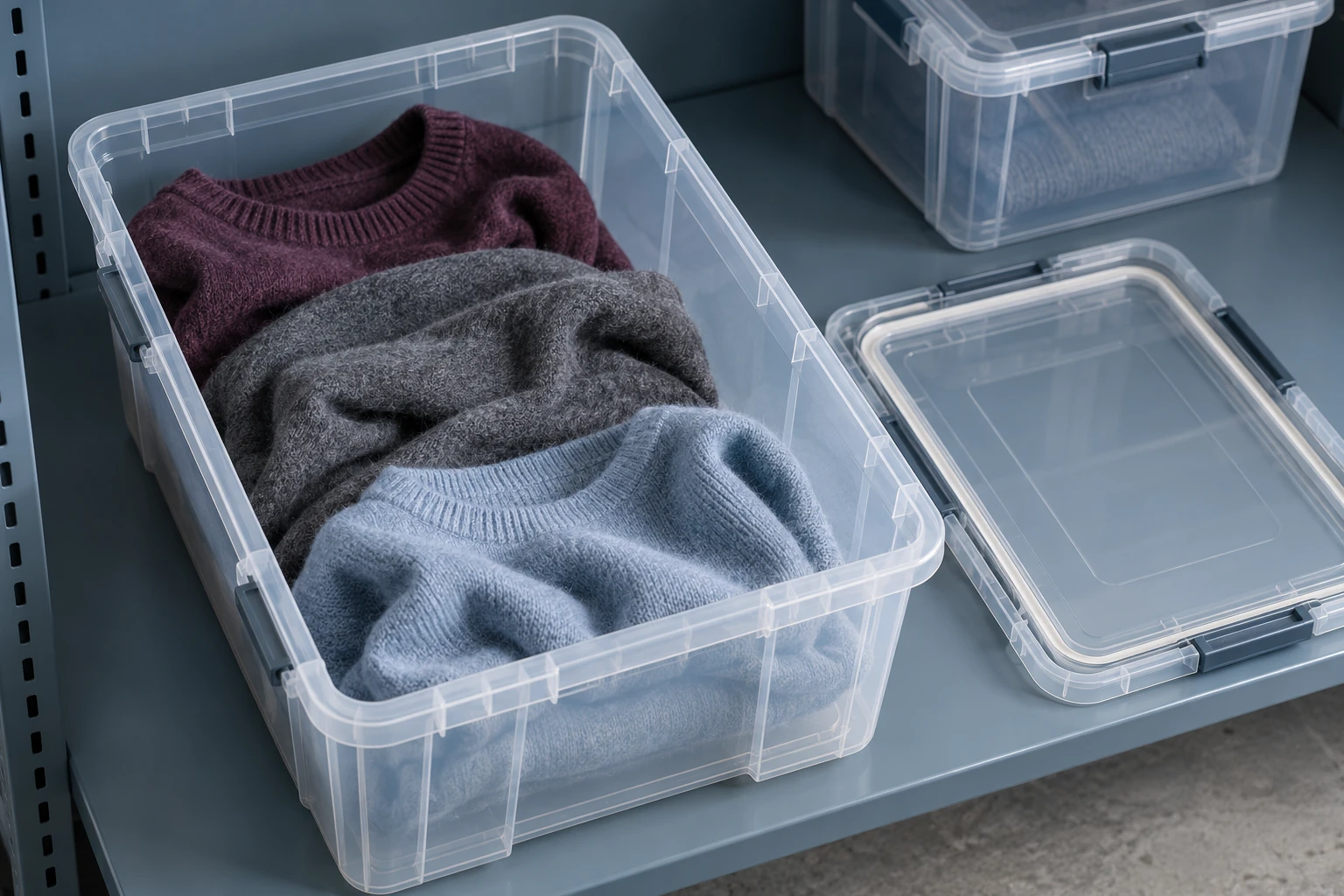
Woolmark’s Merino sweater-care guide allows plastic containers when sweaters are dry, protected from sunlight, and not unduly compressed. It also advises against vacuum bags because tight compression can cause distortion and stubborn creases.
Before buying a bin, measure both the shelf and your largest loosely folded sweater. Check the inside dimensions, not just the advertised capacity. Try arranging one layer before deciding how much the container can hold; a lid that only closes when you press down is a useful signal to stop.
A fabric bag can be convenient for a frequently opened wardrobe, but inspect how it closes. Breathability does not compensate for a damp room, and a fabric cover with openings should not be treated as a sealed pest barrier. Conversely, sealing a container is not a substitute for checking what goes into it.
When insect exclusion is the priority, choose a genuinely sealed container rather than assuming any lidded bin is airtight. English Heritage recommends tightly sealed storage for prepared clothing. Check the lid and any gasket for gaps or damage. Pack only clean, dry, pest-free garments; sealing cannot be relied on to kill insects already inside.
How to store wool sweaters to protect them from moths
Use several practical safeguards together: clean garments, a clean storage area, an effective closure where needed, and occasional inspection. Prevention is an ongoing routine, not a fragrance added at the end.
Clothes moth larvae, rather than the flying adults, damage susceptible textiles. University of California Integrated Pest Management guidance explains the importance of cleaning and protecting stored clothing. Empty the intended storage space before packing and remove accumulated lint and debris, including in corners and along shelf edges.
Make inspection straightforward. Keep an inventory on the outside of a seasonal box and avoid hiding it behind furniture. During a check, take garments out where you can see them rather than simply lifting the lid and looking at the top sweater.
What about cedar and lavender?
Treat cedar or lavender as optional scents, not reliable stand-alone moth protection. UC IPM explains that cedar’s effect is limited and does not provide dependable control of all stages. Neither a pleasant smell nor its absence tells you whether clothing is protected.
There is no reason to add more scented products when the real problem is an open bag, dirty shelf, or garment that needs cleaning. Do not pour essential oils onto wool. If using any commercial pest product, follow its label rather than improvising placement or dosage.
If you find moth activity, pause routine packing
University of Kentucky’s clothes moth guidance emphasizes locating the infestation and treating affected items. Simply moving the sweater into a fresh box can move the problem with it. Set the suspect garment apart, contained separately, and inspect nearby woolens and other vulnerable materials.
Look for larvae, webbing, cases, and new damage, but do not diagnose every small hole as moth damage. Snags and wear can also leave holes. Photograph what you find so an extension service or pest professional can help identify it.
- Separate: keep suspect pieces away from the clean storage group.
- Identify: establish what caused the damage and how far it extends.
- Treat appropriately: ask a professional cleaner about dry cleaning if the label permits it, and mention the suspected moth activity before bringing garments in.
- Clean and recheck: vacuum the emptied storage space, including crevices, and inspect neighboring items before repacking. Dispose of collected debris promptly.
Do not hot-wash or heat-dry a wool sweater merely because a pest-control guide mentions heat. The treatment must also be safe for that garment. A normal gentle wool wash should not be assumed to eradicate every moth life stage. Likewise, a casual overnight stay in a domestic freezer is not a universal solution. The Canadian Conservation Institute’s freezing guidance explains why temperature, exposure time, packing, and the item’s core temperature matter. For valuable or delicate pieces, ask a textile conservator or a qualified cleaner about suitable treatment.
Moth traps can help detect activity, but a trap does not clean or treat affected clothing. Persistent activity, multiple affected areas, or an uncertain source is a sensible point to seek professional help.
How to store wool sweaters in summer
Summer storage follows the same preparation steps, with particular attention to where the container will spend the next few months. Choose a stable indoor location rather than assuming an unused attic, garage, or basement is suitable.
The Canadian Conservation Institute’s guidance on mold and textiles identifies high humidity, warmth, and poor air circulation as contributing conditions. Keeping relative humidity below 60% with good circulation reduces the likelihood of growth; it is not a guarantee against every moisture problem.
If a cupboard smells persistently musty or has a history of leaks, fix the cause or choose another location. A small hygrometer can help you understand conditions rather than guessing. Improve the room’s environment instead of repeatedly opening a box of clean clothes in a damp space.
For a practical seasonal setup, separate the few lighter layers you may still wear from the heavy winter pieces. Label containers with their contents and packing date, and schedule a mid-season inspection. That is a convenient reminder, not a scientifically guaranteed safe interval; check sooner after a leak, unusual humidity, or signs of pests.
Storing Merino sweaters and cashmere
Merino sweaters need the same fundamentals as other wool knitwear. The fiber name does not override the care label, and “machine washable” does not mean a sweater should be hung or compressed for storage.
Let the garment’s construction guide your arrangement. A fine Merino layer can occupy a shallow section of a drawer; a heavy knit needs more space. Put a soft cashmere sweater where bulkier pieces will not bear down on it, and avoid catching delicate fabric on neighboring zippers or embellishments.
For a closer look at the differences between these fibers, see our Merino wool versus cashmere comparison. Storage does not require separate elaborate systems for each: the useful distinction is often between sturdy everyday garments and especially fine, fragile, or sentimental ones.
Taking sweaters out of storage
Unpack on a clean surface in good light. Check each sweater, the container’s corners, and any wrapping before returning everything to the wardrobe. Let an undamaged garment air and settle naturally, then follow its label if pressing or cleaning is needed.
Do not immediately tug a stubborn crease or stretch a compacted sleeve into shape. For distortion that does not relax, seek garment-specific care advice. If you find visible mold or a strong musty odor, keep the item separate and address the storage conditions before using that space again.
Finish by noting what worked: whether a box was awkward to reach, a stack was too deep, or a sweater needed more room. Those observations help improve next season’s arrangement without buying unnecessary equipment.
Frequently asked questions
Is it better to fold or hang wool sweaters?
Fold wool sweaters for routine and seasonal storage. Hanging can stretch knitted garments over time. Keep folds relaxed and choose a drawer, shelf, or container that supports the whole sweater without squeezing it into a smaller shape.
Can wool sweaters be stored in plastic bins?
Yes. Store clean, fully dry wool sweaters in a clean bin with a well-fitting lid and room for loose folds. Keep the bin in a suitable indoor location. Plastic is not a cure for moisture already in the garment or storage area.
Are vacuum bags safe for wool sweaters?
Uncompressed storage is the safer default for wool knitwear. Vacuum bags can flatten the garment and introduce difficult creases or distortion. If space is tight, reduce the number of sweaters in each container rather than relying on strong compression.
Do cedar and lavender keep moths away?
Cedar and lavender should not be relied on as sole protection. Clean clothing, appropriate enclosures, a clean storage area, and inspection matter more than scent. If moth activity is already present, identify and treat the problem instead of adding more sachets.
Should I wash wool sweaters before summer storage?
Put wool sweaters into seasonal storage clean, using the washing or professional-cleaning method their labels permit. Allow enough drying time before packing. A sweater that has stayed clean and unworn since its last cleaning does not need washing simply because the calendar changed.
How often should stored wool sweaters be checked?
Choose a schedule you can maintain, such as a mid-season check, and inspect sooner if conditions change. There is no universal inspection interval that prevents every problem. Check the garments and their surroundings rather than relying only on an intact lid or pleasant smell.