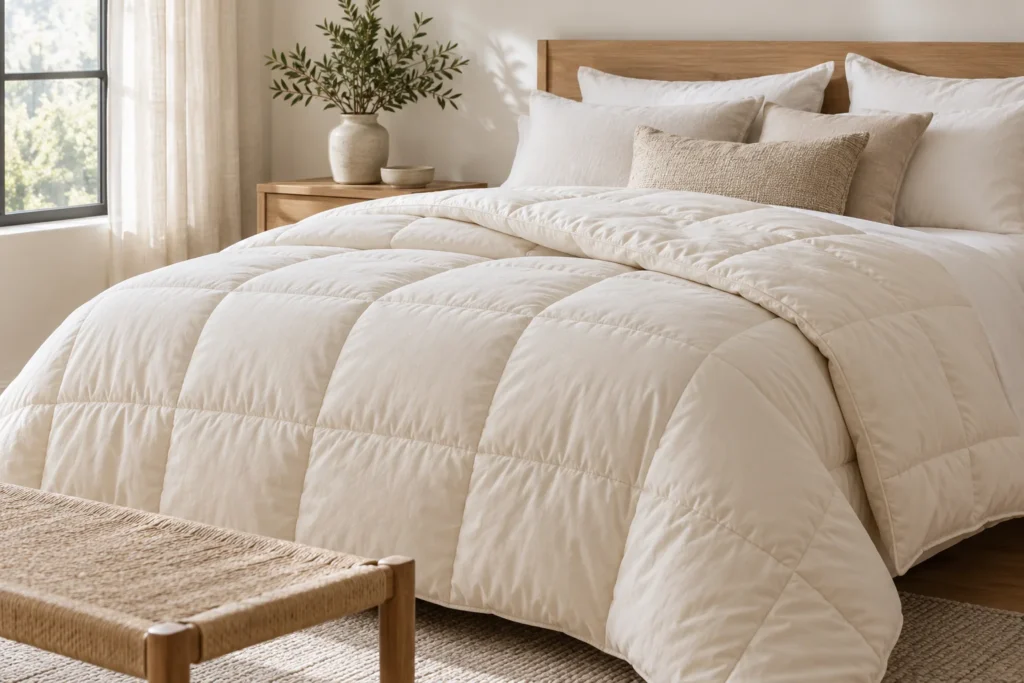
The wool vs down comforter decision comes down to the warmth you need, the feel you prefer and the care you can manage. Wool deserves consideration if you want a quilted wool-filled layer and value the fiber’s moisture-handling properties. Down deserves consideration if a lofty, puffy comforter is your priority. Neither material guarantees comfortable sleep: the amount of fill, shell, construction and bedroom conditions matter too.
Start by choosing an appropriate warmth level, then compare the exact products. A heavy wool comforter and a lightweight down comforter are not equivalent purchases simply because both are marketed for year-round use.
How this comparison was researched: We have not physically tested or slept under these comforters. This guide uses manufacturer specifications, care and return policies, plus textile-industry and allergy guidance. Product examples illustrate differences; they are not performance rankings. Details were checked on October 4, 2026.
Wool vs down comforter at a glance
Both materials are sold in different weights and constructions. Use this table to identify what to check, rather than treating either column as a promise about every product.
| Buying criterion | Wool comforter | Down comforter |
|---|---|---|
| Filling | Often carded wool batting secured by quilting; check for blends | Down clusters; check the label for down and feather content |
| Warmth information | Manufacturer warmth category and fill weight or GSM | Warmth category, fill power and fill weight together |
| Shape and loft | Quilted designs often have a flatter profile | Down can provide a puffier profile; construction affects loft |
| Moisture | Wool fiber can absorb and release water vapor | Do not infer humidity comfort from fill power alone |
| Care | May be washable, spot-clean-only or require specialized care | May be machine washable or require another specified method |
| Weight on the body | Ask for finished-product weight, not only wool weight | Ask for finished-product weight, not only down weight |
| Sourcing | Check product-specific wool certification and its scope | Check product-specific down certification and its scope |
| Deciding factor | Suitable warmth, preferred profile and feasible care | Suitable warmth, preferred loft and feasible care |
These are buying distinctions, not a measured comparison of two equally warm comforters. For terminology, the American Down and Feather Council distinguishes down from feathers and explains common constructions; Woolmark describes wool’s fiber structure.
Warmth and weight are different questions
Neither wool nor down is automatically warmer. Ask how much insulation the finished comforter provides and how much weight you want resting over you.
Down fill power describes loft: the volume occupied by a specified weight of down under test conditions. Fill weight describes how much down the product contains. Finished-product weight includes the shell and other components. Brooklinen’s explanation of these measurements makes the distinctions explicit.
A higher fill-power number alone does not identify the warmer comforter. IDFL’s insulation-factor calculation considers fill power, fill weight and product area together. A large insert with little fill is a different purchase from a smaller, heavily filled one.
Wool listings commonly use GSM, meaning grams per square meter. This describes fill mass per area, not a temperature rating. You cannot directly convert 200 GSM wool into an equivalent down fill-power number: the measurements describe different things.
Use the brand’s warmth guidance as a starting point, then consider your room and other layers. If you already overheat under an all-season comforter, begin with lighter options in either material. If your bedroom is cold, investigate the warmer options rather than assuming that a particular fiber will supply enough insulation.
Loft and construction shape the purchase
Choose the profile you want, then check how the fill is held in place. A comforter’s photograph cannot tell you its weight, warmth or softness.
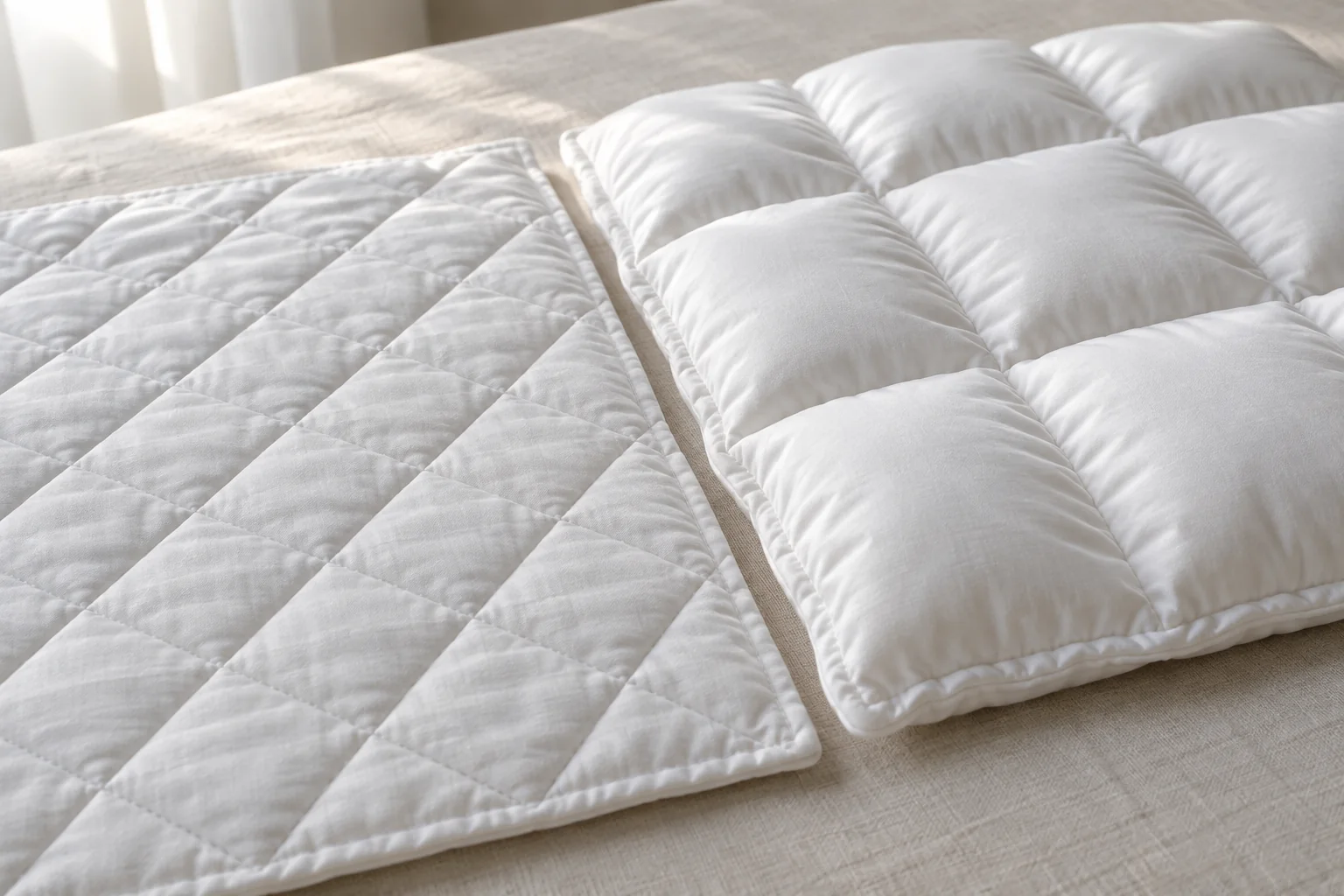
Wool batting is commonly quilted within a fabric shell. Down construction varies: sewn-through designs join the outer fabrics at the seams, while baffle-box designs have internal fabric walls that create chambers for the fill. Feathered Friends explains both approaches in its comforter guidance.
These distinctions help you ask useful questions. Does the listing show the stitching? Is the fill secured in small sections or larger chambers? Does the seller publish the finished weight? Would you prefer a flatter bed covering or visibly puffed sections?
Do not turn construction details into a lifespan prediction. Quilting and baffles describe design; they do not prove that one comforter will remain even, avoid leaks or outlast another. Read the warranty for covered defects and exclusions rather than treating it as an expected replacement schedule.
The shell also deserves attention. Identify its fiber and weave, then check the care label for the whole insert. A cotton shell does not make a wool-filled comforter washable, and a high thread count does not establish cooling performance.
What actual wool and down products demonstrate
Differences within a material category can be as important as differences between wool and down. These US-facing product examples show why labels need closer reading.
| Representative product | Documented fill | Shell and construction | Care stated by manufacturer |
|---|---|---|---|
| Woolroom Organic Washable Wool Comforter — Light | 200 GSM organic British wool | Organic cotton; quilted wool construction | Wool/delicate wash; line dry; no tumble drying |
| Naturepedic Organic Wool Duvet Insert/Comforter | Approximately 500 GSM organic wool | Organic cotton percale; stitch-through boxes | Spot clean only |
| The Company Store LaCrosse Premium Down Comforter range | 500–550 fill power down; four warmth choices | Cotton twill; sewn-through boxes | Cold gentle wash; low/no-heat drying options |
Manufacturer pages: Woolroom Light, Naturepedic wool insert, and LaCrosse down comforter.
The practical interpretation is limited but useful. The two wool examples have different fill densities and cleaning requirements. The down range offers Light, Medium, Extra and Ultra warmth options, so “down” does not identify one fixed warmth level.
For someone who needs home washing, the spot-clean-only example may be unsuitable regardless of its materials. Someone considering the washable wool example still needs somewhere to line dry it. A buyer considering down should select the intended warmth option before comparing prices.
These are not matched products in a thermal test. Their published numbers do not establish equal warmth, a cooling winner or which will feel lighter on your bed.
Moisture handling does not guarantee cooler sleep
Wool’s ability to absorb and release moisture vapor is relevant, but it is not proof that every wool comforter sleeps cooler than every down comforter.
Woolmark’s breathability guidance describes this fiber property. Applying it to shopping requires another step: the fiber is inside a shell, often inside a duvet cover, alongside the rest of your bedding. The amount of insulation still matters.
Treat “cooling” as a claim to examine. Ask whether the manufacturer provides finished-product testing, what it was compared with and under which conditions. A study involving wool clothing or an underlay cannot establish the performance of an unrelated comforter.
For warm sleepers, the practical starting point is an appropriately light insert and manageable bedding layers. Wool is worth considering for its moisture-buffering properties; down is not automatically excluded if a suitably light model meets your preferences. Neither choice can promise to prevent sweating or improve sleep quality.
Care and sensitivities can decide the choice
Buy a comforter whose actual care instructions fit your household. “Natural,” “premium” and “organic” are not washing instructions.
Read both washing and drying requirements before purchase. Check whether the insert will fit your equipment with room to move and whether the seller recommends a commercial machine. A product can be washable yet impractical for your available space or drying routine.
For example, LaCrosse’s instructions recommend a front-loading commercial machine and prohibit dry cleaning. Woolroom’s Light model calls for a wool/delicate cycle, wool detergent and line drying. That difference is more useful than a general rule that wool or down is easier to maintain.
For a washable wool model, our wool detergent buying guide explains detergent selection. Always follow the comforter’s label; choosing a wool detergent does not make a spot-clean-only insert machine washable.
What if you have allergies or sensitivities?
Neither fill should be presented as universally better for allergies. A “hypoallergenic” label does not establish that a product will suit a particular person or manage their symptoms.
The American Academy of Allergy, Asthma & Immunology emphasizes exposure control, including bedding care, for dust-mite allergy. That is a different question from whether an insert contains wool or down.
If you have a diagnosed allergy, use your clinician’s advice to choose compatible bedding and a workable cleaning routine. Do not exceed a comforter’s permitted wash temperature to follow general allergy advice. A shell, cover, fill or finishing treatment may matter to an individual buyer; the material comparison alone cannot resolve that choice.
Check dimensions and the right to return
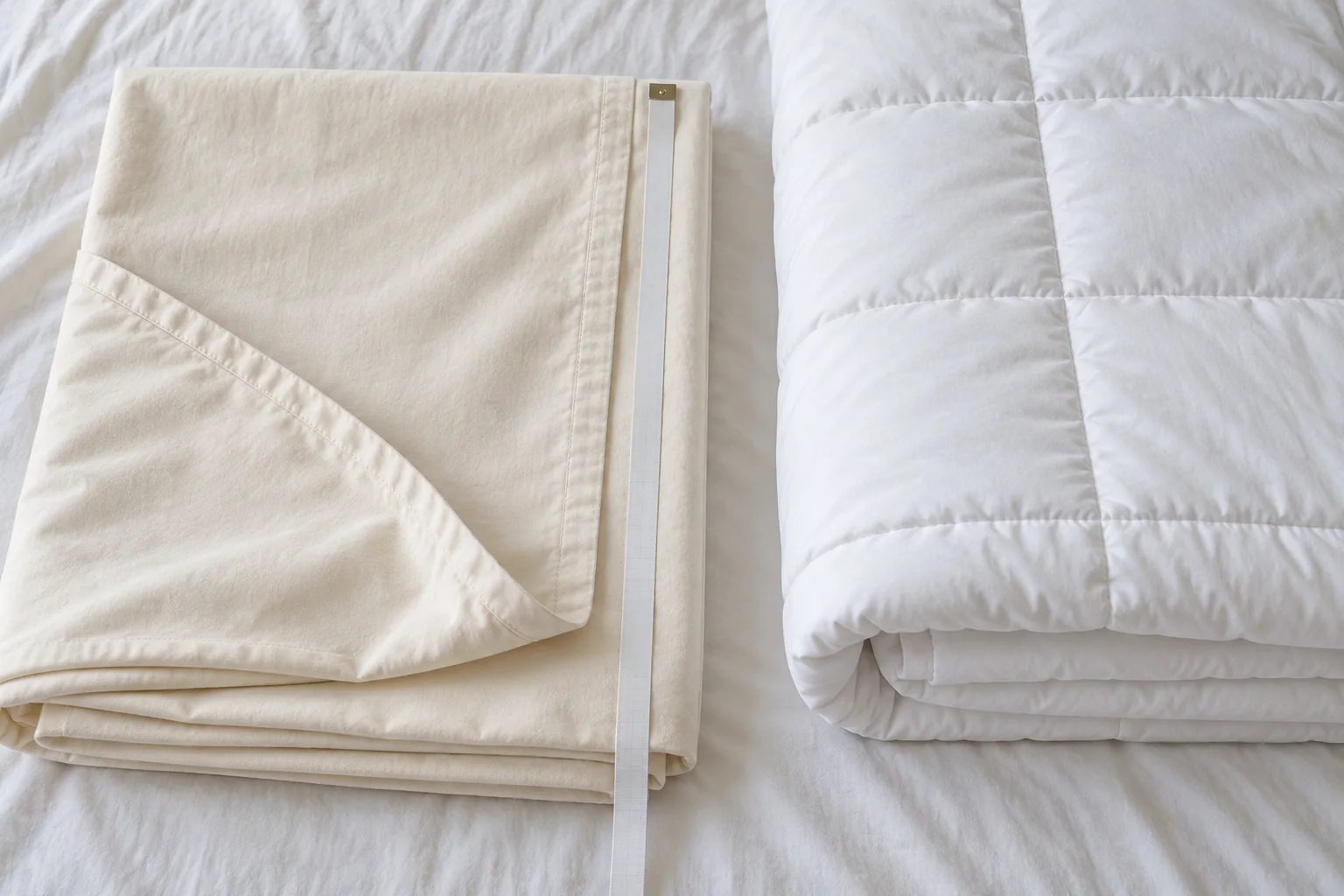
Compare inches, not just “Queen” or “King.” Naturepedic lists its Full/Queen wool insert at 92 × 96 inches; LaCrosse lists Full/Queen at 90 × 96 inches. Even similarly named sizes can differ.
Measure your existing duvet cover and decide how much side coverage you need. Account for a tall mattress and whether two people share the comforter. Check attachment loops or ties if keeping the insert positioned inside a cover matters to you.
A usable return policy is particularly valuable when buying without trying the feel. As checked in October 2026:
- Woolroom’s sleep trial covers eligible comforters for 30 nights from delivery and allows returns after use or washing, subject to its terms.
- Naturepedic’s product page specifies 30-day returns in original packaging. Confirm the conditions before treating this as an unrestricted used-product trial.
- The Company Store’s return policy permits use and washing within its 30-day guarantee, with exclusions and a per-item return fee.
Check the current policy for your location, seller and exact item. Retailer purchases, clearance products and other exclusions can change your options. Keep packaging until you know whether it is needed for a return.
Sourcing claims need product-level evidence
Neither wool nor down is automatically the more sustainable or more ethical purchase. Start with documented sourcing and the scope of any certification.
The Responsible Down Standard prohibits live plucking and force-feeding and uses third-party certification and chain-of-custody requirements. The Responsible Wool Standard addresses sheep welfare, land management and social requirements with chain-of-custody controls.
These standards answer defined sourcing questions. They do not rank the cooling performance, comfort or complete environmental footprint of two finished comforters. A certification covering the fill should not be described as certifying every part of the product.
Both fills are animal-derived. If avoiding animal materials is essential to your purchase, neither meets that requirement. Otherwise, ask for evidence for the exact model rather than accepting a brand-wide “responsible” claim as sufficient.
Which comforter should you choose?
Choose wool when you prefer its quilted construction, want to consider moisture-buffering fiber and can find a suitable warmth level with care requirements you can follow. After deciding on wool, use our best wool comforters guide to compare individual options.
Choose down when you prefer a loftier appearance and want to select among documented down warmth options. Compare fill power alongside fill weight, construction, care and dimensions rather than paying for the largest fill-power number alone.
Before paying, compare the total purchase: the selected size and warmth, a compatible cover if needed, cleaning arrangements and the cost of returning an unsuitable item. Without comparable lifetime evidence, a higher price cannot be justified by an assumed extra number of years.
Frequently asked questions
Is a wool comforter warmer than down?
Not necessarily. Warmth depends on the finished design and amount of insulation. Compare the intended warmth category for the exact size. Wool GSM and down fill power are different measurements, so their numbers cannot establish equivalent warmth.
Is wool better than down for hot sleepers?
Wool can be worth considering because it handles moisture vapor, but a heavily filled wool comforter may still provide too much insulation. Begin with a lighter warmth option and consider your shell, cover and bedroom conditions. Neither material guarantees cooler sleep.
Can wool and down comforters both be machine washed?
Some can; others cannot. The examples above include washable wool, spot-clean-only wool and washable down. Drying requirements also differ. Follow the exact product’s label and check that your equipment can accommodate it.
Is a down alternative comforter the same as down?
No. Down alternative identifies a substitute filling, commonly synthetic, rather than bird down. This comparison addresses wool and actual down. Check the content label before applying the down side of the comparison to a product.
Does wool vs down duvet mean a different comparison?
Usually the material decision is the same. Retailers use “comforter” and “duvet insert” differently, so confirm whether you are buying the filled insert, a removable cover or a set. Match dimensions rather than relying on the name.
Which material lasts longer?
There is no universal winner established here. Construction, use and care vary, and this guide has no matched long-term durability testing. Choose documented construction and manageable care, then read the actual warranty rather than assuming a fixed lifespan.